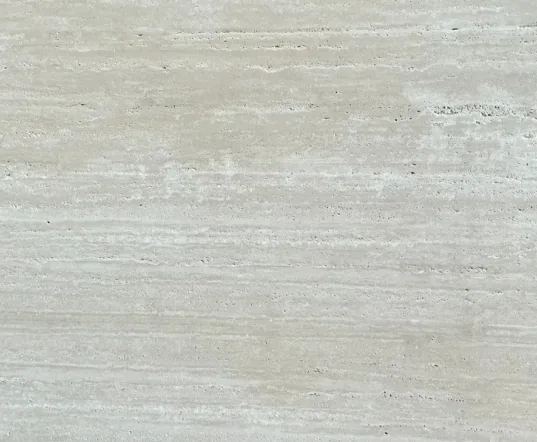
Travertine is a natural limestone formed when calcium carbonate precipitates around mineral springs; it is not a type of marble. Its 2.2–2.7 t/m³ (137–169 lb/ft³) reference density and visible pits vary by slab, so for furniture confirm whether the exact stone is filled, honed, backed, and sealed.
What should you know about travertine before choosing a table?
Travertine’s geology, density, hardness, acid response, and surface treatment are separate properties, and the last one changes the maintenance load most in furniture. The family reference values below do not certify a named slab.
| Property | Reference or condition | Furniture consequence |
|---|---|---|
| Material family | Limestone formed by calcium carbonate precipitation | Voids and bands are expected features |
| Density | 2.2–2.7 t/m³ (137–169 lb/ft³) in this brief | A 1,200 × 600 × 20 mm (47.2 × 23.6 × 0.79 in) solid top is about 31.7–38.9 kg (69.9–85.7 lb) |
| Hardness anchor | Calcite reference Mohs 3 | Specific commercial slabs require testing rather than a label-only claim |
| Acid response | Calcite-bearing surfaces can etch | Wine, citrus, vinegar, and acidic cleaners need prompt control |
| Surface treatment | Filled or unfilled; honed, polished, brushed or tumbled as supplied | Fill and finish change cleaning and visual texture |
The 1,200 × 600 mm (47.2 × 23.6 in) example rises to about 47.5–58.3 kg (104.7–128.5 lb) at 30 mm (1.18 in). Add the base, reinforcement, and packing before planning the lifting route.
What can a travertine slab photo tell you?
The image shows a cream-beige slab with linear banding. It cannot tell you how a future production slab will be filled, cut, or supported. Use it to discuss the visual direction, then match the actual slab number and batch before fabrication.
Ask for views in raking light as well as straight-on views when fill and surface relief matter. A photograph can hide shallow pits, strong reflections, and color shifts that become obvious beside a basin or dining chair.
How do cutting direction and fill change a travertine top?
Vein cuts emphasize long linear bands, while cross cuts can produce broader movement across the surface. Filling levels open pits with a matching compound; unfilled stone keeps the voids visible and usually needs more attention where food, drinks, or plant water collect.
The travertine collection includes White Travertino, Cream White Travertino, Silver Travertino, Romano Classico, Beige Travertino, Crawford Travertino, Golden Travertino, Red Travertino, Noce Persiano, and Titanum names. These commercial names do not guarantee one quarry, finish, or density.
Which furniture can travertine suit?
The stone works for coffee tables, dining tables, side tables, stools, plinths, and similar furniture when the design protects the slab from unsupported overhang and edge impact. A 20 mm top can be appropriate on an engineered frame, but the thickness alone does not supply a universal load rating.
For a coffee table, a continuous frame or well-distributed pedestal limits an unsupported span. For a dining table, chair movement and long overhangs make the frame and base geometry more demanding. For a side table, a small footprint can expose the edge to knocks even when the stone is light.
Which travertine colour suits your room?
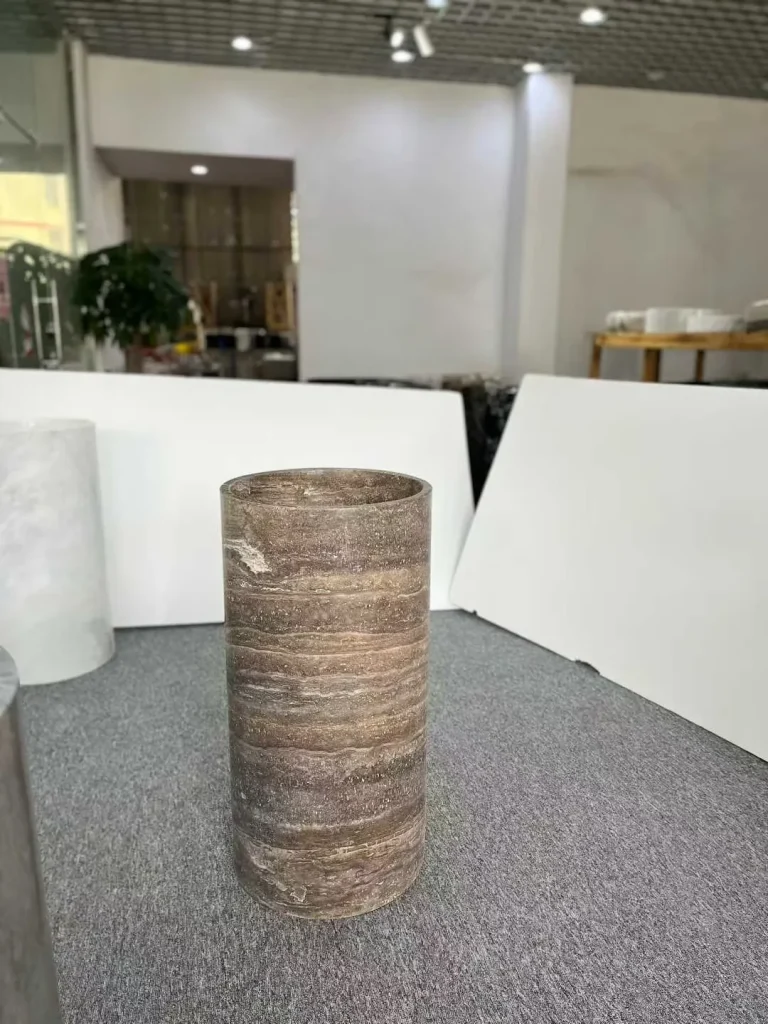
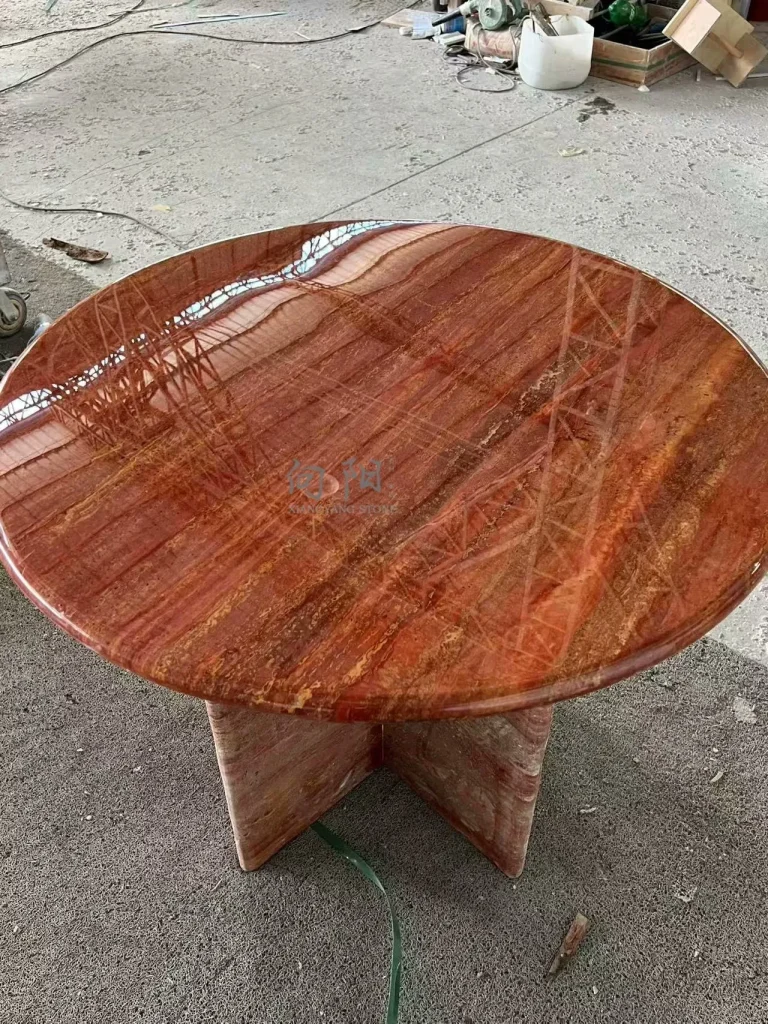
Beige and cream travertine sits easily with warm plaster, oak, linen, and brass without making pattern the only feature. Silver-gray travertine can support cooler metal, gray stone, and darker upholstery; red or brown travertine needs a simpler surrounding palette so the slab is not competing with several strong colors.
Choose the final pair by looking at the actual slab beside the floor, wall, and fabric samples. The same travertine can appear warmer under interior lighting than it does in the supplier photo.
What should a travertine quote include?
A quarry block, a finished slab, and a fabricated table are not comparable price units. Make sure the quotation states whether it covers material, fill, finish, backing, fabrication, packing, and delivery before you compare offers.
| Commercial item | Required confirmation |
|---|---|
| Name and origin | Ask the supplier to state the commercial name, quarry or production region and any public source for the selected travertine in the written offer; approve the named slab before cutting. |
| Finish and backing | In the written offer, confirm whether the approved slab is filled or unfilled, its specified thickness, finish and any backing or reinforcement before fabrication. |
| Price | Slab and finished-piece quote on request through Contact |
How do you care for travertine furniture?
The main weaknesses are the visible pits, potential chipping at exposed edges, color variation between slabs, and acid sensitivity in the calcium-carbonate body. A sealer can slow absorption, but it does not fill deep voids or make the stone acid-proof.
- Blot spills before they dry and rinse with clean water.
- Use coasters and trays on dining and side tables.
- Vacuum crumbs from unfilled voids before wiping.
- Avoid acidic descalers, vinegar, citrus, and abrasive pads.
- Follow the finish-specific sealer instructions.
Natural Stone Institute stone-care guidance is the public reference used for this care framework.
How does travertine compare with marble, limestone and onyx?
Marble usually brings veining and a different porosity profile; limestone can share a sedimentary origin but not travertine’s characteristic spring-formed voids; commercial onyx may be a different material entirely. Use the actual slab and finish when two names overlap in color.
Which travertine furniture can Amazstone supply?
Travertine furniture is available in stock and as custom work, with a one-piece minimum. Send the intended furniture type, finished size, slab direction and finish to request the current travertine product list and a quote; the team replies within 24 hours. Production takes about 20 days after deposit and drawing approval, followed by about 30 days for shipping.
Unspecified shape
Travertine Fireplace AZ-FP-013
travertine
Dimensions on request ×
Dimensions on request ×
Dimensions on request
Weight on request
Travertine Fireplace AZ-FP-016
travertine
Dimensions on request ×
Dimensions on request ×
Dimensions on request
Weight on request
Travertine Fireplace AZ-FP-018
travertine
Dimensions on request ×
Dimensions on request ×
Dimensions on request
Weight on request
Travertine Fireplace AZ-FP-025
travertine
Dimensions on request ×
Dimensions on request ×
Dimensions on request
Weight on request
Travertine Fireplace AZ-FP-027
travertine
Dimensions on request ×
Dimensions on request ×
Dimensions on request
Weight on request
Travertine Fireplace AZ-FP-029
travertine
Dimensions on request ×
Dimensions on request ×
Dimensions on request
Weight on request
What do travertine buyers ask before choosing a slab?
Is travertine a limestone rather than a marble?
Travertine is a natural limestone formed by precipitation from mineral-rich water, not a geological subtype of marble. The commercial stone trade can group materials loosely, so ask for both the trade name and the material description. For a furniture order, the exact slab, fill, finish, backing, and thickness matter as much as the family label.
Why does travertine have pits and linear bands?
Travertine forms as calcium carbonate is deposited around springs and in shallow water; trapped gas and organic material leave voids, while growth layers produce bands. Cutting across or along those layers changes the visual pattern. Filling can level the voids, but it does not erase the slab’s original structure.
Does filled travertine still need sealing?
Filled travertine often still benefits from a finish-compatible penetrating sealer because the filler and stone can absorb liquid differently. Sealing is not acid proofing, and a sealer should not be applied over trapped moisture or a dirty surface. Follow the supplier’s cure and maintenance instructions for the actual finish.
Is travertine suitable for a bathroom vanity?
Travertine can suit a bathroom vanity when filled and sealed for the wet setting, but soap, perfume, citrus, and descalers still need prompt removal. Check the sink cutout, edge support, and moisture path around the basin. A 20 mm top needs a support design matched to the opening; family density alone does not certify the fabrication.
Who wrote this travertine guide?
- Travertine is a limestone deposited from mineral-rich water, and its pits and bands reflect that formation. Travertine reference
- ASTM C1527-22 is a public specification reference for travertine dimension stone; a named commercial slab still needs its own approval. ASTM C1527
- The 1,200 × 600 mm (47.2 × 23.6 in) weight example uses solid volume at 2.2–2.7 t/m³ (137–169 lb/ft³) and excludes the frame and packing. USGS glossary
- The collection lists these trade names. They do not establish a shared quarry, finish, or current stock. Mohs scale reference