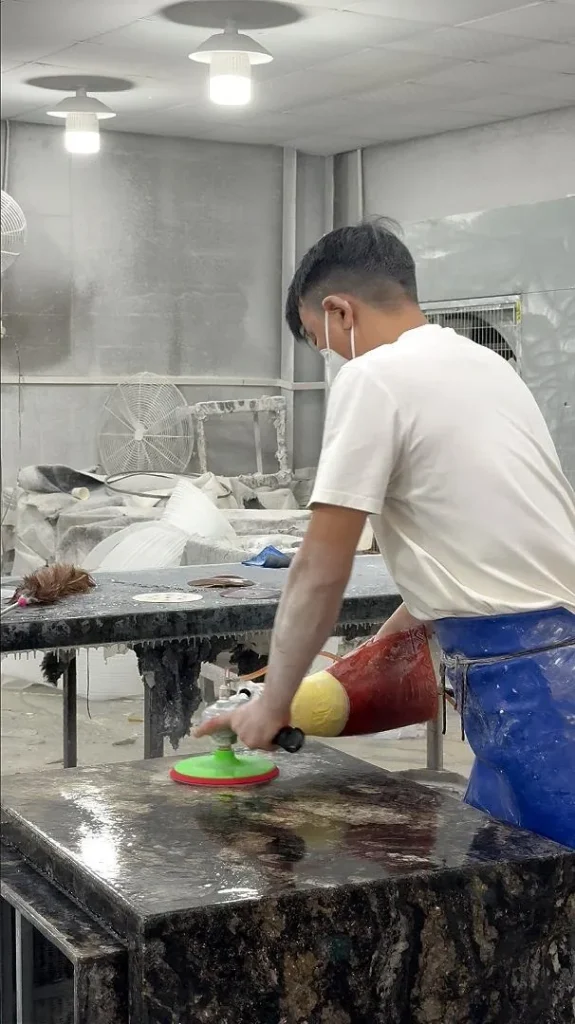
Approve stone, finish and edge together, not a color chip alone. For a 20 mm (0.79 in) tabletop with a built-up 30 mm (1.18 in) edge, the approval should include the slab batch, surface, edge radius or chamfer and sealer. Sample charges, dispatch timing and machining limits remain quotation-specific.
What should a sample and finish approval include?
The approval should set the stone face, finish, edge geometry and sealer. Any later change starts a new approval.
| Decision | What to confirm | What it controls |
|---|---|---|
| Stone and sample | Name, aliases, batch ID, face and sample photo | Links approval to actual material |
| Finish | Surface and sheen under named lighting | Defines appearance and care |
| Edge | Profile drawing, radius and chamfer | Removes verbal interpretation |
| Construction | Solid or built-up edge, with seam | Separates visual and actual thickness |
| Sample terms | Request this project’s sample charge, refund conditions and dispatch timing through Contact. | Separates the sample offer from project-specific commercial terms |
| Edge limits | Minimum order: 1 piece. Ask for the edge drawing and dimensional tolerance to be approved for the selected stone and fabrication step. | Keeps the drawing inside the approved machining range |
A color chip cannot show how veins cross a tabletop. A same-finish coupon adds sheen and texture; an edge mock-up adds profile and joint appearance. The production slab remains the strongest reference.
How does an order move from slab selection to an approved edge sample?
The sequence moves from stone to finish to edge construction before approval freezes. An edge that works on paper can expose an unsuitable pore, seam or weak corner.
| Stage | Work completed | Buyer releases | What to keep |
|---|---|---|---|
| Brief lock | Product, dimensions and appearance | Drawing and finish direction | Revision |
| Slab candidates | Faces with cut area marked | Preferred face | Slab ID |
| Finish coupon | Surface on comparable stone | Sheen and texture | Lighting photo |
| Edge mock-up | Profile at final section | Radius, seam and feel | Dimensioned photo |
| Approval freeze | All references assembled | Dated approval | Order link |
| Production release | Approved set accompanies work | Changes need approval | Inspection checks |
| Elapsed days | Production: about 20 days after deposit receipt and drawing confirmation; shipping: about 30 days. Sample and edge-approval timing is project-specific; discuss it through Contact. | Production and shipping have named triggers | Quotation schedule |
The production clock starts after both deposit receipt and drawing confirmation. Sample and edge-approval timing is project-specific; settle both in the written schedule.
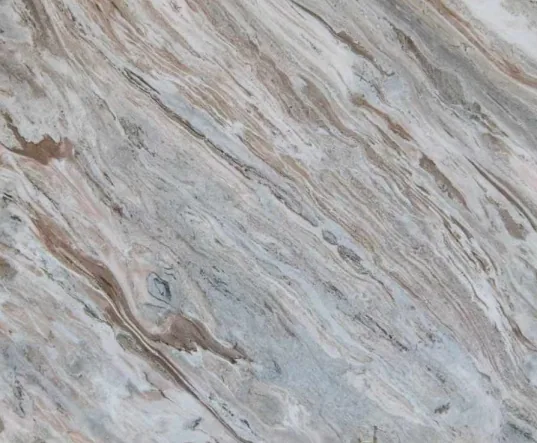
Which finish and edge choices are realistic for stone furniture?
A finish is realistic when its appearance and maintenance suit the room. An edge is realistic when the stone can carry that section without an unresolved corner or seam.
| Choice | Visible effect | What to check before approval |
|---|---|---|
| Polished | Reflective contrast | Etching is more visible |
| Honed | Low sheen | Not stain-proofing |
| Brushed or leather-look | Textured face | Approve depth and direction |
| Tumbled | Soft, uneven surface | Set permitted variation |
| Filled travertine | Pores leveled | Approve filler color |
| Unfilled travertine | Open pores | Check spill removal |
| Square or eased | Crisp or softened arris | State radius in mm and in |
| Chamfer or bevel | Angled cut | Draw angle, width and depth |
| Bullnose | Rounded edge | State profile and radius |
| Built-up edge | Thicker visual edge | For a 20 mm (0.79 in) top built to 30 mm (1.18 in), approve strip and seam |
| Edge standard | Approved machining range | Minimum order: 1 piece. Approve the edge drawing and dimensional tolerance for the exact stone and fabrication step. |
The Natural Stone Institute care guidance supports prompt spill removal. Sealing does not make calcareous stone acid-proof. Compare honed and polished marble on the same stone and lighting.
How should approved samples and finished pieces be packed and protected?
The packed item must remain traceable to approval. An unlabeled sample cannot identify its stone, face or revision after several pieces are unwrapped.
| Item | Transport risk | What to check before dispatch |
|---|---|---|
| Finish sample | Surface contact | Separate wrap and labeled face photo |
| Edge mock-up | Chipped arris | Protect edge; photograph with ruler |
| Production slab | Lost face orientation | Slab ID and matched-piece list |
| Finished top | Point loads | Photo showing separators and lift points |
| Delivery check | Hidden mismatch | Compare before assembly |
Packing rules belong in the quote and packaging and shipping process. A sample package cannot prove protection for a 1,200 mm (47.2 in) face; inspect the crate design.
How can a buyer check a project sample before approval?
Do not accept a project claim from a caption alone. Request details from the same stone family, finish, edge and construction, with permission before reuse.
Useful details include:
- Production slab with cut area marked.
- Finish coupon under both light conditions.
- Dimensioned final-thickness edge mock-up.
- Pre-packing photo with labels and separators.
- Inspection report tied to the revision.
- Authorized project reference only.
If a supplier cannot connect the sample to the proposed batch or revision, treat the image as inspiration rather than production evidence.
Which sample questions should be settled before a purchase order?
Settle sample scale, production finish, final edge section and filler appearance before a purchase order.
Is a small stone sample enough to approve a tabletop?
A small sample can establish stone family, rough color and surface direction, but not how a 1,200 mm (47.2 in) face or built-up edge will read. Approve a representative slab for veining, then finish and edge mock-ups before release.
Should a polished sample be used for a honed tabletop?
No. Polished and honed surfaces reflect light differently, which can change apparent color and texture. Approve the same stone, face and finish as production, then compare that sample from both seating and standing positions under daylight and the room’s actual light.
Does an edge profile need to be approved at full thickness?
Approve the edge at final thickness and construction. A 20 mm (0.79 in) solid edge and a built-up 30 mm (1.18 in) edge can feel different and expose different seams. document profile, radius, chamfer dimensions and a finished photo.
Can filler color be matched after a travertine top is installed?
Post-installation matching is unreliable because filler, stone and sealer age differently. Approve filler and sealer on the production slab or same-batch sample first. document whether the intended surface is filled, lightly filled or open-pore, and keep that reference with the order.
What should be attached to a sample-matched stone furniture inquiry?
Send surface and edge references with the measured brief. Include stone direction, drawing, finish, profile sketch, quantity, destination and installation responsibility.
Project inquiry
Request a stone furniture quote
Send dimensions, material direction and quantity for a comparable reply.
Useful details include product type, finished dimensions, quantity and destination.