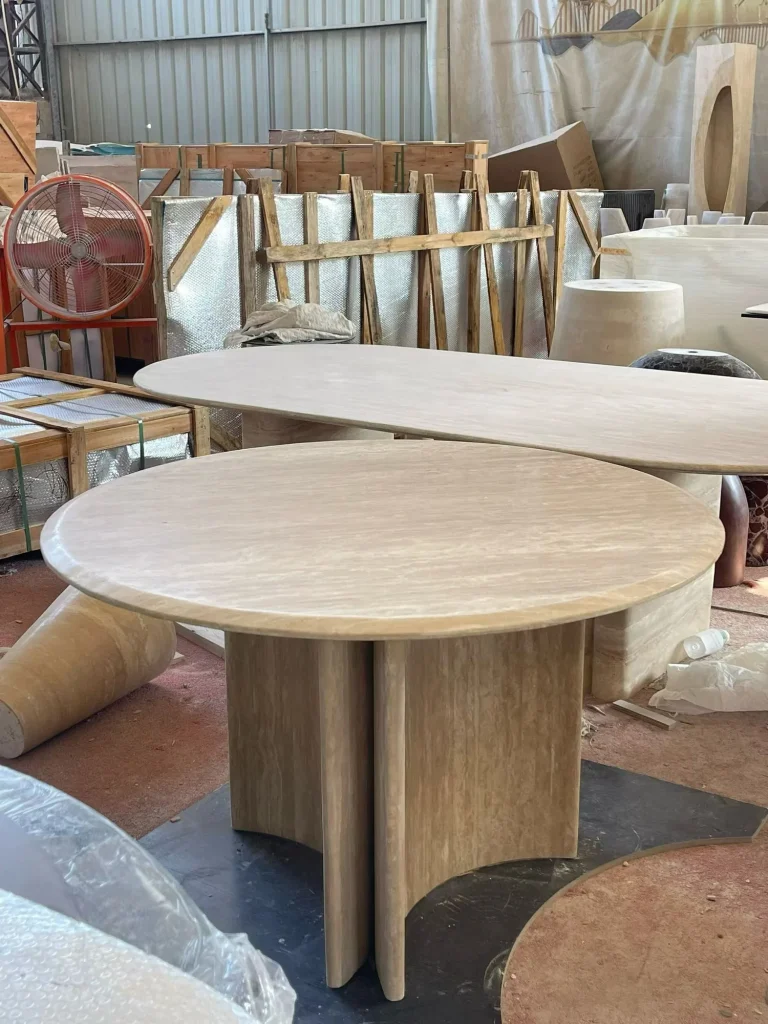
The 2026 report compares stone furniture quotes by normalized top area, category and specification; a 1,200 × 600 mm top equals 0.72 m² (7.75 sq ft). These supplier cells are unverified, so this example is a method, not a market quote. Compare FOB and retail prices only after size, finish, base and freight are defined.
Which furniture examples does the 2026 comparison include?
The table lists furniture dimensions and calculates finished top area without inventing a supplier price. It gives every later quote the same geometry, so a large table cannot look cheaper merely because the comparison used a smaller area.
| Listed item | Furniture type | Top dimensions | Calculated top area | Price |
|---|---|---|---|---|
| LAF-D001 | Cube Coffee Table in Shangrila Marble | 1,000 × 600 mm (39.4 × 23.6 in) | 0.600 m² (6.46 sq ft) | Price on request |
| LAF-D008 | Cube Coffee Table in Jade Green Cloud Marble | 1,000 × 600 mm (39.4 × 23.6 in) | 0.600 m² (6.46 sq ft) | Price on request |
| #T48 Tea Table | Rectangular tea table | 3,680–4,000 × 900 mm (144.9–157.5 × 35.4 in) | 3.312–3.600 m² (35.65–38.75 sq ft) | Price on request |
| Commercial bands | Coffee-table and dining-table ranges | Size and material tier required | Normalize before comparison | Coffee-table and dining-table: price on request |
The October 2026 furniture list confirms product names and dimensions; it does not confirm price, current stock or outdoor suitability. The commercial band is a request template, not a market range; a comparison requires a dated quote that states currency, trade term, size band and material tier.
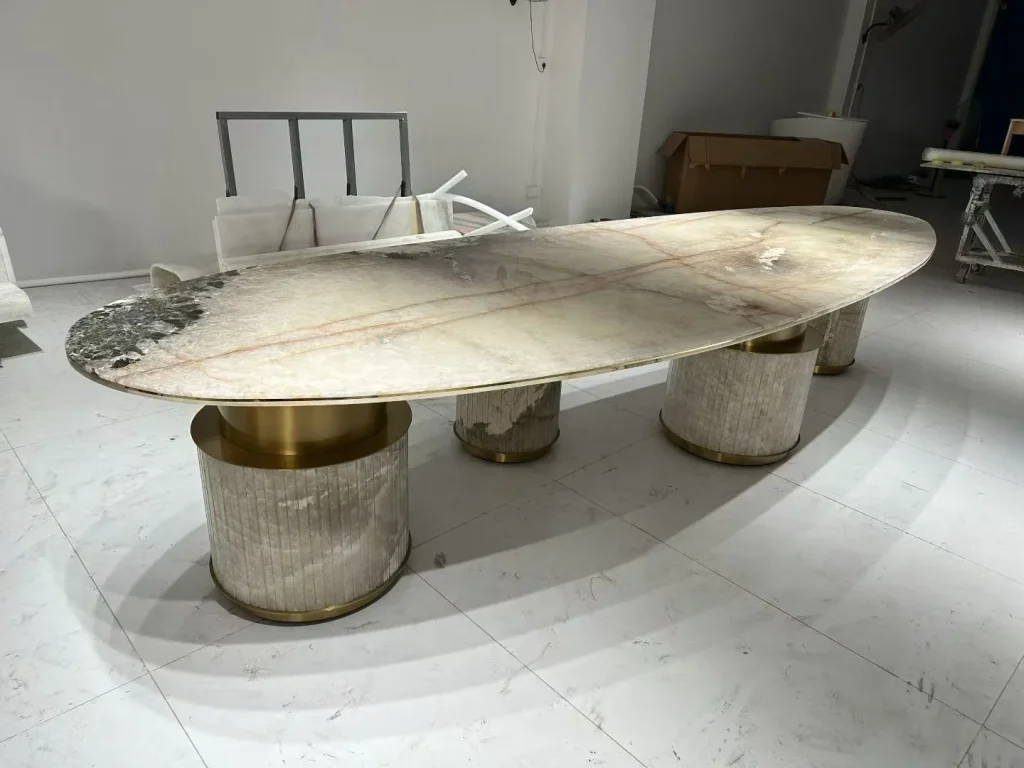
How does the quote-normalization calculator work?
Enter a buyer-supplied total and the finished rectangle to calculate a price per square metre and square foot. The calculator changes units only; it does not estimate a market price or validate the quotation.
Why are there no measured prices in the 2026 release?
We quote each piece on request through Contact. Presenting an unverified range as measured market data would be false precision. Product dimensions can be verified; prices and measured freight weights cannot be inferred from those dimensions.
This page does not present a representative price survey. Before comparing a quoted range, ask the supplier for the collection date, product scope, size tier and sampling method, plus the currency and trade term. For weight, ask which public density range supports the estimate and request measured scale data for the selected product; the formulas here remain estimates until that product-specific data is supplied.
How do you compare unlike furniture quotes for 2026?
The method separates geometry, specification and commercial terms. Each quotation is compared on the same fields, then assessed within the same trade term and product category.
| Field | Rule | Reason |
|---|---|---|
| Date and currency | document quote date, currency and exchange-rate date if converted | Prevents an old or converted total from looking current |
| Trade term | Keep FOB and retail populations separate | Freight, duties, delivery and margin differ by term |
| Category and size | Use finished dimensions and the same category | Top area and base complexity change the work content |
| Stone and finish | document the exact commercial name, grade, finish and thickness | A generic “marble table” is not one specification |
| Base and reinforcement | Describe base type, backing, cutouts and visible edge | These items can change price independently of the slab |
| Packing and quantity | State crate type, pieces and order quantity | A one-off and repeat quantity are different observations |
| Normalized area | Divide the total by finished top area | Allows a transparent geometric comparison |
Area normalization is descriptive, not a complete cost model. A small top can have a higher price per square metre because cutting, edge work and packing are distributed over less area. Keep the actual total beside the normalized figure and report quantity.
How should a buyer use the report without mistaking it for a quotation?
Use the report to design a like-for-like quote request and check arithmetic. Request written figures for the exact product, then compare the totals and normalized area within the same trade term.
- Define the furniture category, finished dimensions and quantity before requesting prices.
- Specify stone name, grade, thickness, finish, edge, base and any backing or cutouts.
- State the trade term, destination, packing expectation and currency.
- Normalize each quote to square metres and square feet, while retaining the original total.
- Ask which items are excluded, such as local delivery, installation, tax or a sample.
- Keep the dated quote and mark whether the price is a range, an estimate or a binding offer.
How can you cite this price-report method?
Cite the report title, access date and formula, and state that supplier ranges are available through a written quote rather than published here. Do not describe a calculated area as a measured price or present a request template as a market figure.
> Amazstone, “Stone Furniture Price Report 2026,” accessed [date], [page URL]. Method: finished-top area normalization; supplier ranges are available only through a quote that names the date, scope and size tier.
For calculations, retain units and show the original total before dividing. A reviewer should be able to reproduce the result from the stated length and width.
What is new in the 2026 price guide?
The 28 October 2026 edition provides the area table, the quote-normalization calculator and a clear distinction between listed product dimensions and dated supplier prices.
| Date | Change | Data status |
|---|---|---|
| 2026-10-28 | Hand rewrite: method, calculator, source boundaries and missing-data disclosure | Product dimensions verified; quote on request |
| Next review | Add the dated price sample and any approved measured weights | Planned, not complete |
Frequently asked questions about the 2026 price report
How do I turn a table price into a price per square foot?
Divide the quoted total by the finished top area in square feet. For a 1,200 × 600 mm rectangle, first multiply 1.2 m by 0.6 m to get 0.72 m², then multiply by 10.7639 for 7.75 sq ft. A total of 1,550 in the quote currency equals 200 per sq ft.
Why does this report separate FOB and retail prices?
FOB describes a supplier price at a named export point, while retail normally includes later freight, import costs, storage, delivery and seller margin. Adding those items to another number produces a figure that looks comparable but is not. document the trade term before comparing totals.
What furniture details must match before comparing quotes?
Match finished length, width, diameter or radius, thickness, stone variety, finish, edge, base, reinforcement, packing, quantity and trade term. A 1,200 × 600 mm top is 0.72 m² (7.75 sq ft); changing its thickness or base changes both material and fabrication content.
Can I use this report as a current supplier quote?
No. The report defines a 2026 comparison method and exposes which supplier ranges have not yet been verified. Prices, freight and availability change by date, slab and specification. Use a dated written quotation for a transaction, with currency, Incoterm, dimensions, finish, packing and validity period clearly stated.
Who prepared the report, and where do the verified figures come from?
The Amazstone Editorial Team prepared the method and calculator. The displayed furniture dimensions come from the Amazstone catalog, 2026; commercial ranges are not estimated and are available through a project-specific quote.
- One square metre equals 10.7639 square feet; the calculator uses that conversion after converting finished dimensions from millimetres to metres.
- Stone weight equals volume multiplied by density; the related USGS stone glossary is a reference for stone terms, while this report uses conditional density bands.
- The LAF-D001, LAF-D008 and #T48 dimensions come from the 2026 Amazstone catalog; they describe catalog geometry, not price or stock.
- The report withholds market ranges until the sample count, date, scope and method have been defined, supplied and reviewed.