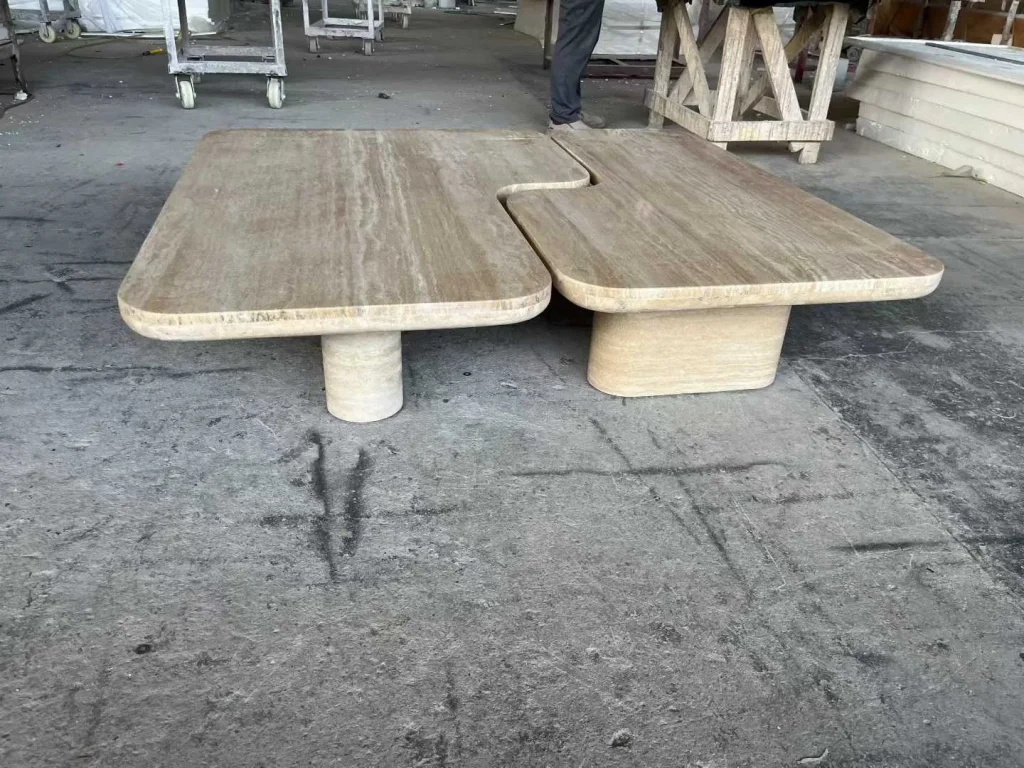
Choose travertine for matte warmth; marble for stronger veining. A 1,200 × 600 × 20 mm (47.2 × 23.6 × 0.79 in) top is 38.9 kg (85.7 lb) at 2.7 t/m³ (168.6 lb/ft³) and 31.7 kg (69.9 lb) at 2.2 t/m³ (137.3 lb/ft³). Both need acid care.
Which differences change travertine and marble furniture performance?
The decisive differences are geological structure, surface continuity and how the finished slab handles spills and load. Colour is the easy part; pores, fissures, filling and support determine whether the furniture works in daily use.
| Property | Travertine | Marble | Furniture consequence | Source |
|---|---|---|---|---|
| Stone class | Sedimentary limestone with natural voids and bands | Metamorphic carbonate rock | Compare the finished surface, not one broad category | Travertine; Marble |
| Typical visual structure | Linear bands, pits and directional bedding | Veins, breccia or clouded movement | Travertine rewards edge planning; marble rewards slab matching | USGS glossary |
| Bulk density band | 2.2–2.7 t/m³ (137–169 lb/ft³) | 2.5–2.8 t/m³ (156–175 lb/ft³) | Weight can differ even at identical dimensions | Typical reference bands; test the selected slab |
| Calcite hardness | Mohs 3 | Mohs 3 | Both are softer than quartz; finish and mineral content still vary | Mohs scale |
| Surface porosity | Visible voids can remain if unfilled | Pores and fissures vary by slab | Unfilled travertine needs more attention to crumbs, spills and residue | Travertine |
| Filling | Can be filled; voids may remain or reopen | No equivalent pore-filling category | Filled and unfilled travertine are different furniture specifications | Surface inspection and written finish scope |
| Acid reaction | Sensitive because the stone is carbonate-based | Sensitive when composed mainly of calcite | Sealer slows absorption; it does not make either acid-proof | Natural Stone Institute |
| Stain visibility | Depends on filling, pores, colour and sealer | Depends on slab, finish and absorbed liquid | No material wins on every spill | Finish specification and test area |
| Finish direction | Honed and filled is common for furniture | Honed or polished; verify the named slab | Honed surfaces show softer reflections; polish reveals etching | Stone-care guidance |
| 100 kg (220 lb) load | Can be below that weight at 20 mm (0.79 in) depending on size and density | Can exceed 100 kg (220 lb) in large dining sizes | Use calculated weight and a support drawing | Length × width × thickness × density |
| Outdoor suitability | Condition and freeze-thaw exposure must be assessed | Carbonate marble is not the default exposed outdoor choice | Shelter, drainage and local freeze-thaw conditions matter | Natural Stone Institute |
| Furniture price | Quote-specific | Quote-specific | Grade, yield, finish, base, packing and destination can outweigh the stone family | Slab and finished-piece quote on request through Contact |
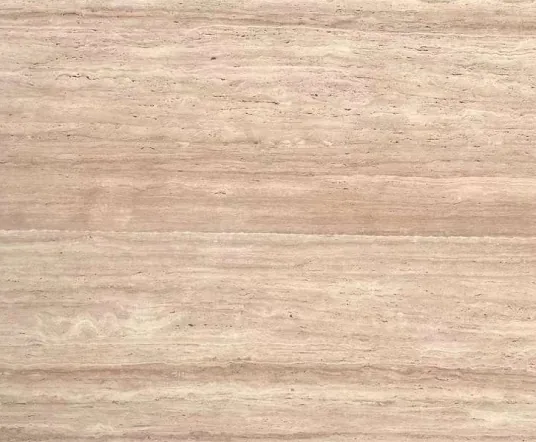
Where do travertine and marble part ways in daily use?
Daily performance diverges around surface continuity, visible wear and how much visual variation the room can absorb. Both remain carbonate stones, so neither is a low-care alternative to quartzite or porcelain.
Is travertine more expensive than marble for furniture?
The answer is quote-specific because the comparison changes with grade, slab size, filling, finish, thickness, base and delivery. A select filled travertine can cost more than a common marble, while an ordinary unfilled travertine may cost less than a rare veined marble.
Compare at least the same dimensions and finish category. Ask whether the travertine price includes filling and the marble price includes backing or reinforcement. A lower slab price can disappear when those processes, packing and freight are added.
What are the downsides of travertine furniture?
Unfilled voids can hold crumbs or moisture and make cleaning less straightforward. Linear pits and bedding planes may also catch at the edge of a table. Filling can smooth the top, but the filler must be compatible with the chosen finish and inspected for gaps or later wear.
Travertine remains reactive to acids. Wine, citrus and acidic cleaners can dull the surface even when the top is honed and sealed. For a dining table, plan coasters and immediate wiping as part of the purchase rather than as optional care.
Does filling make travertine non-porous?
No. Filling improves the continuity of the visible surface but cannot convert the whole stone into an impermeable sheet. A sealer can further reduce absorption, yet both fill and sealer require condition checks over time.
Before sealing, clean and dry the furniture, then test a small area. Follow the sealer maker’s written preparation, dwell and cure instructions. If an oil or coloured liquid has already entered, sealing over the patch can trap the appearance rather than remove it.
Which stone hides wear better?
Neither material reliably hides wear. A complex travertine can camouflage small crumb marks with its bands, but pits draw the eye if debris collects. A quiet beige or gray marble can make small rings less visually obvious, while a bright white field with dark veining makes contrast more noticeable.
The existing finish matters more than the category label. A honed surface has a broader reflection than a polish, so small gloss interruptions can be less obvious. The trade-off is that some honed surfaces show fingerprints or oil marks differently.
Is travertine a cheaper substitute for marble?
Treat “cheaper substitute” as a purchasing hypothesis, not a fact. Travertine and marble are distinct materials with different surfaces. A low-priced travertine table may use unfilled stone, a thin top or a simple base, while a marble quote may include a heavier slab and reinforced base.
A valid comparison lists the same dimensions, filling, finish, thickness, support and delivery. The relative cost is quote-specific. Quote amounts vary with the selected travertine slab grade, finished size and quantity. Share a slab photo and the finished dimensions on the Contact page for pricing.
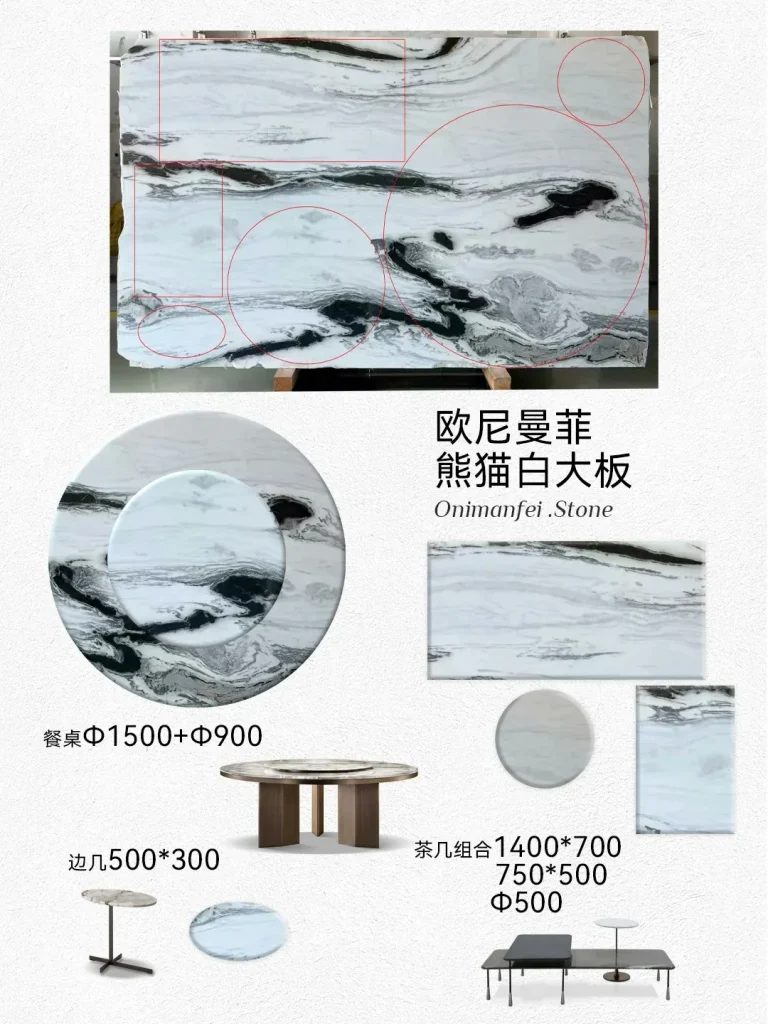
How can you identify travertine and marble before buying?
Look at the edge, face and repeated slab evidence; a single website swatch is not enough. Travertine commonly shows elongated voids, fill patches and directional bedding. Marble commonly shows veins or breccia movement across the face, without the same visible pore system.
| Visual check | Travertine clue | Marble clue | Limit |
|---|---|---|---|
| Face texture | Small pits, elongated openings or filled patches | Continuous surface with veins or breccia | Some travertine is well filled; some marble has fissures |
| Edge section | Open voids or filler may be visible | Fissures and backing may be visible | An edge build-up can hide the natural section |
| Movement | Bands often follow a bedding direction | Network of veins or fragmented clasts | Commercial names do not guarantee one pattern |
| Written document | Material name and filled/unfilled status | Material name, finish and backing | Visual inspection is not a laboratory identification |
Ask for a close photograph of the actual slab edge and an untouched area of the face. Do not identify the stone solely from a finished table image where filler, polish and lighting can remove the distinguishing clues.
Should you choose travertine or marble for furniture?
Choose the material whose surface behaviour supports the room and maintenance routine, then confirm that the individual slab can make the furniture drawing.
| Choose travertine when… | Choose marble when… |
|---|---|
| You want a warmer, linear, lower-reflection surface | You want more pronounced veined or breccia movement |
| The brief accepts filled voids and a periodic filler check | The brief can accept fissures, backing or slab matching |
| A honed, tactile dining top suits the room | A honed or polished stone table is the focal point |
| You will protect acidic spills in either case | You will protect acidic spills in either case |
| The selected travertine slab can yield the required edge and seam | The named marble slab can yield the required edge and seam |
For a low-use coffee table, travertine’s texture can be the main visual feature. For a busy family dining table, the safer decision is the filled, sealed, visually quieter option that the household will actually maintain.
Which collections make the travertine-versus-marble choice concrete?
Compare complete furniture formats rather than loose material samples. A base and edge change how the top reads, and the collection page states which dimensions and stone families are being grouped.
Review travertine dining tables alongside white marble dining tables. For a living room, compare travertine coffee tables and black marble coffee tables. Use the travertine material guide and marble material guide to verify names before assuming a color direction.
The travertine care guide covers filling and sealing in more detail, while the marble care guide covers etching.
What should settle the travertine-versus-marble decision?
The final decision should come down to the actual slab, fill, finish, furniture drawing and maintenance plan. When two options look close, choose the quieter surface with the clearer written specification.
Is travertine usually more expensive than marble for furniture?
No universal order exists. Compare the actual slab grade, dimensions, finish, filling, backing, thickness, base and delivery scope. A carefully selected filled travertine can cost more than a common marble, while an ordinary travertine may cost less than a rare veined marble. The material name alone cannot rank the finished furniture price.
What are the practical downsides of travertine furniture?
Natural travertine contains voids and linear bedding planes, so an unfilled top can collect crumbs, liquids and cleaning residue. Filling improves surface continuity but must be inspected and maintained. Travertine is also carbonate stone, meaning acidic drinks and cleaners can etch it. A filled, honed and properly sealed surface is often easier to live with than an open, textured one.
Can filled travertine furniture still stain?
Yes. Filling closes many visible voids, but it does not make travertine non-porous or acid-proof. Liquid can enter unfilled pits, seams and fissures if the surface is left wet. Prompt removal, pH-neutral cleaning and an appropriate sealer reduce risk. Check a water-drop test on an inconspicuous area rather than assuming a filler has sealed the entire slab.
Which suits a dining table better, travertine or marble?
Choose filled and honed travertine when a warmer, linear surface and lower reflection suit the room. Choose marble when its veining is the main design feature and you accept similar carbonate care. In both cases, support, edge durability and spill management matter. A calm marble may show fewer visual disruptions than a highly pitted travertine.
Who wrote this travertine and marble comparison?
- Wikipedia’s travertine reference describes travertine as a form of limestone deposited by mineral springs, with natural voids that may be filled for use.
- Wikipedia’s marble reference describes marble as a metamorphic carbonate rock; its calcite content explains why acid can etch a finished surface.
- The Mohs scale places calcite at 3 and quartz at 7, which is why quartzite is a harder reference when acid and scratch resistance are compared.