Before paying a deposit, settle 5 essentials: a dimensioned drawing, named stone and finish, approved slab, inspection criteria and delivery term. Compare at least two written offers on the same revision; a photo or low unit price alone does not show what will be made or who pays freight and import costs.
Which commercial terms make two Chinese stone-furniture quotes comparable?
Two quotes become comparable when they describe the same drawing revision, stone, finish, packed scope and delivery obligation; otherwise the apparent price difference may simply be an omitted service.
| Term | What the written offer should state | Why it controls comparison |
|---|---|---|
| Product scope | Finished furniture or top only; base, hardware and installation responsibility | Prevents comparing different deliverables |
| Drawing revision | Revision number, dimensions, overhangs, cutouts and tolerances | Gives both suppliers one fabrication target |
| Stone approval | Named material, actual slab, batch and finish sample | Separates price differences caused by appearance |
| Price basis | Currency, quantity break, named Incoterm and destination | Shows what transport and import steps are included |
| Payment | Payment stages and method can be confirmed in the written quotation; send the project scope through Contact before comparing offers. | Connects cash flow to production milestones |
| Delivery term | Ask Contact to confirm the applicable FOB, CIF or DDP basis, named place and included services in the quotation. | Defines where responsibility changes |
| Packing | Request the project-specific packing drawing, packed dimensions and packed mass in the written offer. | Makes freight assumptions visible |
Ask for exclusions in the same document. A quotation cannot be compared reliably if one offer includes crating and another treats it as an extra, or if one names a destination port and another names a supplier warehouse.
What sourcing sequence prevents a low quote from becoming an expensive order?
Use a gate at each handoff: no cutting from an undimensioned sketch, no production from an unapproved slab and no shipment from an uninspected package.
| Stage | Buyer provides | Supplier returns | Hold point |
|---|---|---|---|
| 1. Brief | Use, quantity, destination and target date | Feasibility questions and quote scope | One shared scope |
| 2. Drawing | Plan, elevation and access limits | Shop drawing with support and openings | Written drawing approval |
| 3. Stone and sample | Named material, finish and approval lighting | Slab photos and physical finish sample | Signed slab and finish standard |
| 4. Production | Approved drawing and sample | Cut, fabricated and finished item | No unapproved substitution |
| 5. Inspection | Dimension and appearance criteria | Inspection report and photos | Released or reworked status |
| 6. Packing | Destination and handling limits | Closed crate with mass and dimensions | Package check |
| 7. Shipment | Incoterm, consignee and documents | Dispatch papers and document set | Named-place handoff |
How can a buyer check a supplier's production capability?
Check capability by asking for information that connects machines, working limits and inspection to the same production site; a gallery of finished rooms does not establish either capacity or dimensional limits.
| What to check | What to ask the supplier for | Why it matters |
|---|---|---|
| Equipment | Request a dated machine list and compare its working dimensions with the exact drawing and process step. | Whether the planned part fits the process |
| Output | Ask for the reporting month, product type, units and supporting capacity statement in writing. | Whether the target date is plausible |
| Inspection | Drawing, gauge or template, inspection report and responsible person | Whether dimensions have a release method |
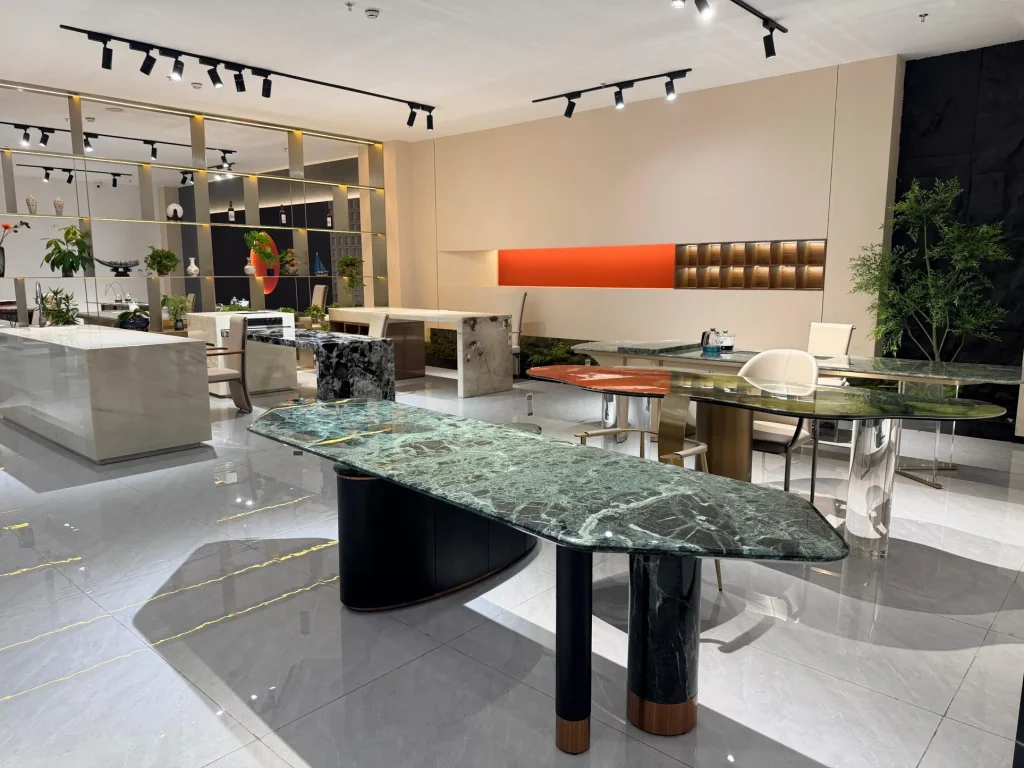
| Workshop proof | Dated workshop and process images with captions and permission | Whether the image belongs to the claimed process |
How should a stone-furniture crate and shipping route be specified?
Specify the crate around the finished geometry, lifting points and route: the package needs edge protection, a restrained stone face and an external label that can be read before unloading.
Ask for the closed-package dimensions and gross mass, the lifting method, and photographs of internal blocking before the crate closes. Mark orientation and package count. For an upper-floor delivery, note the lift, door widths, turning space and floor protection requirement.
Wood packaging used in international trade must meet the destination’s phytosanitary requirements, including the ISPM 15 treatment and marking system where applicable. Brass or coated hardware, stone protection and moisture control should also be listed by component rather than hidden under a general packing allowance.
Can an unnamed project photo show what a supplier delivered?
An unnamed project photo cannot connect a room, year, specification, quantity or permission to the supplier, so use it for design inspiration rather than proof of delivery.
Useful project photos name an approved or anonymized project, place, year and product scope, and include permission for the supplier to publish them. Compare those details with the drawing, stone approval and packing plan.
The packaging and shipping guide gives a checklist for labels and access. A third-party listing image must never be presented as a delivered case.
Frequently asked questions
How do I verify a Chinese stone furniture supplier?
Match the quotation entity to a business document, then ask for a dimensioned drawing, equipment list, maximum working size, inspection method and packing plan. Request the production address and the name of the person who approves specifications. A showroom photo proves appearance only. Keep every document tied to the same legal entity and project revision.
What should a China stone furniture RFQ include?
Include product type, finished dimensions, stone name, finish, edge, quantity, destination, target date and installation responsibility. Attach a plan or elevation and show any cutouts or weight limits. Ask each supplier to quote the same revision and state exclusions. This lets you compare fabrication, packing and delivery on one basis.
How do I approve travertine or marble slabs before fabrication?
Approve the production slab or a representative same-finish sample under agreed lighting. document the batch, face, filled areas and finish. A small color chip cannot control a large top with strong movement. Photograph the approved face and link it to the drawing and purchase order. Reapprove any substitution before cutting.
Which Incoterm protects a first stone furniture order?
No single Incoterm protects every buyer or seller; choose by who can control freight, insurance and import clearance. FOB leaves main carriage to the buyer, CIF places it with the seller but still requires the buyer to understand destination charges, and DDP shifts more delivery responsibility to the seller. Confirm the exact named place and responsibilities in writing.
What should a buyer send in the first sourcing brief?
Send one concise package: use and room, a dimensioned sketch, stone and finish references, quantity, destination, target date and who will install; this gives a supplier enough information to quote the actual scope.
Send the package through the contact page. For a custom process, continue with the custom stone furniture workflow.
Project inquiry
Request a stone furniture quote
Send dimensions, material direction and quantity for a comparable reply.
Useful details include product type, finished dimensions, quantity and destination.
Last updated: 2026-10-28.