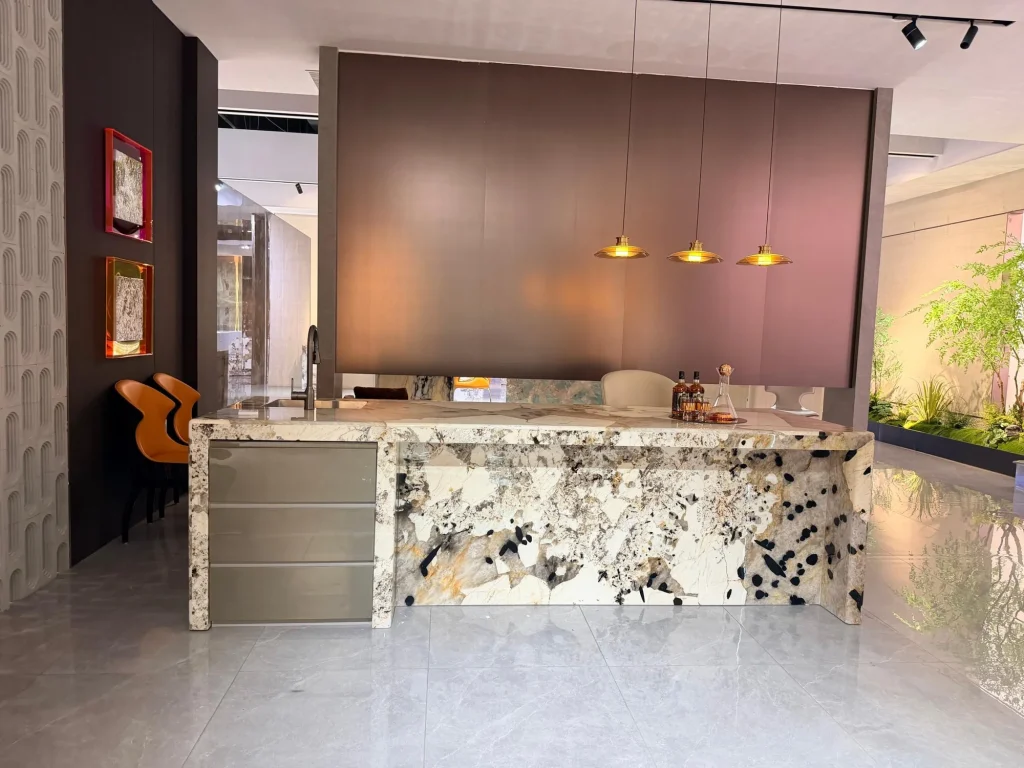
Clean marble furniture with a pH-neutral stone cleaner and a soft microfiber cloth, and wipe acidic spills immediately. A water-drop absorbency test shows whether a sealer still reduces absorption. Etching is chemical removal of calcite at Mohs 3, not surface dirt: light marks may improve with matched polishing, but deep damage needs controlled refinishing.
What is the fastest safe response to each mark on a marble table?
Identify the mark before choosing a product. A dark patch, a white dull patch, a raised film and a scratch require different actions, and the wrong cleaner can enlarge the problem.
| Visible problem | Likely cause | First response | Do not assume |
|---|---|---|---|
| Dust or sticky film | Surface soil or cleaner residue | Dust dry, then clean with a pH-neutral stone product and rinse | That the surface needs abrasive scrubbing |
| Dark patch | Oil, wine or another liquid has entered pores or a seam | Blot, clean gently, dry, and observe whether the patch fades | That heat will pull the liquid out |
| White dull ring | Etching from acid, or a water/mineral film | Clean and dry first; inspect under raking light | That vinegar or lemon will remove it |
| Fine line with raised edges | Scratch or a filled fissure | Stop polishing and document depth, direction and finish | That a sealer will close a deep scratch |
| Water remains dark longer than nearby stone | Reduced absorption at that spot | Dry fully and consider a tested sealer process | That a wet-looking patch is a colour variation |
| Uneven gloss over a patch | Local abrasion or etch removal of the finish | Compare reflections at a low angle before any repair | That a topical gloss product restores the stone |
This is a diagnostic table, not permission to experiment over a large visible area. Test on an inconspicuous part of the same slab and finish.
How can you tell whether the marble is stained, etched, scratched or dirty?
The safest test is a clean, dry surface examined under light moving across it at a low angle. Colour that sits in the stone suggests a stain; a change in the reflected edge of a light source suggests finish damage.
What does etching look like on polished and honed marble?
Etching removes calcium carbonate at the surface, so it usually changes sheen rather than adding a colour. On polished marble, an acid mark can look like a dull white ring against a sharp reflection. On honed marble, the same damage may appear as a lighter, chalky patch because the surface already has low gloss.
A water ring can be a removable mineral film, a dark moisture stain or an etch; appearance alone cannot always separate them. Clean and dry the area first. If the pale mark remains at the same boundary after gentle cleaning, treat it as possible finish damage.
Which cleaners should never touch marble furniture?
Avoid vinegar, lemon, acidic bathroom descaler and strong acid products on carbonate marble. Even a cleaner labelled for “stone” should be checked for acidic ingredients when the stone contains calcite. Acid reacts with the carbonates in the surface and can remove a shallow layer of material.
The Natural Stone Institute’s care guidance recommends pH-neutral cleaners and prompt removal of spills. A neutral cleaner still needs the correct dilution and dwell time; more concentrate does not make an etching mark safer to scrub.
Why does sealing not make marble acid-proof?
Sealing slows liquid absorption but does not stop acid from reacting with the stone surface. That distinction matters at a dining table: wine, citrus and vinegar can etch before a spill has time to become an absorbed stain.
Sealer performance depends on the product, porosity, finish and how the sealer was applied. A solvent- or water-based impregnator can protect the pore network while leaving the mineral surface chemically reactive. Use coasters, wipe up acidic liquids, and avoid claiming that “sealed marble” can withstand every household spill.
What happens if the wrong cleaner is already used?
Stop the process, lift any remaining product with a damp pH-neutral cloth, rinse and dry. Do not add another chemical in an attempt to reverse the first reaction. document the cleaner name, concentration, dwell time and visible change because a repairer needs that history.
If the surface feels rough or the mark persists, avoid polishing the whole top immediately. A small test by an experienced stone-care professional can determine whether the surface needs honing, polishing or only cleaning.
| Mark | What changes | Usual repair direction |
|---|---|---|
| Etch on honed marble | Surface becomes lighter or rougher | Clean, test a matched polish, then restore a uniform hone |
| Etch on polished marble | Local loss of gloss | Gradual polishing with controlled pressure; check the boundary |
| Oil stain | Pores or fissures hold a darker liquid | Clean, dry and use a stone-specific poultice only when suitable |
| Deep scratch | Material is displaced or removed | Assess whether filling, honing or replacement is appropriate |
What details should you note before repairing an etched marble table?
Before work begins, document the finish, mark and area so a test is not mistaken for the final result. A repair note can be compared later as long as it describes observations rather than only naming a product.
| Detail | Useful information | Why it matters |
|---|---|---|
| Finish reference | Honed, polished or other process, with a photograph in raking light | Restoration must match reflection as well as colour |
| Mark location | Distance from edges and measured area in mm and in | Defines the test area and later inspection boundary |
| Appearance | Wet, dry, day-lit and raking-light photographs | Shows whether the change is a stain or finish damage |
| Chemical history | Cleaner, sealer, acid exposure, dilution and time | Helps avoid repeating a damaging process |
| Test result | Method, pressure, pad or abrasive, product batch and result | Allows the full repair to follow a proven patch |
No measured workshop treatment time is asserted on this page. Product dwell times and cure windows must come from the label or a stone-care professional’s written method for the named material and finish.
How do you clean, seal and repair marble furniture step by step?
Use the least invasive process first and stop whenever the surface changes unexpectedly. A clean test area is more informative than a shelf of household remedies.
- Remove loose dust with a dry soft cloth, then clean with a pH-neutral stone cleaner diluted exactly as directed. Rinse and dry.
- Inspect the clean surface in daylight and under low-angle light. Photograph the mark with a scale and note whether the gloss has changed.
- Place a few water drops on an inconspicuous area for a short, controlled observation period. Wipe and dry. If the stone darkens, discuss whether an impregnating sealer is appropriate.
- Apply any sealer according to its labelled surface preparation, dwell and cure instructions. Do not stack extra coats as an acid-proofing strategy.
- For a suspected etch, have a small area tested with a polish matched to the existing finish. Keep the test inside a boundary that can be blended during final work.
- If the mark remains, deepens or covers a large visible area, stop. Arrange controlled diamond honing or polishing, then restore the complete visible surface to an even finish.
For everyday use, keep acidic drinks off the surface without protection and wipe up wine or citrus before it dries. Use a trivet for hot objects, but do not mistake heat protection for acid protection.

Which product pages help choose a marble surface that is easier to maintain?
The stone name alone does not determine an easy-care table. Finish, vein movement, edge detail and the amount of visible field all affect how quickly a mark is noticed.
Browse marble coffee tables for low-use surfaces, marble dining tables where spills are frequent, or white marble dining tables when a light surface is required. Compare finish behavior in the honed versus polished guide.
For a stronger question about the stone itself, read whether marble stains and how porous it is. To understand a specific commercial stone, start with Calacatta Viola marble and its pattern variation.
What mistakes turn a small marble mark into a larger repair?
The common mistakes are using acid as a universal remover, polishing a whole top after testing nothing, and sealing over a stain that should have been removed first. Prevention is cheaper than refinishing.
Can vinegar remove hard-water marks from a marble table?
No. Vinegar is acidic and can etch carbonate marble, making the mark duller or larger. Mixing vinegar with baking soda does not solve the chemistry because the resulting mixture can still leave an alkaline residue and abrasive particles. Use a pH-neutral stone cleaner, dwell only as directed, rinse, and dry with a clean microfiber cloth.
Does marble furniture need sealer every year?
No fixed annual schedule fits every slab, finish, sealer and room. Test an inconspicuous area by leaving water drops for a few minutes, then wipe and dry. If the stone darkens, the sealer is no longer reducing absorption enough for that condition. Follow the sealer manufacturer’s dwell and cure time, and test again.
How do you remove a white etch ring from a marble table?
A white ring that remains after cleaning is likely etching, not a removable stain. For a light mark on a honed or polished surface, a stone-care professional can test a matched polishing powder on a small area. Deep or widespread damage may need diamond abrasives and refinishing of the whole visible area to restore an even sheen.
Can toothpaste polish etched marble furniture?
Toothpaste is not a controlled marble-polishing system. Its abrasive particles, humectants and additives vary, so the result can be uneven and the residue may collect in pores or seams. A small test might change gloss without removing the etch cleanly. Use damage assessment and a marble-specific process; deep etching needs a refinishing sequence rather than a household paste.
Who wrote this marble care guide?
- Wikipedia’s marble reference explains that marble is composed mainly of recrystallized carbonate minerals, which is why acidic products can attack the surface.
- The Mohs scale places calcite at 3; marble hardness and abrasion response still depend on the specific stone and finish.
- The Natural Stone Institute care page recommends pH-neutral cleaners, prompt spill removal and suitable sealing practice rather than acid-based cleaners.