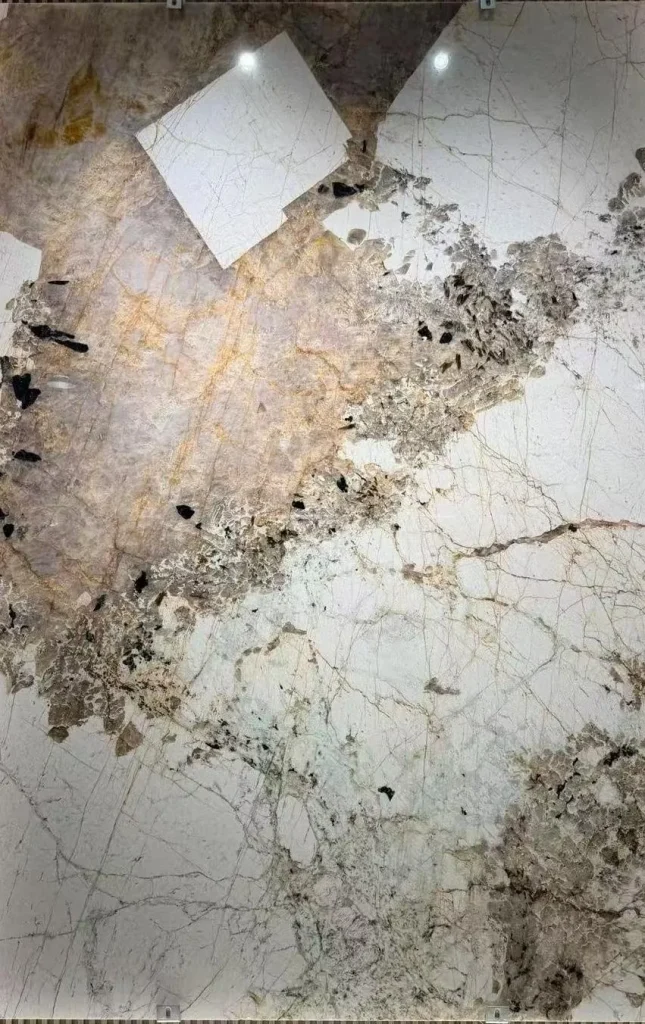
Quartzite furniture must be specified from the exact slab, not the trade name alone. A 1,200 × 600 × 20 mm (47.2 × 23.6 × 0.79 in) top at 2.75 t/m³ weighs about 39.6 kg (87.3 lb). A quartz-rich slab suits busy tables, but carbonate veins, fissures and finish still require approval.
Which measurements distinguish quartzite from marble at the specification stage?
Quartzite forms when quartz-rich sandstone is altered by heat and pressure, producing a largely quartz-based metamorphic rock. That explains its scratch resistance, but commercial slabs can include other minerals, repairs and visible defects. Test and approve the actual slab before relying on the family name.
| Parameter | Working value | What to verify | Source |
|---|---|---|---|
| Rock family | Metamorphic, mostly quartz | Whether the commercial stone meets that description | Wikipedia |
| Quartz hardness | Mohs 7 reference | Hardness does not prove resistance to every stain | Mohs scale |
| Bulk density | 2.6–2.9 t/m³ (162–181 lb/ft³) | Actual thickness, weight and base load | Reference band |
| Reference weight | 1,200 × 600 × 20 mm: 37.4–41.8 kg (82–92 lb) | Slab density and edge build-up | Calculated |
| Acid response | Normally low on quartz; variable at veins | Carbonate veins, fillers and resin | Slab test |
| Water absorption | Not fixed by the family name | Slab-specific result and finish | ASTM C1526 |
| Outdoor use | Conditional | Freeze-thaw, drainage, slip and fixing | Project review |
Which quartzite names are available?
The names below are commercial stone names. A trade name is not a laboratory identification, and the limestone-like appearance of Taj Mahal is a reason to ask for test evidence rather than assume the subtype.
| Stone name | Common appearance | Furniture check | Page |
|---|---|---|---|
| Taj Mahal | Cream or white ground with soft movement | Test mineralogy; inspect pale repairs and vein direction | This family guide |
| Patagonia | Cream, green or contrasting breccia-like areas | Confirm the exact variant, fissures and colour continuity | Stone coffee-table formats |
| Macaubas Fantasy | Pale or blue-white movement with strong contrast | Match pattern across joins and approve the slab | Azul Macaubas guide |
| Azul Macaubas | Blue, white or charcoal patches | Read its dedicated guide and test acid-sensitive veins | Azul Macaubas |
What does metamorphism mean for cuts, edges and repairs?
Recrystallization develops interlocking quartz grains, which help explain the stone’s hardness and low porosity. It does not remove every fissure, and cutting an edge or drilling a fixing can expose weak zones hidden in the face. Honing lowers glare, polishing deepens colour, and any resin or mesh should be shown on the furniture drawing.
How should the Patagonia or Macaubas pattern be selected from photographs?
Review the whole slab in diffuse daylight before choosing a crop. Patagonia and Macaubas can change from pale to dark within one face, so a phone crop may hide the area that will dominate the table.
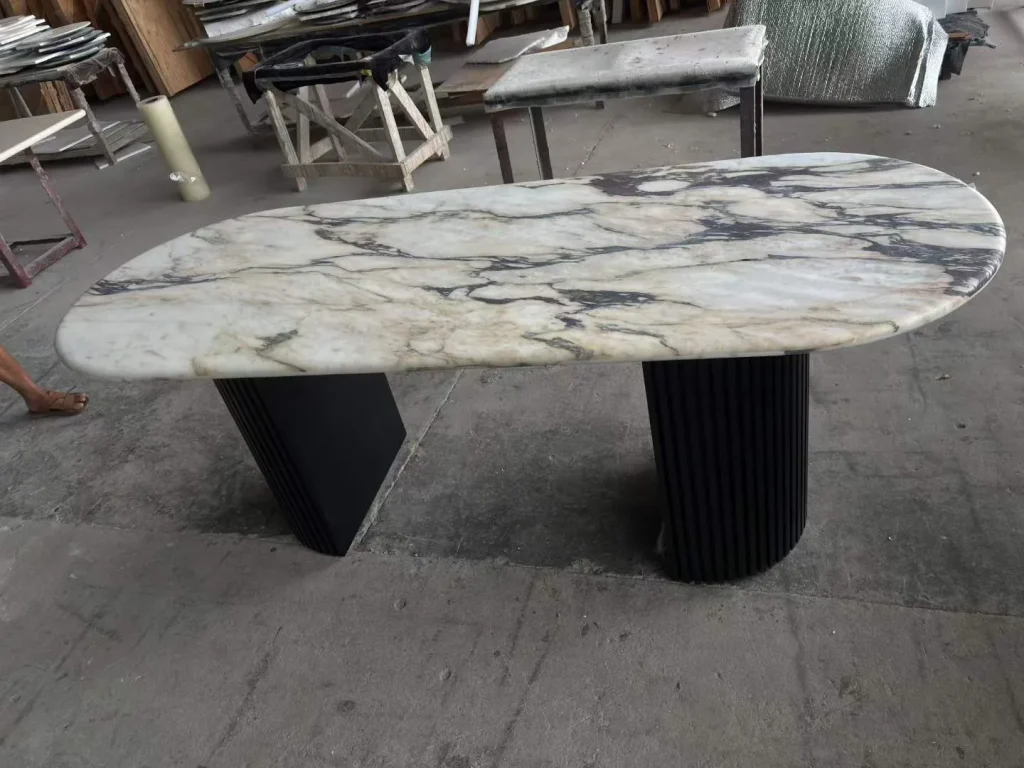
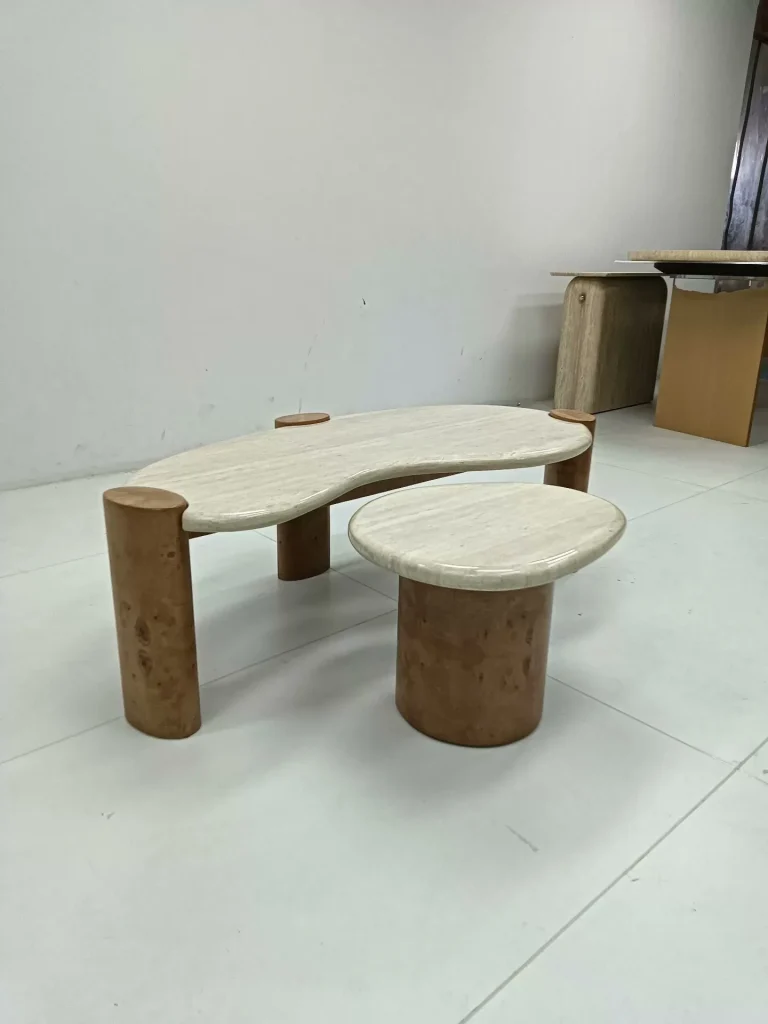
Pair the full-slab view with the intended edge and base sample. A furniture photograph shows one example, not a promise that the next slab will match.
Why can two slabs of the same quartzite look unrelated?
Quartzite blocks vary in grain, colour, vein scale and fracture pattern. One face may be calm on one side and heavily brecciated on the other, and cut direction changes whether the pattern runs along or across the table. Put the slab number, finish, orientation and book-match decision in the order.
Which quartzite furniture uses justify its higher fabrication demands?
Quartzite suits dining and coffee tables where scratch resistance is useful, provided the support handles its weight. Dense quartzite is harder to cut and polish than calcite marble, so fabrication skill matters.
| Use | Fit | Condition |
|---|---|---|
| Coffee or side table | Good | Approve weight, edge profile and base contact |
| Dining or console table | Good with engineering | Control span, joints and unsupported overhang |
| Vanity top | Conditional | Check acid-sensitive veins and drainage details |
| Outdoor table | Conditional | Assess climate, fixing, finish and freeze-thaw exposure |
Which interiors make the most of Taj Mahal, Patagonia and Macaubas?
Let the slab’s temperature guide the room. Cream Taj Mahal pairs with oak, linen and bronze. Patagonia can connect cream, green and charcoal, but its dark patches need a calm surrounding palette. Macaubas blue is strongest when repeated once. Use a physical sample because room lighting and finish shift the colour.
Why can two quartzite tables cost so differently?
The collection’s price tier is only a relative guide, not a delivered furniture price. A quotation changes with slab rarity, usable area, thickness, matching, edges, reinforcement and destination. Heavily patterned stone can require more careful cropping and produce more waste.
To judge whether a finish is repeatable, ask the supplier to identify the approved slab and put its finish, nominal thickness, filling, repairs, reinforcement and backing in the written offer. Compare those fields with the sample or slab you approve, because a generic quotation cannot show whether the delivered exposed face and rear support will match. Send a slab photo and finished dimensions through Contact to request a specification and quote.
Which quartzite weaknesses still matter despite its hardness?
Quartzite is hard, but carbonate veins may etch, resin can discolour and flexing can crack a poorly supported top. Clean with a pH-neutral stone product, use coasters and felt pads, and test sealer on an offcut. Do not acid-clean a finished table to identify the stone.
When should a buyer choose marble, onyx or another stone instead?
Choose marble when predictable fabrication and a softer calcite appearance matter more than maximum scratch resistance. Choose onyx when translucency is central to the design and you accept extra care. Choose a different material when the priority is low weight or a porous, matte surface.
| Stone | What changes | Read next |
|---|---|---|
| Marble | Calcite-based, usually easier to work but more acid-sensitive | Marble vs quartzite |
| Onyx | Stronger translucency and pattern, with greater slab variability | Onyx vs marble |
| Azul Macaubas | A named blue quartzite with its own guide | Azul Macaubas quartzite |
Which furniture collections can carry a quartzite specification?
Start with tables that display the face. A compact coffee table uses one slab economically; a dining table makes span, matching and weight the first checks.
- Marble and stone dining tables
- Marble and stone coffee tables
- Onyx dining tables
- Marble and stone side tables
What should a quartzite buyer ask before approving the slab?
Ask for the slab identity, mineral or acid-test evidence, finish sample and reinforcement plan.
Is Taj Mahal quartzite or marble?
Taj Mahal is commonly sold as quartzite because it is quartz-rich, but commercial labels and mineral content can vary. A professional acid test and petrographic report are more reliable than appearance alone. Do not apply acid to a finished table to test it; ask for slab evidence and inspect carbonate veins before approving edge details.
Can Patagonia quartzite be used outdoors?
It can be specified outdoors when the exact slab, finish, drainage and climate suit the project. Quartzite is generally hard and acid-resistant, but carbonate veins, fissures, resin and freeze-thaw exposure still matter. An outdoor slab needs non-trapping fixing, edge protection and a finish that will not become slippery when wet.
Does Macaubas quartzite need sealing?
Sealing should follow the actual slab’s absorption, finish and setting, not the trade name. A dense polished quartzite may need little or no sealer, while open grain, resin repairs or a textured finish can justify one. Test an offcut and use a breathable product suited to stone; over-sealing can leave residue.
Who wrote this quartzite guide?
The Amazstone Editorial Team reviewed the named commercial stones alongside public geology and stone-testing references. No supplier photograph confirms current stock, and no unverified finish range is stated as available.
Amazstone Editorial Team
Material and furniture research
Last updated 2026-10-28
Sources:
- Wikipedia: Quartzite describes its metamorphic, quartz-rich origin.
- ASTM C1526 provides a relevant quartzite test standard, not a blanket certification.
- The Mohs scale gives quartz a reference hardness of 7.
- The 2026 Amazstone collection includes Taj Mahal, Patagonia, Macaubas Fantasy and Azul Macaubas; ask the supplier for written confirmation of subtype and finish availability for the selected slab.