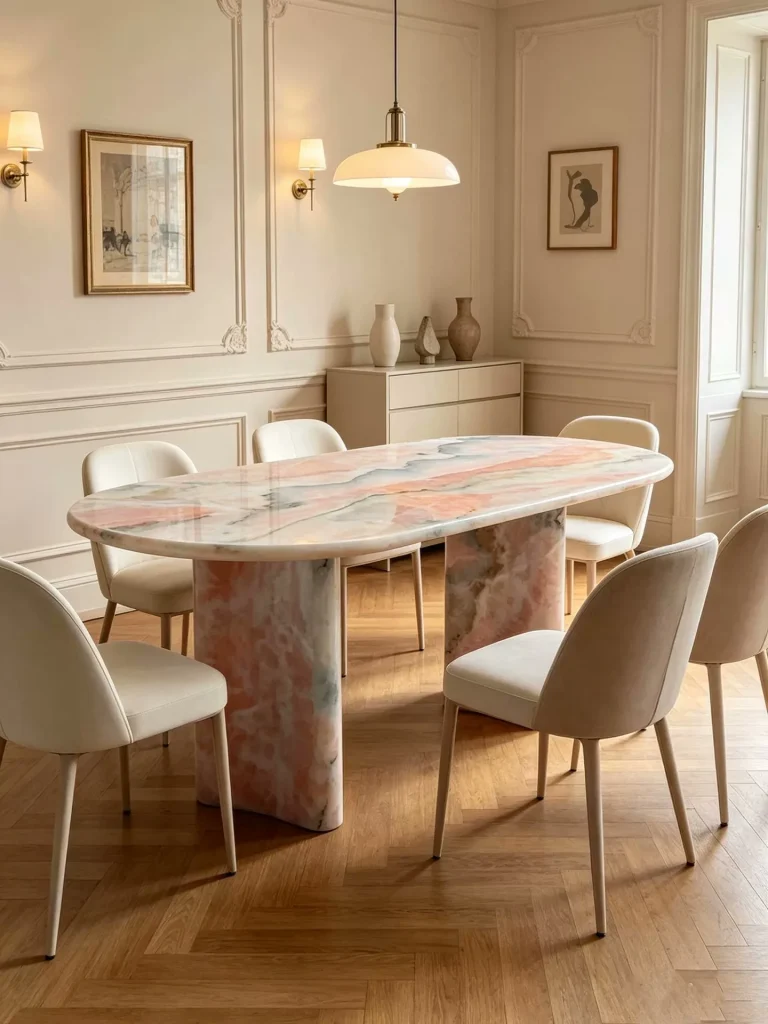
Commercial onyx is a trade label for strongly banded or translucent stone whose mineral composition can differ between slabs; treat it as a furniture-finish risk, not a single material. At the 2.4–2.7 t/m³ reference density, a 1,200 × 600 × 20 mm top weighs about 34.6–38.9 kg (76.2–85.7 lb).
What does the name “onyx” actually tell you?
The mineral name, commercial name, colour and fabrication method are different things. A stone sold as onyx may look strongly banded or translucent even when its mineral composition is not known, so ask for a written material description before choosing furniture.
| Property | What the label tells you | What furniture still needs |
|---|---|---|
| Mineral onyx | Banded chalcedony in the strict mineral sense | The trade name can also be applied to carbonate materials |
| Commercial appearance | Strong banding, color variation, possible translucency | Appearance alone cannot tell you the hardness or acid resistance |
| Reference density | 2.4–2.7 t/m³ (150–169 lb/ft³) for this brief’s commercial family | Actual slab density affects handling and support |
| Hardness | Calcite reference Mohs 3; quartz reference Mohs 7 | Do not infer which mineral is present from the label |
| Acid response | Varies with mineral composition and finish | Carbonate varieties can etch; test and confirm |
The 30 mm version of the same 1,200 × 600 mm top is about 51.8–58.3 kg (114.2–128.5 lb). Add backing, base, and packing before planning the lift.
What can an onyx slab photo tell you?
The photograph shows a silver-gray banded slab. Use it only to review the visual direction: it cannot confirm that a future slab will have the same translucency, colour, backing or mineral composition.
Ask for the actual slab number and a view under transmitted light when translucency matters. Also ask for a straight-on view to separate color from reflection and a close view that shows fissures, fill, and surface finish.
Why do onyx slabs vary so much?
The onyx collection includes 21 names, including White Jade Onyx, Green Onyx, Pink Onyx, Orange Flower Onyx, Persian Onyx, Blue Onyx, Ivory Onyx, Bulgari White Onyx, Red Line Onyx, Tiger Onyx, Honey Onyx, Rainbow Onyx, and Peacock Onyx. These names describe commercial appearances, not a shared quarry or mineral recipe.
The strongest movement may be concentrated in one area of the block. Cutting across that band can produce dramatic matching, while cutting along it can reduce the apparent contrast. Translucency can also become more visible when a thin panel is backlit, so approve the final lighting and backer together.
Which furniture suits onyx?
Onyx can suit a low-traffic coffee table, a feature side table, a plinth, or a display surface when the slab is protected and the base does not force an unsupported span. A dining table is possible, but daily food, acidic drinks, chair impact, and cleaning make slab approval and backing more demanding.
For a table with a cutout or a narrow edge, ask for a section drawing showing the stone, backer, support rails, and base connection. Translucency can reveal an uneven subtop even when the top surface looks uniform.
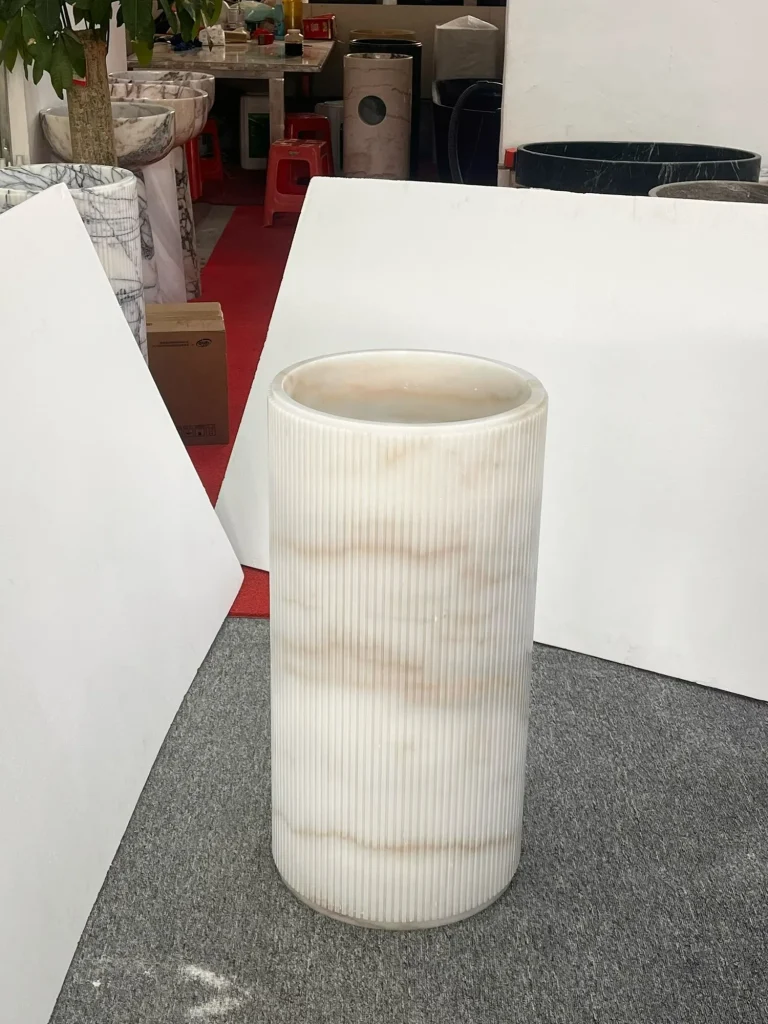
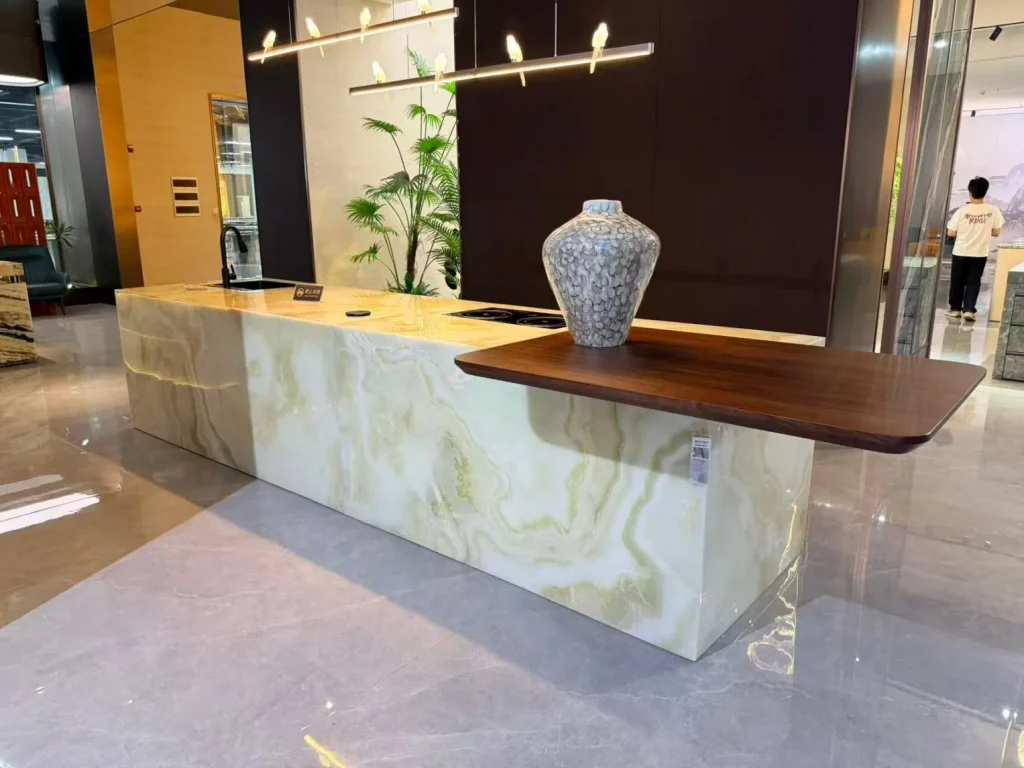
Which colours pair well with onyx?
Green, blue, red, honey, and peony-banded onyx already bring strong color and pattern. Use quieter wall, floor, and upholstery tones near a bold slab, or repeat one secondary color rather than introducing several competing accents.
White or ivory onyx can sit beside warm neutrals and pale metal, while darker honey and red slabs need more contrast at the table edge to read clearly. Compare the slab under the intended lighting before fixing the palette.
What should an onyx quote include?
The same trade name can cover different mineral bodies, fill, surface conditions, and backing requirements. A usable slab quote should identify the slab, finish, thickness, backing, and whether the price covers a slab or a finished product.
| Commercial item | Required confirmation |
|---|---|
| Material description | Ask for the commercial name, quarry or production region and any public source for the selected slab in the written offer, then approve that individual slab before fabrication. |
| Finish and backing | Confirm the approved slab’s finish, thickness, fill or repair, and any mesh or resin backing in writing, and match those details to the slab you approve. |
| Price | Slab and finished-piece quote on request through Contact |
How should onyx furniture be cared for?
The risk profile depends on the actual mineral and finish, but banded and translucent slabs often attract attention to cracks, pits, and edge chips. A backer can support a thin slab, while sealer can reduce liquid absorption; neither makes a carbonate stone acid-proof.
- Blot acidic drinks and food residue promptly.
- Use coasters, trivets, and stable lifting points.
- Keep the underside dry if a backer is exposed.
- Ask whether the finish and sealer are compatible.
- Inspect the approved slab for fissures before cutting.
Natural Stone Institute care guidance supports material-specific cleaning and sealing decisions.
How does onyx compare with marble?
Marble usually shows veining and clouding rather than the strong banded look of many onyx stones; the two materials also need different care checks when their mineral compositions differ. A named green, blue, white, or honey onyx guide is the right next step when colour is already fixed.
Which onyx furniture styles can you browse?
The furniture grid below groups styles by shape and can narrow the visual direction. It does not confirm that a named slab is suitable for a particular span, that a translucent panel has a suitable backer, or that an item is currently stocked.
Stock and custom production are available with a minimum order of 1 piece; request this category's product list.
Request product listWhich onyx questions change the slab approval?
Is commercial onyx the same as mineral onyx?
Not necessarily. Mineral onyx is a banded form of chalcedony, while the stone trade also uses “onyx” for strongly banded or translucent carbonate materials. The trade name alone cannot settle the mineral type. Ask for the commercial description, composition test if required, finish, and backing before specifying furniture.
Why do onyx slabs vary so much from one another?
Onyx is valued for concentrated banding, translucency, and color change, all of which can shift across a single block. Cutting direction, resin treatment, lighting, and slab thickness change what the buyer sees. Approve the actual slab layout rather than relying on a small sample or a catalog thumbnail.
Is onyx good for a dining table?
Onyx can make a dining table when the exact material, finish, thickness, backing, and support are approved for daily use. Strong slabs may need a continuous backer, and acid-bearing food can affect carbonate varieties. A dining table also needs a stable base and enough clear span; the visual pattern is not a strength rating.
Does translucent onyx need a backing?
A translucent slab often needs a continuous backer or frame to control handling, support a cutout, and keep the underside visually uniform. Whether a mesh, resin, laminated panel, or another method is appropriate depends on the slab and furniture design. Approve the backing and fixing method together before fabrication.
Where do these onyx facts come from?
- The mineral name onyx refers to banded chalcedony, while the furniture trade may use the same label for other banded materials. Onyx reference
- The 1,200 × 600 mm (47.2 × 23.6 in) weight example uses solid volume at the reference 2.4–2.7 t/m³ (150–169 lb/ft³) commercial density band. USGS glossary
- Calcite and quartz have Mohs reference values of 3 and 7, so hardness cannot be inferred from a visual trade label. Mohs scale
- Stone care and sealing should follow the actual material and supplied finish. Natural Stone Institute care