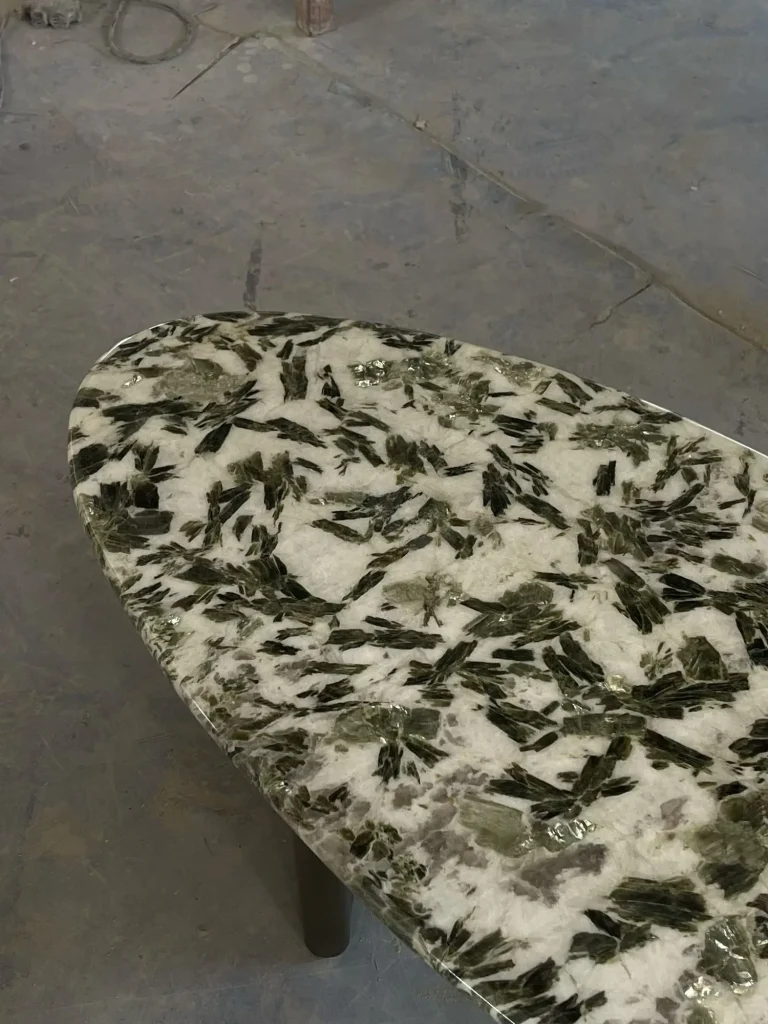
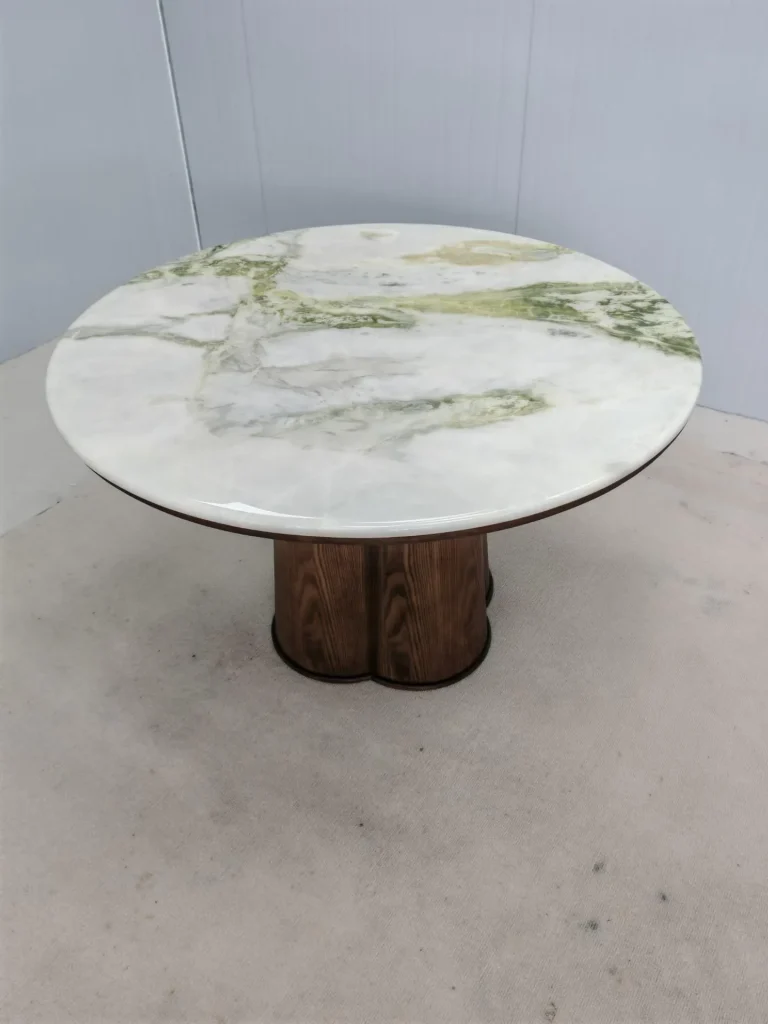
A 900 mm (35.4 in) round marble coffee table suits a 1,350–1,500 mm (53–59 in) sofa under the two-thirds planning rule; test the 400–450 mm (16–18 in) height and walking clearance. Its 20 mm top weighs about 34.4 kg (75.7 lb) at 2.7 t/m³ before the base.
What should I decide before choosing a round marble top?
Diameter, height, edge and base placement decide how useful the circle is; stone pattern comes after those dimensions. The circular plan has no corners, but it still needs a clear access route and a stable support beneath the top.
| Specification | Round-table basis |
|---|---|
| Typical diameter | 600–1,200 mm (23.6–47.2 in), with 750–1,000 mm (29.5–39.4 in) covering many living-room uses |
| Top height | Usually 400–450 mm (16–18 in), adjusted to the sofa seat |
| Top thickness | 20 mm (0.79 in) with continuous support; 30 mm (1.18 in) for a heavier exposed edge where the structure allows |
| Edge | Straight, eased, bullnose or chamfered; edge profile changes apparent thickness |
| Base and finish | Pedestal, legs or drum; honed reduces glare, polished sharpens reflection |
How does diameter change the usable top on a round marble table?
A larger diameter adds useful surface quickly: a 900 mm (35.4 in) circle has about 0.64 m² (6.9 ft²) of area, while a 900 × 600 mm (35.4 × 23.6 in) rectangle has 0.54 m² (5.8 ft²). The table still needs to suit the sofa and room, not merely offer the largest circle that fits.
Compact round tables, 600–750 mm
Use this range for two chairs, a small room or a secondary surface. Check foot clearance and that books remain on the top.
Standard and large tables, 800–1,200 mm
This range suits many two- or three-seat sofas. The widest point controls circulation; larger circles need a wider support or substantial pedestal and a separate lifting plan.
Stock and custom production are available with a minimum order of 1 piece; request this category's product list.
Request product listMore stone coffee tables in selected finishes
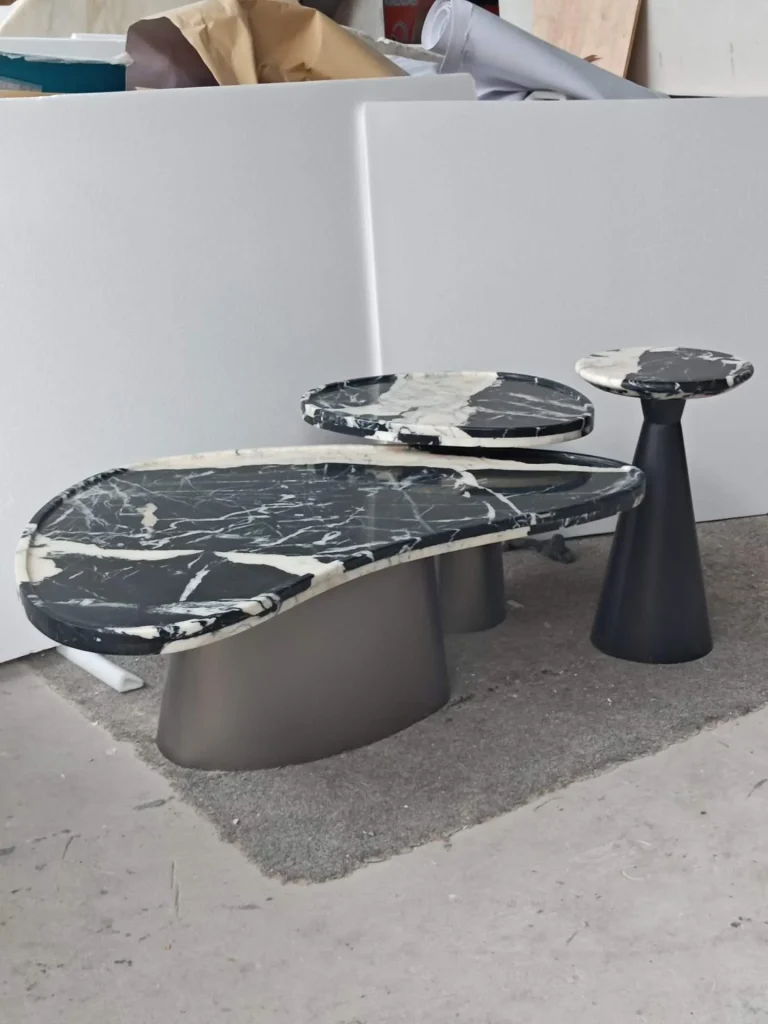
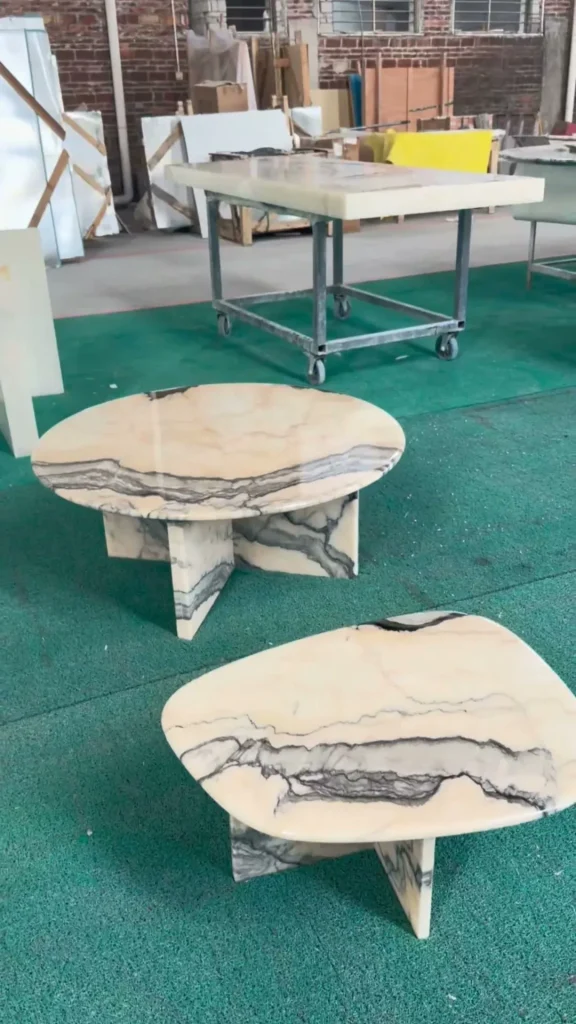
Is a round marble coffee table good for a sofa arrangement?
Yes, when the seating wraps around the table and the room needs a softer circulation edge; choose a rectangle when the zone is narrow or several people need to share long sightlines. The round form is efficient only when the furniture actually follows its geometry.
| Room condition | Round table | Rectangle alternative |
|---|---|---|
| L-shaped or curved sofa | Good visual fit; check the centre point | Can leave an awkward corner gap |
| Narrow room | Wide point may obstruct the path | Fits closer to a wall with controlled clearance |
Marble is suitable for a thoughtful living room, but it trades a broad pattern choice for acid sensitivity and weight. Use a honed, sealed finish where daily glare is a nuisance.
Which marble and edge should I choose for a round table?
Choose a restrained stone for patterned seating and a strong vein for a quiet room. Approve the slab under the intended light; honed lowers glare, and an eased edge softens knee contact.
What commercial details must a round-table quotation separate?
The diameter, thickness, base type, edge work and packing must be separated before comparing two prices. A larger circle changes slab yield and weight even when the stone name is identical.
| Variable | Status |
|---|---|
| Minimum order | 1 piece |
| Production schedule | About 20 days production + about 30 days shipping; production starts after deposit receipt and drawing confirmation |
| Price | Coffee-table quote on request through Contact |
| Availability | Yes, stock is available. Sizes and quantities are not published. |
The marble table cost guide explains why quotations should separate the top, base and delivery scope.
How does marble compare with other round table stones?
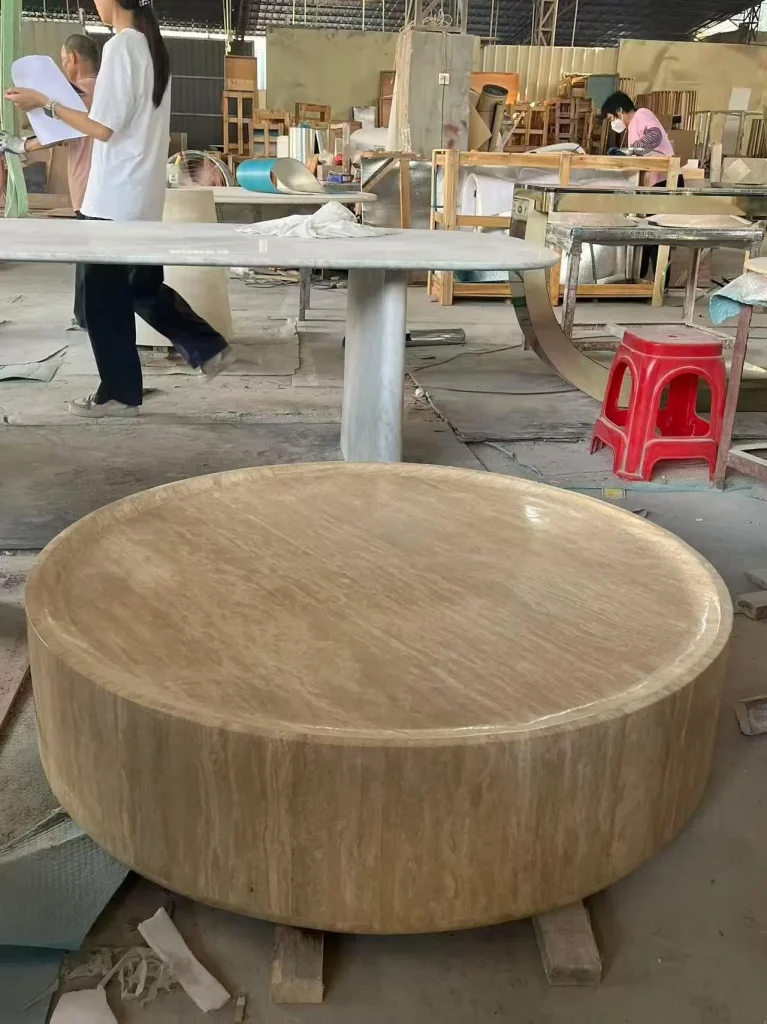
Marble offers rich veining, travertine linear texture and quartzite a denser-looking option when the actual slab is specified.
| Stone | Appearance | Weight and care | Best fit |
|---|---|---|---|
| Marble | Veins and clouds | 2.5–2.8 t/m³ (156.1–174.8 lb/ft³); often acid-sensitive | Pattern-led room |
| Travertine | Bands and voids | 2.2–2.7 t/m³ (137.3–168.6 lb/ft³); filling changes the surface | Textured neutral |
| Quartzite | Crystalline movement | 2.6–2.9 t/m³ (162.3–181.0 lb/ft³); test the slab | Dense-looking option |
How do I keep a round marble coffee table looking even?
Wipe spills promptly with pH-neutral stone cleaner and use coasters. Check the edge for contact damage and lift the base when moving the table.
What do buyers usually ask about round marble tables?
What is a good size for a round coffee table?
Match the diameter to the sofa: a 900 mm (35.4 in) table is a practical starting point for a 1,350–1,500 mm (53–59 in) sofa under the two-thirds planning rule. Smaller 600–750 mm tables suit compact chairs or a secondary surface. Test the taped outline with the actual walking path, because a circle of the same width can feel different from a rectangle.
What shape decorative tray for a round coffee table?
A round or softly oval tray usually follows the table edge without creating a competing square outline. Keep the tray smaller than about two-thirds of the top diameter if books, a lamp and a cup also need space. A shallow tray with a stable base is easier to lift, while a tray with hard corners can read as a separate table on a small round surface.
Does a round coffee table need a certain base diameter?
The base should carry the top without narrow, unsupported overhangs and should remain stable when someone leans on one edge. A central pedestal can use much less floor area than a ring or three-leg base, but its top plate and fixing have to resist tipping. Ask for the load path rather than using a universal percentage of the diameter.
Which related pages help specify a round stone table?
Use the parent category for silhouettes and the guide for room scale.
Project inquiry
Request a stone furniture quote
Send dimensions, material direction and quantity for a comparable reply.
Useful details include product type, finished dimensions, quantity and destination.
What evidence supports this round-table guidance?
The page separates calculations from unverified commercial terms; the slab and support control the result.
- A 900 mm (35.4 in) diameter top at 20 mm (0.79 in) and 2.7 t/m³ (168.6 lb/ft³) calculates to 34.4 kg (75.7 lb) before the base. ASTM C503
- A 900 mm (35.4 in) circle covers about 0.64 m² (6.9 ft²) versus 0.54 m² (5.8 ft²) for a 900 × 600 mm (35.4 × 23.6 in) rectangle; the two-thirds relationship is a planning convention. Circle geometry
- Natural Stone Institute guidance supports prompt spill removal with finish-appropriate products. Stone care