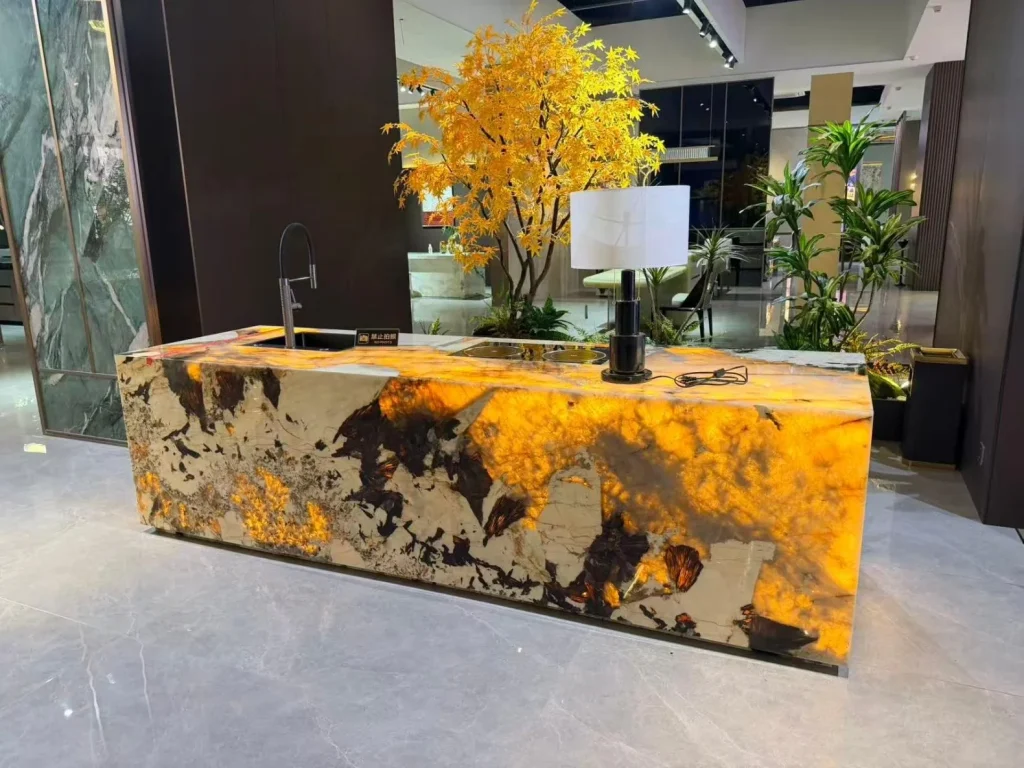
Some stone furniture can stay outdoors, but not every slab can. A 1,200 × 600 × 20 mm carbonate top weighs about 32–39 kg (71–86 lb); it needs perimeter support, drainage, and freeze-thaw testing before year-round exposure. Use quartzite or a proven travertine grade in open weather; keep marble, alabaster, and most onyx under cover.
Which stone and exposure combinations can work?
The material label is only the starting point: an exposed table must suit the slab, finish, base, drainage and local weather together. The matrix below separates open exposure from a sheltered porch, where rain and freezing are limited.
| Stone type | Open rain and freezing | Covered, well-drained outdoor area | Typical limit to verify | Source basis |
|---|---|---|---|---|
| Quartzite | Possible only after slab-specific testing | Usually the strongest starting point | Fissures, finish and point loads still matter | Quartzite geology |
| Travertine | Conditional on density, filling and freeze-thaw results | Good when water drains and the finish suits the use | Unfilled voids, salts and sealed water traps | ASTM C1527 |
| Limestone | Conditional; dense grades and test data are essential | Possible with a sheltered, drained setting | Absorption, acid exposure and freeze-thaw loss | Limestone geology |
| Marble | Not recommended without project-specific evidence | Covered patio only; spills and rain still reach the edge | Acid etching, staining and freeze damage | Marble geology |
| Onyx | Not recommended for exposed year-round use | Best indoors or fully protected from rain | Fissures, calcite weakness and backing details | Onyx definitions |
| Alabaster | Unsuitable | Keep away from rain, damp stone and wet planters | Gypsum alabaster is soft and water-sensitive | Alabaster |
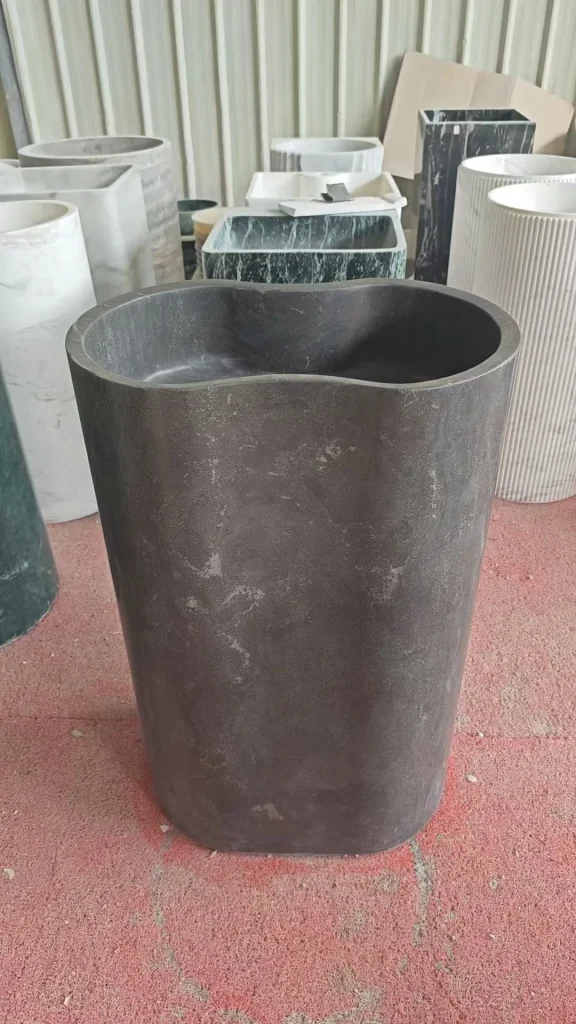
What fails first when stone furniture stays outside?
Water movement, acid exposure and unsupported edges usually cause trouble before the stone simply “wears out.” Each problem has a different remedy, so one coat of sealer cannot replace a complete outdoor specification.
Rain and freezing test the pores, joints and base
Rain alone does not make every stone fail. The risk rises when water enters open pores, seams, cracks or the gap between the top and base, then remains there through repeated freezing. Travertine’s natural voids make the filling choice important; marble and limestone can also absorb enough water to require evidence for the exact slab.
An outdoor table therefore needs a drainage path. Water should not sit in a tray-like recessed base, behind a retaining lip or under a solid plinth. Keep the underside ventilated and avoid soil or mulch touching the stone. In freezing climates, test the proposed slab and finish before treating the table as permanent site furniture.
Acid and staining affect carbonate stone even under a roof
Marble, limestone, travertine and calcite-based onyx contain carbonate minerals. Vinegar, citrus, some cleaners and acidic bird or leaf debris can etch these surfaces. Rain can dilute a spill, but it can also drive material into pores and continue the reaction at a sheltered edge.
Use a pH-neutral cleaner recommended for the specific stone, wipe food and drink spills promptly, and place coasters under acidic drinks. The Natural Stone Institute recommends identifying the stone before choosing a cleaner. A penetrating sealer can buy time by reducing absorption; it does not turn a carbonate surface into an acid-proof table.
Sun, heat and thermal movement are separate risks
An outdoor top expands and contracts while its base may move at a different rate. A dark polished top can also become uncomfortable to touch in direct sun. These effects do not have one temperature limit because slab mineralogy, finish, base material and joint design all change the result.
Use a trivet under hot cookware and leave a designed gap where the top meets a restrained frame. Avoid pouring cold water onto a hot top. If the design uses metal, specify drainage and corrosion protection rather than trapping water against the stone.
Thickness changes weight before it guarantees strength
At the same 1,200 × 600 mm plan area, a 20 mm carbonate top weighs roughly 32–39 kg (71–86 lb); a 30 mm top weighs roughly 48–58 kg (105–129 lb) across the density bands in this guide. The thicker slab is heavier and stiffer, but an unsupported overhang can still crack.
Support the perimeter and every cantilever as a structural condition. A pedestal should meet the top through a designed plate or load-distribution frame, not through a few small points. For heavy tops, check the floor, delivery route and number of people required before installation.
Finish changes slip resistance and how water leaves the face
Polished surfaces show reflections and can become slippery when wet. Honed, brushed or tumbled finishes reduce some shine and can alter how water beads or spreads, but the result still depends on the exact finish sample. Test the intended finish wet rather than assuming a finish name guarantees slip resistance.
Snow, salt and grit should be removed with tools that do not scratch the surface. Avoid burying the base in snow for the season. A cover can trap moisture unless it allows ventilation, so moving a table under shelter is often more reliable than wrapping it tightly.
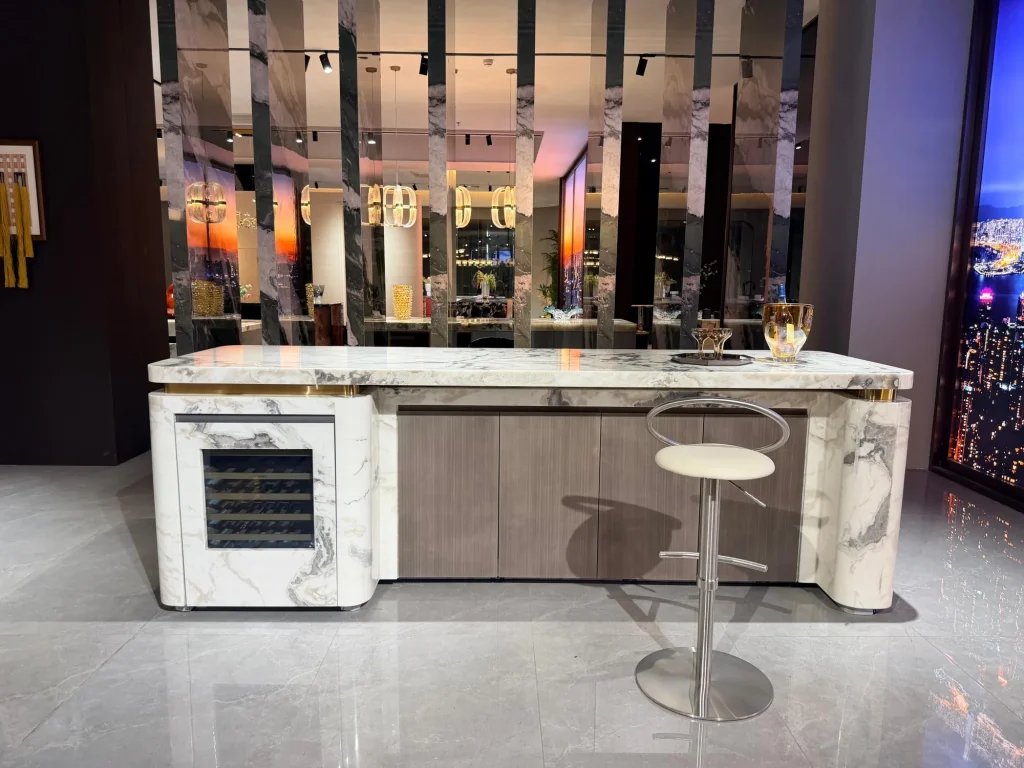
What should you verify for an outdoor stone table?
The collection lists dimensions and material names, but it does not classify every model as outdoor furniture. For example, model LAF-G032 is a 350 × 350 × 500 mm Beige Travertine side table, while model LAF-D001 is a 1,000 × 600 × 300 mm Shangrila Marble coffee table. The model names and dimensions describe shape and size, not frost resistance.
For a proposed table, ask the supplier to document the exact stone, finish, assembly, drainage, fastening and climate exposure. Request comparable outdoor service evidence for that combination, including exposure duration and maintenance, and review it before approving the specification. Treat outdoor placement as a project-specific decision rather than an assumption attached to the material name.
How should you specify a stone table for exterior use?
Start with exposure and work backward to slab, finish and support. A written schedule makes the supplier answer the same questions that a winter, a coastal season or a windy terrace will ask.
- Define exposure: fully open, covered but rain-driven, coastal, or freezing. Note the expected wet and freezing periods.
- Name the stone and finish precisely: commercial name, filled or unfilled where relevant, honed or polished, and backing details.
- Request durability evidence for that combination, not a generic “outdoor stone” statement.
- Draw the support and drainage: perimeter contact, overhang, fasteners, adjustable feet and clearance from soil.
- Test the care plan on a sample. Confirm cleaner, sealer and a response procedure for etching or staining.
- Plan seasonal handling before delivery. Heavy stone tops require a safe route, lifting equipment and a sheltered winter position where needed.
Which collections help you apply these choices to a real table?
The next decision is furniture type and material, not weather performance alone. Use the product collections to compare table shapes, then cross-check the stone guide before requesting an exterior specification.
Frequently asked questions about outdoor stone furniture
Can you leave a marble table outside in winter?
Only if the exact slab, finish, base and climate have passed a freeze-thaw review. Marble is carbonate stone, so rain, salts and acidic debris can alter the surface. A sealer slows absorption but does not make the stone frost-proof; move an unprotected table under cover or indoors before sustained freezing.
Is travertine better than marble for an outdoor bench?
Tested travertine is often the more practical carbonate choice because its finish can be selected around its natural voids. It is not automatically safer than marble. Filled or unfilled travertine, density, absorption and repeated freeze-thaw cycles all change the result. Specify the exposure and ask for a slab-specific durability document.
Does sealing make stone furniture frost-proof?
No. A suitable exterior sealer can slow water absorption, but it cannot prevent freeze damage if water still enters pores, joints or cracks. Choose a product intended for that stone and exposure, test it on the actual finish, and maintain drainage at the base. Reapplication belongs in the outdoor-care plan.
What base should an outdoor stone table have?
Use a base that supports the top around its perimeter and lets water drain away. A 1,200 × 600 × 20 mm carbonate top weighs about 32–39 kg (71–86 lb), so small pads or a narrow central support can overload the slab. Confirm the structural drawing and corrosion protection for the outdoor setting.
Who wrote this outdoor stone furniture guide?
The Amazstone Editorial Team wrote this guide and reviewed it against public stone references and the Amazstone collection for 2026. It distinguishes listed dimensions from engineering and weathering claims.
- Travertine is a form of limestone deposited by mineral springs, which explains both its carbonate chemistry and its visible voids.
- ASTM C1527 is a specification for travertine dimension stone; the selected grade, finish and intended exposure should be confirmed in writing for the proposed table.
- Natural Stone Institute stone care identifies the stone before cleaning and calls for suitable products; a generic acidic household cleaner is not safe for carbonate surfaces.
- The weight examples use nominal dimensions and the reference density bands in this guide; actual slabs vary, and bases, crates and packaging add weight.