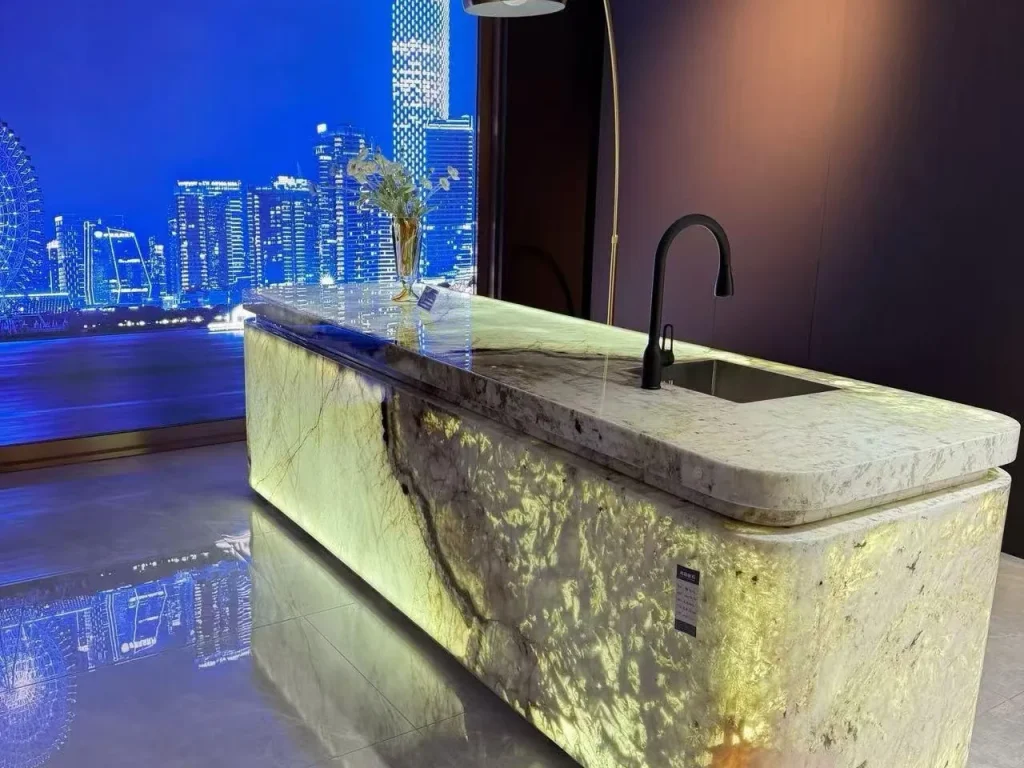
Choose quartzite when a table must tolerate acidic spills and abrasive contact with less surface change; choose marble when you want its carbonate-based veining and accept sealing, blotting and possible etching. At 20–30 mm thickness, the visual difference may be subtle while the maintenance difference is not.
What separates a marble tabletop from a quartzite tabletop?
The geological difference is fundamental: marble is dominated by carbonate minerals, while quartzite is dominated by quartz. Commercial naming complicates the decision because some stones marketed as quartzite look like marble and some suppliers use familiar names loosely.
| Property | Marble | Quartzite |
|---|---|---|
| Parent material | Limestone or dolostone altered by heat and pressure | Quartz-rich sandstone altered by heat and pressure |
| Dominant minerals | Calcite or dolomite | Quartz and related silicate minerals |
| Reference hardness | Calcite: 3 on the Mohs scale | Quartz: 7 on the Mohs scale |
| Typical bulk density | 2.5–2.8 t/m³ (156–175 lb/ft³) | 2.6–2.9 t/m³ (162–181 lb/ft³) |
| Acid resistance | Low because carbonate reacts with acid | Generally higher, though mineral inclusions and finishes vary |
| Stain tendency | Pores and fissures can absorb oil or pigment | Usually lower absorption, but natural defects require review |
| Scratch and abrasion | Softer face is easier to mark and refinish | Harder face resists many scratches and is harder to refinish |
| Heat response | Can suffer thermal shock; direct heat can damage finish | More heat-resistant in ordinary use, though thermal shock remains possible |
| Pattern | Veins, clouds and breccia can vary sharply across a slab | Veins, bands or fine grain can mimic marble |
| Fabrication | Easier grinding and polishing with carbonate-aware methods | Requires blades, tooling and dust controls suited to hard quartz |
| Repair | Etches and shallow marks are often refinishable | Chips can be filled; blending a new repair is harder |
| Best table role | Feature dining, coffee and console tops with controlled use | High-use dining and hospitality tops where acid resistance is valuable |
These density ranges come from the USGS stone glossary; the hardness references come from the Mohs scale. They are useful planning bands, not test results for a named slab.
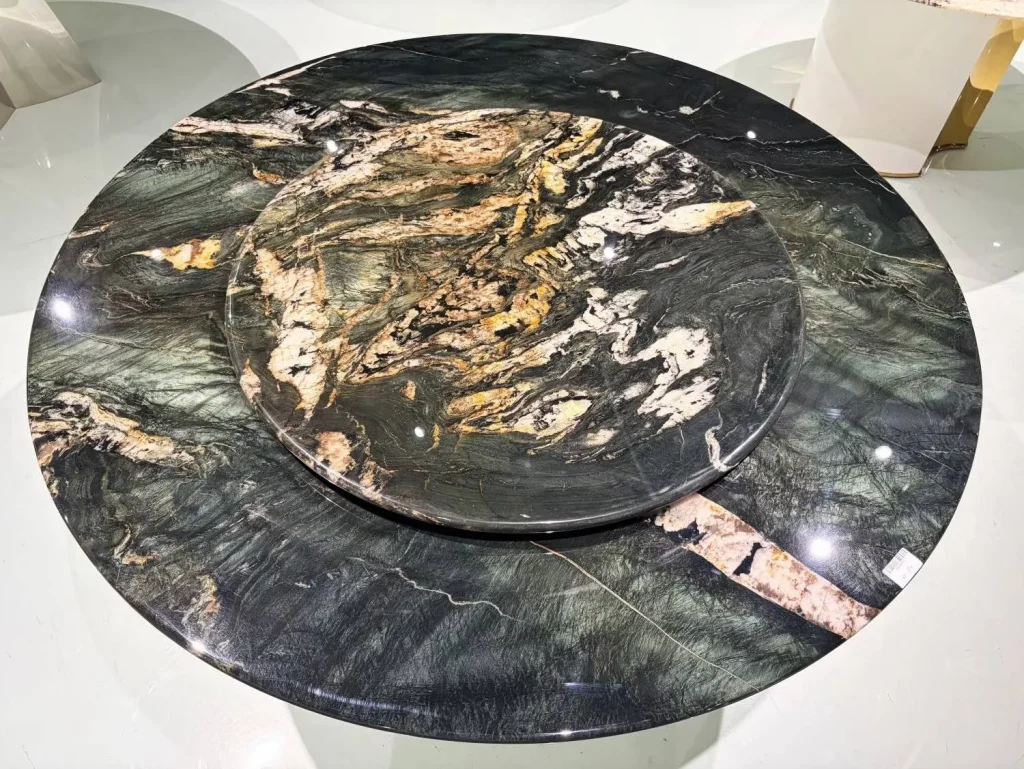
Why can a quartzite slab look so much like marble?
Quartzite can look like marble because heat, pressure and mineral fluids can create broad veins and movement during metamorphism. The label describes the rock’s composition, not a guaranteed colour scheme. White quartzite is often marketed for its marble-like face, which is also why buyers ask whether “Taj Mahal quartzite” is really marble.
Marble begins as a carbonate rock and recrystallizes into calcite or dolomite. Quartzite begins as a quartz-rich sandstone; in strong metamorphism, quartz grains recrystallize and fuse. A true quartzite should be dominated by quartz, but a transitional rock can contain enough carbonate or other minerals that acid response is not obvious from a photo.
Our current catalog illustrates the naming problem: it classifies 84 entries as marble and none as quartzite, while containing 84 engineered-stone entries. That describes our catalog labels, not proof that a quartzite slab can or cannot be supplied for a particular project.
Does quartzite resist lemon juice and red wine better than marble?
Quartzite generally resists household acids better than marble because quartz does not react like calcite. A red-wine or lemon spill is therefore less likely to create the chalky chemical etch associated with marble. Pigment can still enter a fissure, and any reactive mineral in the slab may leave an unexpected mark.
Do not turn “quartzite” into a guarantee of acid-proof performance. Resin fills, sealers, surface contamination and specific mineral inclusions can change the result. Clean any spill promptly with a pH-neutral stone product and test the exact cleaner on the proposed finish. The Natural Stone Institute care guidance distinguishes routine care from problem-specific treatment.
Marble’s reaction is more predictable at the material-family level: acidic food, wine, vinegar and many bathroom cleaners can dull a polished face because they attack carbonate. A sealer may reduce liquid absorption, but it does not convert the etched chemistry into a quartz surface.
Is quartzite too hard or too heavy for stone furniture?
Quartzite is harder and usually denser than marble, but those qualities do not make it unsuitable for furniture. Hardness changes cutting, edge-finishing and scratch behaviour; density changes transport and lifting. A 1,200 × 600 × 20 mm top at 2.9 t/m³ weighs about 41.8 kg (92.2 lb), compared with about 38.9 kg (85.7 lb) for marble at 2.7 t/m³.
The higher weight becomes important on large dining tops, narrow bases and upper-floor deliveries. The structure should be specified from the actual slab thickness and span rather than from a generic material name. A strong quartzite top can still crack if it is unsupported or lifted from an overhang.
Harder stone also affects repair. A shallow marble etch can often be refinished by a fabricator with familiar abrasives. Quartzite may need diamond tooling and careful control to restore the finish without leaving a visible patch. Ask who will maintain the table after installation and whether replacement slabs from the same batch will be reserved.
How do honed and polished finishes change the comparison?
Finish changes both appearance and maintenance more than many buyers expect. A polished quartzite can look glass-like and may show fingerprints, while a honed marble face can make water rings or oil marks more obvious. The chosen finish must be evaluated with the cleaning products and lighting used in the room.
Sealer requirements are stone- and finish-specific. A low-absorption quartzite may need little or no sealer in ordinary indoor use, while a fissured or honed marble may benefit from a tested penetrating product. Film-forming coatings can alter sheen and are not a universal substitute for routine care. Keep a written care sheet with the approved slab and finish.
Edge work also deserves a sample. A thick-looking mitred edge can make a 20 mm top read as 40 mm, but the joint must be fabricated and supported correctly. The article on how thick a marble table top should be explains the structural and visual questions that also apply to quartzite.

How can a buyer check whether a slab is marble or quartzite?
Use the written material declaration, the supplier’s source information and an acid test only on an approved sample. A photograph and a commercial name are not enough, especially when the face is white and heavily veined.
| Evidence | What it helps establish | Limit |
|---|---|---|
| Supplier declaration | The named material and intended classification | A label can be broad or inconsistent |
| ASTM quartzite reference | The specification framework the supplier cites | The standard does not identify a photograph |
| Acid spot test on a sample | Whether carbonate is conspicuously present | Resin, sealer and test method can obscure the result |
| Petrographic examination | Mineral composition and rock classification | More costly than an appearance review |
| Slab identification system | Traceability from approval to production | Requires disciplined batch controls |
The relevant public specifications are ASTM C503 for marble dimension stone and ASTM C1526 for quartzite dimension stone. The Wikipedia quartzite page is a plain-language introduction to the geological difference.
Which tabletop should a designer or homeowner choose?
Choose quartzite for a frequently used dining table when acid resistance, cooler visual character and harder surface matter more than easy refinishing. Choose marble when the exact vein composition is the reason for the table and the household will accept a documented care routine. Neither is a universal premium option.
| Requirement | Better starting point | What to settle first |
|---|---|---|
| Repeated acidic spills | Quartzite | Confirm the exact slab and finish |
| A specific marble-like vein | Marble | Approve the face and sealer on the actual slab |
| Easy local refinishing | Marble | Ask whether the finish can be matched |
| High-traffic dining | Quartzite | Review weight, support and edge protection |
| Tight budget with a fixed look | Neither assumed; compare quotes | Separate stone, fabrication and freight costs |
| Large thin-looking top | Either with a fabricated edge | Approve the structural drawing and support |
Where can the two stone families be compared as furniture?
The product format should make the material trade-off visible: a large dining top exposes weight and span, while a compact coffee table exposes daily spill response and edge handling.
For the natural-stone side of a project, start with the Natural Stone Materials Library and the Quartzite material guide. Marble tables can be compared through the marble dining table collection or the white marble dining table range. If a supplier mixes up manufactured quartz and natural quartzite, use Marble vs Granite vs Quartz for Tables to separate the three product categories.
Frequently Asked Questions
Author, update date and sources
Amazstone Editorial Team · Updated 28 October 2026