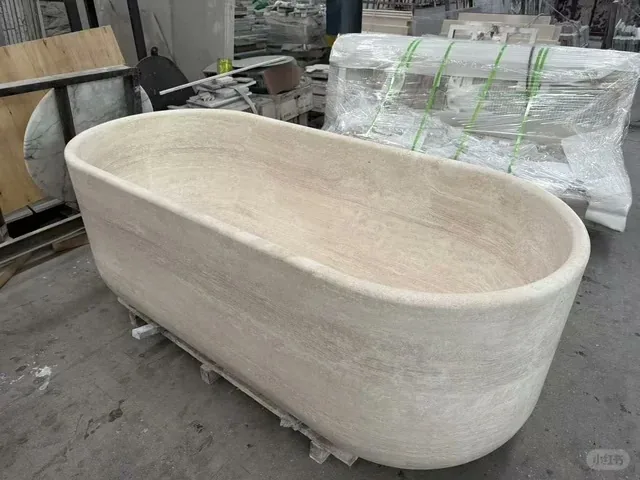
A 1,700 × 800 mm (66.9 × 31.5 in) rectangular tub filled to 500 mm (19.7 in) can hold up to about 680 L (180 US gal), weighing roughly 680 kg (1,500 lb) before the stone body and bather. Actual capacity is lower because the interior is rounded, so floor loading needs engineering review.
What bathtub sizes can I plan for?
Amazstone’s bathtub designs do not include outer size, wall thickness, net weight or water capacity. Plan around 1,600–1,800 mm (63–71 in) length and 550–650 mm (22–26 in) rim height as ranges, not published specifications.
| Detail | What is known | What to confirm |
|---|---|---|
| Available tub dimensions | Not provided for bathtub designs | Dimensional drawing for the exact tub |
| Common outer length | 1,600–1,800 mm (63–71 in) | Room, access path and comfortable internal length |
| Common rim height | 550–650 mm (22–26 in) | User height, step and surrounding floor |
| Water depth | Not provided | Overflow height and internal shape |
| Net tub weight | Not provided | Finished assembly weighed by the maker |
| Drain and overflow | Not specified | Drawing with trap access and waste position |
| Minimum order | 1 piece | Approved commercial terms |
| Production timing | About 20 days production + about 30 days shipping; production starts after deposit receipt and drawing confirmation | Quotation with a defined start event |
| Price basis | Bathtub quote on request through Contact | Comparable size, finish and delivery scope |
| Current stock | Yes, stock is available. | Sizes and quantities are not published |
The missing dimensions and mass are safety-critical, not minor copy details. A quotation should attach them to the exact design.
Which bathtub collection should be assessed?
Choose the material direction only after the installation route passes. A carved tub can be too large for a turn even when the bathroom floor area looks adequate on plan.
- Onyx bathtubs for a strongly patterned, slab-approved design.
- Travertine bathtubs for a filled linear stone surface.
- Marble material guide for the broader family context.
- Stone sinks for basin-scale drainage and care questions.
A smaller visual footprint does not automatically reduce structural risk if the shell remains thick and rigid. Confirm the section.
Which bathtub models can Amazstone supply?
Amazstone can supply stock bathtubs and custom designs from one piece. Share your bathroom plan and preferred stone through Contact to request the current bathtub list and a quote. Production takes about 20 days after deposit and drawing approval, followed by about 30 days for shipping; replies are provided within 24 hours.
Stock and custom production are available with a minimum order of 1 piece; request this category's product list.
Request product listStone stone bathtubs in our collection

Which stone is suitable for a bathtub?
Marble and filled travertine can be considered when the interior finish, drainage slope and maintenance routine are designed together. Onyx is a more visually variable choice that needs slab and structural approval. Quartzite offers a harder mineral reference, but its density and fabrication demands must suit the whole assembly.
| Stone | Density reference | Wet-area issue | Design condition |
|---|---|---|---|
| Marble | 2.5–2.8 t/m³ (156.1–174.8 lb/ft³) | Acid cleaners and etching | pH-neutral routine; tested wet slip finish |
| Travertine | 2.2–2.7 t/m³ (137.3–168.6 lb/ft³) | Open voids hold residue if unfilled | Filled interior and maintained sealer |
| Onyx | 2.4–2.7 t/m³ (149.8–168.6 lb/ft³) | Slab structure and colour vary | Approved block, backer and detailed care |
| Quartzite | 2.6–2.9 t/m³ (162.3–181.0 lb/ft³) | High mass and hard tooling | Engineered load path and fabrication plan |
The family ranges are not a tub test. See the ASTM C503 marble specification, ASTM C1527 travertine specification and Natural Stone Institute care guidance.
How much water load can a bathtub create?
Use internal dimensions and overflow height, not the outer shell, to estimate capacity. The table gives a rectangular upper bound; a rounded interior holds less, and a bather displaces additional water.
| Internal footprint × depth | Maximum water volume | Water mass |
|---|---|---|
| 1,500 × 700 × 450 mm (59.1 × 27.6 × 17.7 in) | 472.5 L (124.8 US gal) | About 472.5 kg (1,042 lb) |
| 1,700 × 800 × 500 mm (66.9 × 31.5 × 19.7 in) | 680 L (179.6 US gal) | About 680 kg (1,500 lb) |
| 1,800 × 800 × 500 mm (70.9 × 31.5 × 19.7 in) | 720 L (190.2 US gal) | About 720 kg (1,587 lb) |
These figures use 1 L of water at about 1 kg (2.2 lb). The empty tub, bather, surround and any standing water outside the shell add load. A structural engineer should evaluate the floor and load path for the final assembly.
Why must the stone tub be treated as a structural assembly?
A filled tub combines an uneven shell, a rigid base, plumbing interfaces and concentrated bearing points. The floor cannot be assessed from the outer footprint alone, and the delivery route cannot be assessed from a doorway measurement alone.
Ask for the empty weight, water capacity at overflow, support footprint, reinforcement, drain position, access panel and lifting points. The stone-weight calculator can establish the mass of a simple stone volume only; it cannot calculate a carved tub. A measured datum and drawing are required.
How should a stone bathtub be maintained?
Rinse the interior after use and remove soap residue with a pH-neutral stone cleaner. Dry the rim and visible surfaces to reduce mineral spotting. Avoid acidic descalers, bleach-based mixtures and abrasive pads unless the stone supplier has approved them for that exact finish.
Inspect the overflow, drain seal and accessible plumbing for leaks. Recheck the interior finish for slip and wear rather than resealing blindly. Marble etching and hard-water deposits require different treatments; the marble cleaning and etching guide explains the distinction.
What information is needed for a custom stone bathtub?
Provide the room plan, finished floor level, floor construction, drain and tap positions, bather dimensions, access route and local requirements. Mark an inspection opening and show every lift and turn on the route.
The custom stone furniture process covers drawing approval and production. An exact bathtub quotation must resolve commercial terms and engineering data together.
What should be checked before committing to a stone tub?
The answers below separate finished weight, possible upstairs installation, compact sizing and wet slip.
How much does a stone bathtub weigh?
A stone bathtub must be weighed as a finished assembly; density alone cannot reveal wall thickness, carving, hollowing, reinforcement or a plinth. A cubic metre of marble is about 2.5–2.8 tonnes, so even a substantial void still leaves serious mass. Require a measured net weight for the exact drawing before structural approval.
Can a marble bathtub go upstairs?
It can only be assessed after the exact weight, floor structure and transport route are known. Water adds about 680 kg (1,500 lb) for a 1,700 × 800 mm rectangular interior filled to 500 mm, before the tub and bather. A structural engineer should review the point loads and route, not just the door width.
What size freestanding stone bathtub fits a small bathroom?
A compact plan often starts near 1,500–1,600 mm (59–63 in) long, but the installed footprint also includes a tap deck, access gap and door swing. Check the clear floor area and the turning route. A smaller outer shell may still have a heavy, rigid plinth that is difficult to move.
Is a stone bathtub slippery?
Polished stone can become slippery when wet, so the internal base needs a tested finish and drainage slope. A honed or textured surface may improve grip but can retain more cleaning residue. Ask how the actual stone performs when wet and specify a finish that can be maintained without changing the fit or waterproofing.
Where can the bathtub project continue?
Project inquiry
Request a stone furniture quote
Send dimensions, material direction and quantity for a comparable reply.
Useful details include product type, finished dimensions, quantity and destination.
Who wrote this bathtub guide?
The editorial team updated this page on 2026-10-27. The bathtub designs do not include a complete specification, so capacity, floor load and access are presented as calculations to verify rather than product claims.