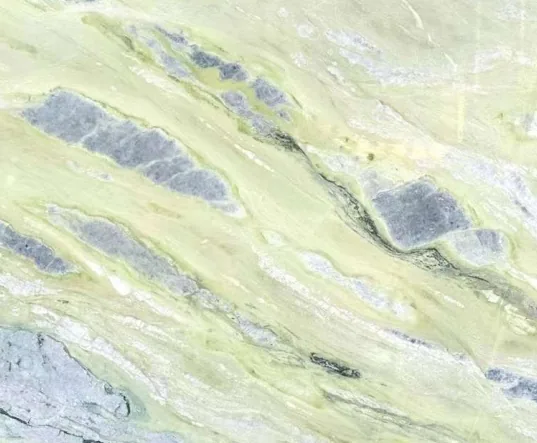
Rainforest Green Marble is a commercial green stone with brown-green veining and mineral inclusions. Our catalog places it at price tier 2 of 5 without naming a geological subtype. A sealed 20–30 mm (0.79–1.18 in) top may suit side or console tables after slab inspection; fissures and acids make wet or outdoor use a poor default.
What should I know about Rainforest Green Marble?
The catalog lists Rainforest Green in the green color family at tier 2 and gives the alias Rain forest green. It does not specify the quarry, mineral composition, absorption or structural grade.
| Parameter | Typical specification | Reference or detail to confirm |
|---|---|---|
| Type | Commercial marble | Catalog p.20 |
| Also known as | Rain forest green | Stone catalog p.20 |
| Origin | Ask for the exact Rainforest Green trade name, the quarry or region, a public source and the slab identifiers in the written offer. | Written-offer check |
| Appearance | Green ground with brown-green inclusions | Working appearance |
| Finish and backing | Require the written offer to specify finish, slab thickness and dimensions, treatment of fissures, and whether mesh, resin or a carrier reinforces the approved slab. | Written-offer check |
| Hardness | Slab untested; calcite reference 3 | Mohs |
| Bulk density | 2.5–2.8 t/m³ (156–175 lb/ft³) | Marble |
| Water absorption | Not provided | Test the selected finish |
| Price tier | 2 of 5 | Stone catalog p.20 |
| Slab availability | Not established | Inspect current lot |
| Best for | Side, console and selected dining tops | Inspect fissures |
| Avoid for | Uninspected spans and wet zones | Testing required |
| Outdoor use | Not recommended by default | Exposure testing needed |
What does the image show about Rainforest Green's appearance?
The reference image shows a green breccia, but it is not identified as a Rainforest Green slab. Use it only to judge possible color and inclusion variation.
Before layout approval, ask for the numbered slab, dry and wet faces, and close views of fissures. Check that brown inclusions do not form an unintended line through a sink, edge or bookmatched joint.
Why do Rainforest Green, Verde Alpi and Indian Green look different?
Rainforest Green is one commercial label, not a formula for every green stone. Its broad brown-green inclusions distinguish its working appearance; Verde Alpi, Verde Guatemala and Indian Green are separate trade labels. These descriptions do not certify minerals or hardness.
| Label | Visual starting point | What still needs checking |
|---|---|---|
| Rainforest Green | Broad brown-green inclusions | Fissures and face balance |
| Verde Alpi | Distinct dark-green field | Slab identity and tests |
| Verde Guatemala | Another green trade material | Invoice and face |
| Indian Green | Broad market label | Supplier and test data |
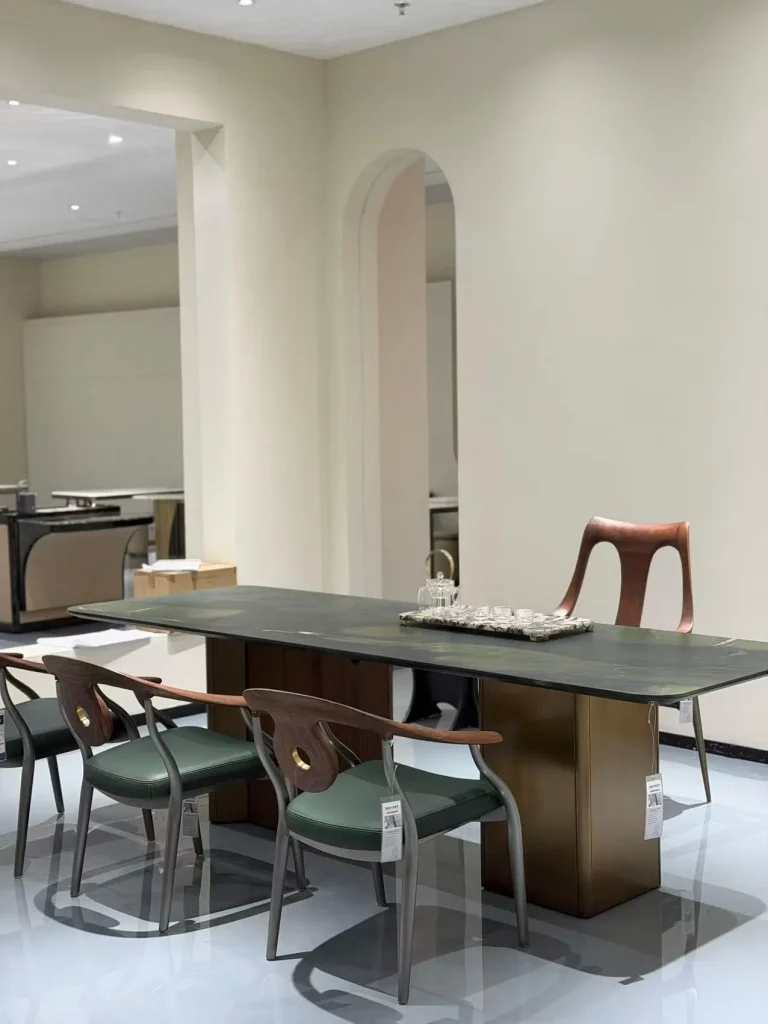
A dining top should be laid out across the full face so inclusions are balanced. For a pair, mark the centerline and review the mirror joint. Match approved slab numbers, not just the word “green.”
Which furniture types suit Rainforest Green's pattern?
Rainforest Green works best where its large pattern reads as a deliberate field: side tables, console tops and low-traffic dining tables. Narrow cuts can isolate an inclusion and look accidental.
| Furniture | Suitability | Condition |
|---|---|---|
| Side table | Good | Inspect every edge |
| Console top | Good | Set inclusion direction |
| Coffee table | Conditional | Large field and support |
| Dining table | Conditional | Inspect fissures |
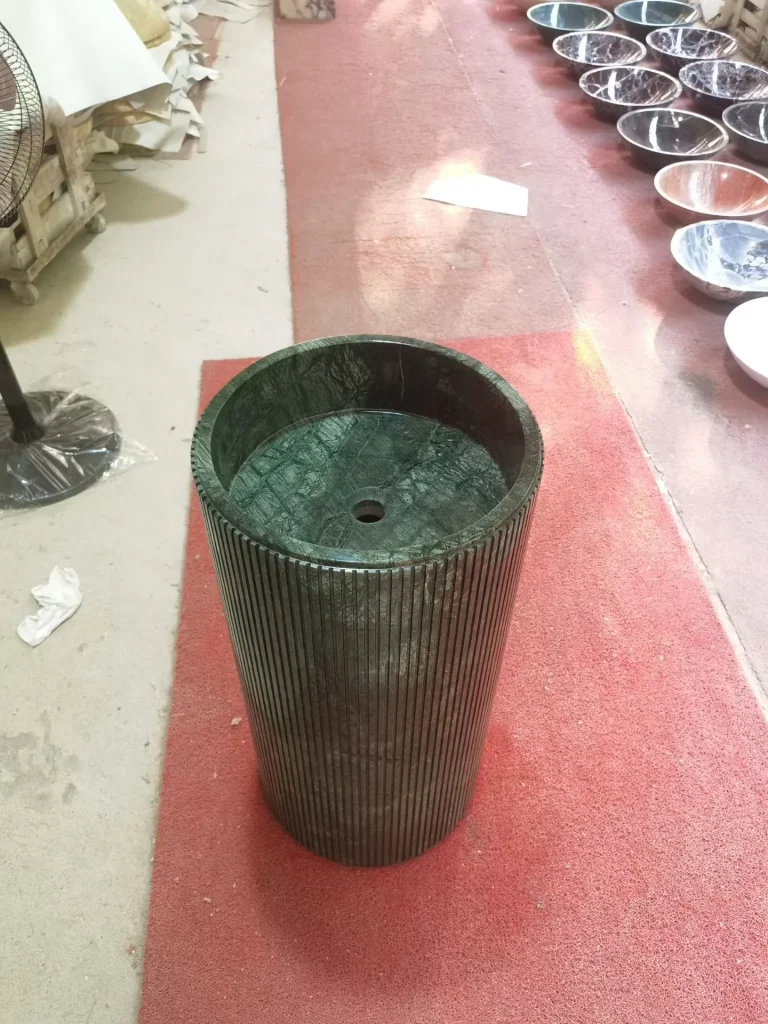
| Vanity or sink | Not preferred | Cutouts and water |
| Bathtub or outdoors | Avoid by default | No exposure testing |
What colors work with a Rainforest Green slab?
Use rust, terracotta, cream travertine, dark walnut or unlacquered brass to support the stone’s brown-green range. A second saturated green or a bright blue can compete with the inclusions; a clean warm neutral lets the slab act as the main pattern.
Keep the room’s lighting in the review. Under a warm lamp the brown inclusions become more prominent; under a cool source the green ground may look bluer. Compare the slab with upholstery, cabinet and wall samples at the intended furniture height rather than at eye level.
What does price tier 2 mean for a Rainforest Green project?
Tier 2 is one step above the catalog’s lowest stone-price group. It is not a dated monetary price and excludes fissure-conscious cutting, bookmatching, reinforcement and freight.
Quote amounts vary with the selected Rainforest Green slab grade, finished size and quantity. Share a slab photo and the finished dimensions on the Contact page for pricing. Check usable area around inclusions; equal headline rates can require different material quantities.
What are Rainforest Green's main weaknesses?
Visible inclusions and fissures are the first fabrication concern, followed by acid sensitivity. A crack, repaired vein or resin area may not fail immediately, but it changes where a cutout or mounting point can go.
Seal the approved finish and wipe with pH-neutral stone soap. Rinse wine, citrus, vinegar and cleaners promptly; avoid abrasive pads. Protect exposed edges and inspect joints. Natural Stone Institute guidance supports pH-neutral care but does not replace slab inspection.
Which green stones are close alternatives?
Verde Alpi is the closest named alternative, green onyx is more translucent and beige travertine is a warm neutral. Choose by face and structural review, not hue alone.
| Alternative | Difference | Link |
|---|---|---|
| Verde Alpi | Separate green trade material | Verde Alpi |
| Green onyx | Translucent bands and different care | Green onyx |
| Beige travertine | Warm neutral with pits | Beige travertine |
Which green furniture collections can I browse?
We do not currently offer Rainforest Green as a named finished piece. Browse the green collections for formats, then approve the actual slab and finish.
| Collection | Useful comparison |
|---|---|
| Green marble coffee tables | Inclusion layout |
| Green marble dining tables | Span and pattern |
| Green marble side tables | Small face and edge |
What should a Rainforest Green buyer inspect first?
Inspect the numbered slab for fissures, inclusions and backing before color approval.
Why does Rainforest Green Marble have brown markings?
Rainforest Green’s commercial appearance includes green ground with brown-green veining and mineral inclusions. Marks vary by slab; the catalog lists no mineral analysis. Inspect the numbered face before table layout or bookmatching. A small photograph can hide an inclusion that changes visual balance.
Is Rainforest Green Marble suitable for a dining table?
It can suit a low-traffic dining table after slab, fissures and backing are inspected and the top supported. Use coasters and wipe acidic spills promptly. A large table shows more variation than a side table, so approve the exact face. Wet or outdoor use is weaker.
Should Rainforest Green Marble be sealed?
Sealing is advisable for an absorbent finished slab, but the catalog states neither absorption nor a required sealer. Ask the fabricator to test the finish and follow sealer instructions. Avoid acids; sealing cannot replace fissure inspection or sound substrate support.
How does Rainforest Green differ from Verde Alpi?
Rainforest Green usually shows broader brown-green inclusions, while Verde Alpi has a separate pattern and lot range. Do not substitute one because both look green. Compare actual slab, finish, fissure map and invoice, then review the furniture layout. Keep both samples for approval.
Rainforest Green sources and review date
This guide uses the catalog for the trade name and price tier, together with visible-face guidance and public carbonate-stone references. A green trade name does not identify one mineral or quarry.