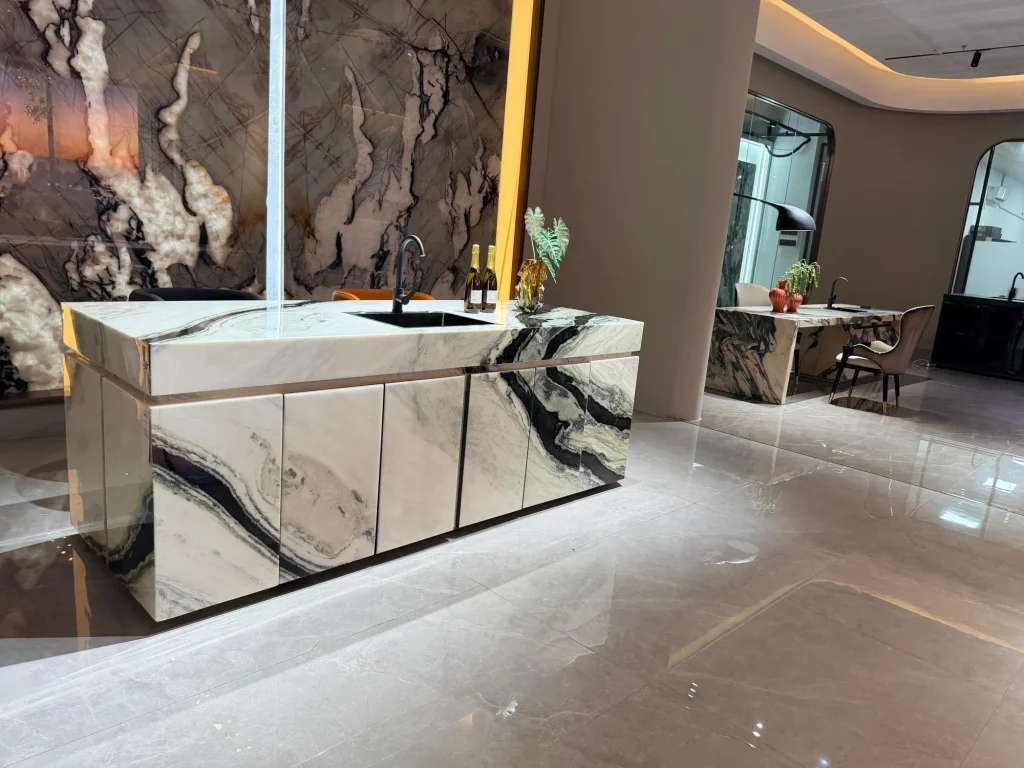
Clean travertine furniture with a pH-neutral stone cleaner, blot spills and avoid acidic cleaners. Test any impregnating sealer on a hidden 300 × 300 mm (12 × 12 in) area, then recoat only when water stops beading and the product label permits it.
What is the safest cleaning and sealing routine for travertine furniture?
The safe routine is to remove grit dry, clean with a pH-neutral product, control moisture and reseal only after a test. Filled and unfilled travertine respond differently because open pores give soil and liquid more places to collect. The finish matters too: a honed top can show rings and rub marks differently from a polished top.
| Situation | Do this | Avoid | Escalate when |
|---|---|---|---|
| Loose dust or sand | Wipe with a soft dry or barely damp cloth | Dragging grit across the face | Grit is trapped in open voids |
| Normal food residue | Use a pH-neutral natural-stone cleaner and a soft cloth | General-purpose acid bathroom cleaners | The cleaner changes gloss or color |
| Wine, citrus or vinegar | Blot immediately and rinse according to the stone product label | Rubbing the acid deeper into the surface | A dull mark remains after drying |
| Water ring | Dry the top and clean gently with a pH-neutral product | Heat guns, strong solvents or abrasive pads | The ring persists or the finish feels rough |
| Unfilled pores | Lift loose soil with a soft brush and neutral cleaner | Digging filler from adjacent filled areas | Pores hold dark residue or filler is loose |
| Sealer review | Place water on an inconspicuous area and follow product directions | Adding coats on a wet or contaminated surface | Water no longer beads or the surface darkens |
The table describes ordinary indoor furniture care, not a repair method for structural cracks, loose filler or severe etching. Those conditions need a fabricator who can inspect the finish and the backing.
Why does travertine furniture stain even when it has a sealer?
Travertine can stain because sealer reduces absorption rather than closing every pore permanently. It is a banded carbonate stone, and its visible voids are part of the structure. A coating can wear first at a table edge or around the most-used seating positions, so the top can look protected while one small area absorbs liquid.
How quickly should a spill be removed?
Remove the liquid as soon as it is noticed and blot rather than spread it. Acidic wine, citrus juice and vinegar are more urgent because carbonate stone can etch chemically; a stain means material has entered the surface, while an etch is a change to the finish itself. Do not wait to see whether the mark dries.
Does using more sealer make travertine waterproof?
No. Excess sealer can leave a film, trap moisture or change color, and it does not remove the need for prompt spill control. A sealer can make water bead for a time, but the result depends on the stone, finish, product and application. Follow the label’s number of coats and waiting time instead of adding coats because a surface looks dry.
Do filled and unfilled travertine need different care?
They need different attention, even when both are sealed. Unfilled travertine has open voids that can collect crumbs, red wine and cleaning residue; use a soft brush rather than digging at the pores. Filled travertine presents a flatter face, but filler can shrink, chip or age. If the filler changes color, repair should use a compatible filler and finish.
How often should travertine furniture be resealed?
Reseal by performance and test, not by a fixed calendar interval. Clean and dry a hidden 300 × 300 mm (12 × 12 in) area, put a small water drop on the surface and follow the sealer system’s directions for timing and coverage. A changed water-beading result may indicate a review, while darkening can mean moisture is present and further sealing should wait.
Which sealer and care details should you confirm?
Ask the supplier to name the exact sealer, the stone type and finish it has been approved for, and its coverage per container. A generic “stone sealer” label is not enough because travertine may be filled or unfilled and may have a honed, polished or textured finish.
Ask the supplier to name the exact maintenance product, its approved stone and finish, and the coverage stated by the manufacturer. Test it on a hidden area and follow the product instructions before applying it to the furniture.
Use the product label and a hidden-area test; note the cleaner, sealer, batch and application date on a maintenance card kept with the furniture.
How do you clean, test and seal a travertine table step by step?
The sequence is dry removal, gentle cleaning, full drying, a hidden absorption test, controlled sealer application and a long enough cure before normal use.
- Clear the top and wipe away dry grit with a clean soft cloth so it does not scratch the finish.
- Mix a pH-neutral natural-stone cleaner at the label’s dilution and clean a small section with a soft pad.
- Lift the cleaner with a clean damp cloth, then dry the surface fully and identify any remaining mark as residue, moisture or an etch.
- Examine the edge, filled pits and reverse face; water that stays dark or damp means the top is not ready for a coating.
- Test the sealer on a hidden 300 × 300 mm (12 × 12 in) area and compare color, gloss and water behavior after the label’s cure time.
- Apply complete, thin coats with the recommended applicator, wipe excess and follow the product’s dwell and between-coat directions.
- Keep liquids and heavy objects off the surface for the full cure period, then test again before treating the whole top.
Do not seal over an etched or scratched area and expect the finish to be restored. Mechanical polishing changes the stone surface and should be reviewed against the original finish. If the table has a backlit or meshed top, confirm that the coating and cleaning method are compatible with the backing.
Which travertine furniture and care pages should you read next?
The care routine is similar across travertine pieces, but the shape and finish change where soil collects. A low coffee table receives drinks and foot traffic, a console is often reached from one side, and a larger dining top has more seating-edge exposure.
- Travertine Coffee Tables for low tables with exposed edges.
- Travertine Console Tables for narrow tops and wall-side care.
- Silver Travertine for the gray color grade and fill decisions.
- Travertine vs Marble for a material comparison.
Frequently asked questions
Can white vinegar be used to clean travertine furniture?
White vinegar is an acid, and travertine is a carbonate stone that can etch when acid remains on the surface. Use a pH-neutral stone cleaner instead. For a greasy mark, choose a product labeled for natural stone rather than strengthening vinegar or lemon. Blot the cleaner dry, rinse if the label directs and test any unfamiliar product on a hidden corner first.
Will sealing stop a travertine table from staining?
Sealing slows liquid absorption, but it does not create a permanent barrier against every stain. Oil, red wine and rust can still enter through pores or reach an unprotected edge, especially on unfilled travertine. Wipe spills promptly, maintain the finish and repeat the water-beading test before assuming another sealer coat is needed.
Should you wax travertine furniture?
Wax is not the default maintenance treatment for travertine furniture. It can build in pores, collect soil and change the appearance of a honed or filled finish. Use a sealer specified for the tested stone and finish, or follow the care system supplied with the piece. Any coating should be compatible with the existing finish and removable without damaging it.
How do you treat a wet-glass ring on travertine?
Blot the liquid first and identify whether the mark is surface residue, moisture in a pore or an etch. Clean gently with a pH-neutral stone product and dry the area. If the mark remains, ask a stone fabricator to inspect and polish the finish; scrubbing or applying an acid is likely to enlarge carbonate stone damage.
Who wrote this travertine care guide?
Amazstone Editorial Team. Written for furniture owners and installers; based on the Amazstone catalog, 2026, and public stone-care guidance. Last updated: 2026-10-28.