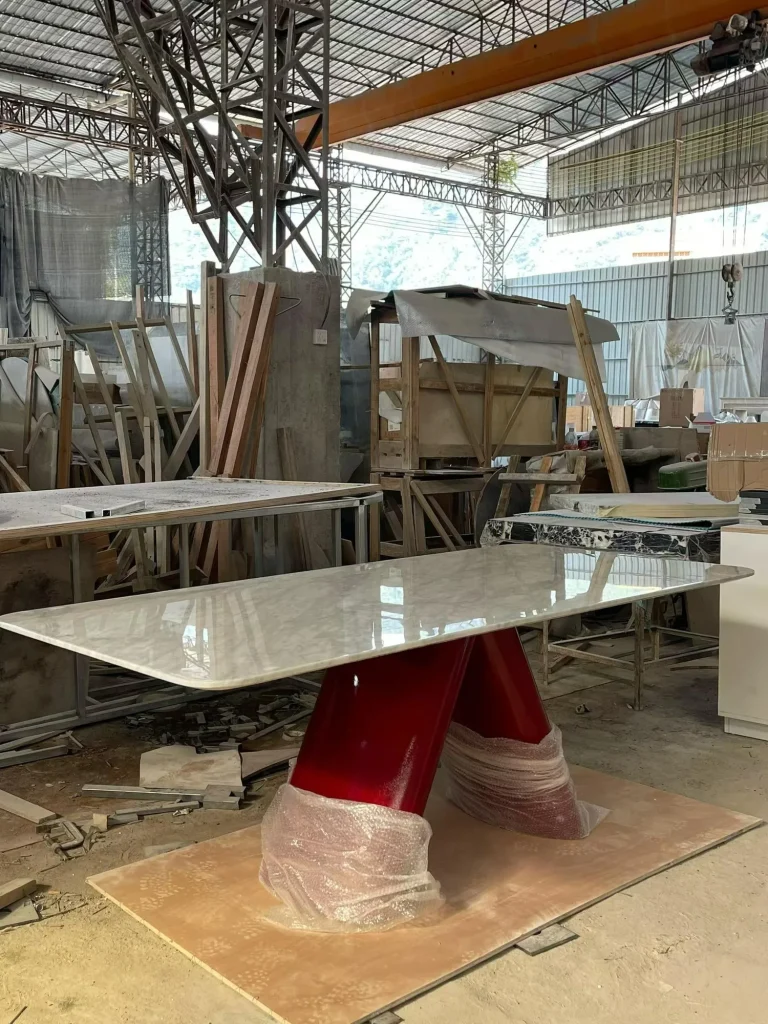
A 1,200 × 600 × 20 mm (47.2 × 23.6 × 0.79 in) marble top at 2.7 t/m³ (168.6 lb/ft³) weighs 38.9 kg (85.7 lb); at 12 mm (0.47 in): 23.3 kg (51.4 lb); at 30 mm (1.18 in): 58.3 kg (128.5 lb). Add base, reinforcement and crate.
What do common stone table-top sizes weigh?
The static table below uses representative densities within the public ranges in the methodology. It is deliberately more conservative than a calculator that assumes every marble has the same density. A fabricator should replace the representative value with the tested density or a measured sample for the selected stone.
| Top size and thickness | Marble at 2.65 t/m³ (165.4 lb/ft³) | Travertine at 2.45 t/m³ (153.0 lb/ft³) | Onyx at 2.55 t/m³ (159.2 lb/ft³) | Quartzite at 2.75 t/m³ (171.7 lb/ft³) | Limestone at 2.40 t/m³ (149.8 lb/ft³) |
|---|---|---|---|---|---|
| 1,200 × 600 × 12 mm (47.2 × 23.6 × 0.47 in) | 22.9 kg / 50.5 lb | 21.2 kg / 46.7 lb | 22.0 kg / 48.6 lb | 23.8 kg / 52.4 lb | 20.7 kg / 45.7 lb |
| 1,200 × 600 × 20 mm (47.2 × 23.6 × 0.79 in) | 38.2 kg / 84.1 lb | 35.3 kg / 77.8 lb | 36.7 kg / 81.0 lb | 39.6 kg / 87.3 lb | 34.6 kg / 76.2 lb |
| 1,200 × 600 × 30 mm (47.2 × 23.6 × 1.18 in) | 57.2 kg / 126.2 lb | 52.9 kg / 116.7 lb | 55.1 kg / 121.4 lb | 59.4 kg / 131.0 lb | 51.8 kg / 114.3 lb |
| 1,400 × 700 × 20 mm (55.1 × 27.6 × 0.79 in) | 51.9 kg / 114.5 lb | 48.0 kg / 105.9 lb | 50.0 kg / 110.2 lb | 53.9 kg / 118.8 lb | 47.0 kg / 103.7 lb |
| 1,600 × 800 × 20 mm (63.0 × 31.5 × 0.79 in) | 67.8 kg / 149.6 lb | 62.7 kg / 138.3 lb | 65.3 kg / 143.9 lb | 70.4 kg / 155.2 lb | 61.4 kg / 135.5 lb |
| 1,800 × 900 × 30 mm (70.9 × 35.4 × 1.18 in) | 128.8 kg / 283.9 lb | 119.1 kg / 262.5 lb | 123.9 kg / 273.2 lb | 133.7 kg / 294.6 lb | 116.6 kg / 257.1 lb |
These are stone-volume estimates, not product net weights. A laminated edge, solid base, steel reinforcement, sink cut-out or hollow core changes the total. Use the table to screen a design, then weigh the actual construction.
How do I calculate an untabulated stone size?
Enter the finished stone footprint in millimetres and use a density that represents the actual material. The calculator reports the solid-stone mass in kilograms and pounds; it does not add a base, resin backing, crate or pallet.
Stone volume calculator
Estimated stone weight: 38.9 kg (85.7 lb).
Estimate only. The result excludes the base, reinforcement, cut-outs, packing and pallet.
Which weight figures still require measurement?
The dimensions on this page are catalog sizes, not measured furniture weights. The formula and static table provide estimates with stated conditions; ask for dated net and gross weights and a calculation review for the selected item when weight is needed for transport.
| Weight detail | What to ask for | Important limit |
|---|---|---|
| Dated scale data | Ask for the selected item’s dated net and gross weights, scale documentation and packed dimensions; the table above remains a calculated estimate. | Do not turn a calculated weight into a measured claim. |
| Calculation basis to review | Ask which density range and public source support the estimate, and request measured data for the selected product when weight affects lifting or freight. | Keep a public density range separate from a tested value. |
How was the weight table calculated?
Weight is volume multiplied by density. Convert millimetres to metres by dividing by 1,000, multiply length × width × thickness to obtain cubic metres, then multiply by tonnes per cubic metre. Multiply tonnes by 1,000 for kilograms, and kilograms by 2.2046226218 for pounds.
| Material group | Public bulk-density range | Reference |
|---|---|---|
| Marble | 2.5–2.8 t/m³ (156.1–174.8 lb/ft³) | Marble |
| Travertine | 2.2–2.7 t/m³ (137.3–168.6 lb/ft³) | Travertine |
| Onyx | 2.4–2.7 t/m³ (149.8–168.6 lb/ft³) | Onyx |
| Quartzite | 2.6–2.9 t/m³ (162.3–181.0 lb/ft³) | Quartzite |
| Limestone | 2.1–2.7 t/m³ (131.1–168.6 lb/ft³) | Limestone |
- The public Marble reference supports treating commercial marble as a natural stone group whose density varies by composition.
- The Mohs scale separates calcite hardness from quartz hardness; it does not estimate table weight.
- The USGS stone glossary supplies terminology for dimension stone and distinguishes stone from a finished assembled product.
- The Natural Stone Institute advises care based on the specific stone and finish, rather than a universal cleaner.
A representative midpoint or reasonable value is used only for the static table. The answer box deliberately uses 2.7 t/m³ (168.6 lb/ft³) to make that assumption visible. If the fabricator supplies a tested density of 2.61 t/m³ (162.9 lb/ft³), recalculate with 2.61; do not retain the default because the colour looks similar.
How should a buyer use the calculated weight?
Use the stone estimate during concept design, then replace it with packed load data before transport, floor review or installation. The most common error is comparing a top-only estimate with a supplier’s gross crate weight.
For delivery access, document door width, stair turns, lift capacity and the largest unpacked dimension. For floor loading, provide the structural engineer with the total table load and its footprint; a heavy top concentrated on a small plinth has a different effect from the same weight spread over a broad base. For installation, identify lift points and use trained installers. A 51.9 kg (114.5 lb) top at 1,400 × 700 × 20 mm (55.1 × 27.6 × 0.79 in) is a two-person mathematical split, but grip, stairs and local lifting rules still govern the safe method.
Use the custom marble table-top collection when replacing a top, the travertine coffee-table collection to compare complete furniture, and the thickness and support guide to choose 12, 20 or 30 mm (0.47, 0.79 or 1.18 in) construction. The natural stone materials library identifies the named material before a density is selected.
How can I cite these weight estimates?
Cite the page title, access date, formula, dimensions, thickness and density assumption together. A useful citation states: “Stone Furniture Weight Chart & Calculator, accessed 2026-10-27; solid stone estimate calculated as length × width × thickness × 2.7 t/m³ (168.6 lb/ft³); excludes base and packing.”
Do not cite a calculator result as a scale measurement. If a row is copied into a specification, preserve metric and imperial values and identify whether it describes the stone, the assembled table or the packed crate. That distinction lets another reviewer reproduce the calculation.
When was this calculator last checked?
The formula, static examples and public density ranges were checked on 2026-10-27. The calculator logic and published range should be reviewed whenever the density basis or unit conversion changes.
The scale readings described above are not published measurements. To replace an estimate in a transport document, request the measurement date, scale evidence and gross-weight basis for the selected item.
What weight questions matter most before fabrication?
Thickness and material set the stone estimate, but the packed load and installation route determine whether the design can be delivered safely. Ask for both numbers rather than using one weight for every purpose.
How much does a 30 mm marble table top weigh?
At 2.7 t/m³, a 1,200 × 600 × 30 mm solid marble top weighs about 58.3 kg (128.5 lb). A 1,600 × 800 × 30 mm top weighs about 103.7 kg (228.6 lb). Those figures cover the stone volume only. Add the base, reinforcement, crate and any packaging to obtain the shipping weight.
Why does changing table-top thickness change weight so much?
Weight rises in direct proportion to thickness when length, width and stone remain the same. Moving from 12 mm to 30 mm increases the stone volume by 2.5 times. A 1,200 × 600 mm marble top therefore rises from about 23.3 kg (51.4 lb) to 58.3 kg (128.5 lb) at 2.7 t/m³.
What weight should I give a freight forwarder?
Give the measured gross weight and packed dimensions for each crate, not the calculator’s stone-only estimate. If a scale reading is unavailable, provide the calculated stone weight as a clearly labelled estimate and add the documented base, reinforcement, crate and cushioning weights. The forwarder also needs the number of pieces and lifting points.
How many people should lift a solid stone table?
The lifting plan depends on the measured load, grip points, stairs and local safety requirements, not just weight divided by headcount. A 100 kg (220 lb) top is a two-person mathematical split but may still exceed a safe team lift. Use trained installers, mechanical lifting where practical, and a site-specific plan for heavy or awkward pieces.
Who prepared this calculator, and what are its limits?
The editorial team prepared this tool on 2026-10-27 to support early sizing and logistics checks. It is a geometry-based estimate, not a substitute for a tested density, a calibrated scale or an engineer’s floor assessment.
Sources and method: Marble, Travertine, Onyx, Quartzite, Limestone, and the USGS dimension-stone glossary.