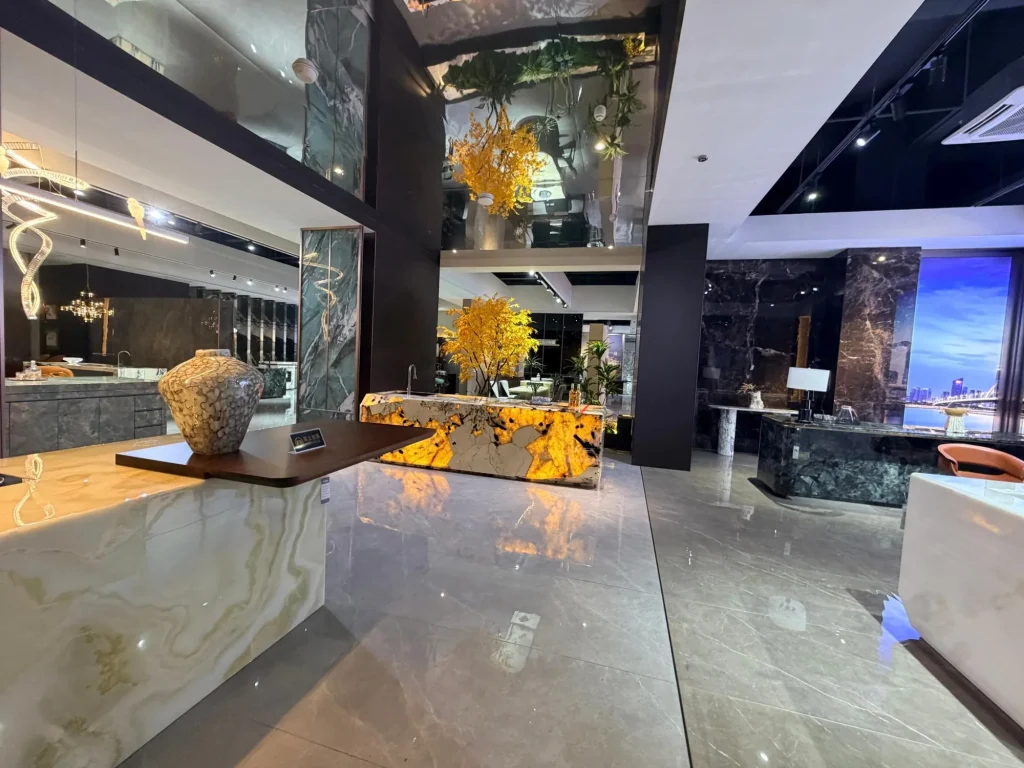
Natural marble suits a table when slab variation and refinishing matter; sintered stone suits repeatability and easier cleaning. A 1,200 × 600 × 20 mm marble top at 2.7 t/m³ weighs about 38.9 kg (85.7 lb), excluding base and packing. Approve the exact finish and support plan before ordering.
We also supply engineered stone, a manufactured material that is clearly identified as not natural stone on our engineered stone page.
How do real marble, faux, cultured and sintered surfaces compare?
The four labels describe different products, not four grades of the same stone. Natural marble is quarried; a “faux” finish may be patterned or coated; cultured marble is commonly a cast mineral-and-resin composite; and sintered stone is a manufactured, heat-processed slab. Product-specific testing always overrides a broad category.
| Check | Real marble | Faux / decorative marble | Cultured marble | Sintered stone | How to verify |
|---|---|---|---|---|---|
| Material | Quarried stone | Decorative film or coating over a substrate | Molded mineral-and-resin composite | Pressed and fired mineral slab | Read the material declaration and edge. |
| Pattern | Slab-to-slab variation | Often repeats | Usually uniform | Repeatable by batch | Compare actual faces in one light. |
| Acid | Calcite can etch | Coating-dependent | Resin-dependent | Generally more resistant | Use a finish-specific chemical report. |
| Scratches | Softer than quartz | surface pattern can reveal the core | Resin can mark | Usually harder | Use abrasion data, not a key test. |
| Heat | Thermal-shock and sealer risk | Film may blister | Resin may scorch | Higher tolerance, still limited | Keep the maker’s temperature limit. |
| Stains | Pores and finish control risk | broken surface pattern is hard to hide | Gel coat controls risk | Low absorption is common | Test the specified spill. |
| Weight | 38.9 kg (85.7 lb) for 1,200 × 600 × 20 mm at 2.7 t/m³ | Substrate-dependent | Thickness-dependent | Formulation-dependent | Weigh the actual top. |
| Repair | Often rehoned or patched | Film repair is visible | Gel-coat match varies | Chip repair may be visible | Agree on an acceptance test. |
| Outdoors | Test stone, finish and freezing | Usually unsuitable | Not a default choice | Only with an exterior rating | Require written approval. |
| Best fit | Visible stone character | Protected, decorative use | Molded composites | Repeatable, busy homes | Start with use and approved sample. |
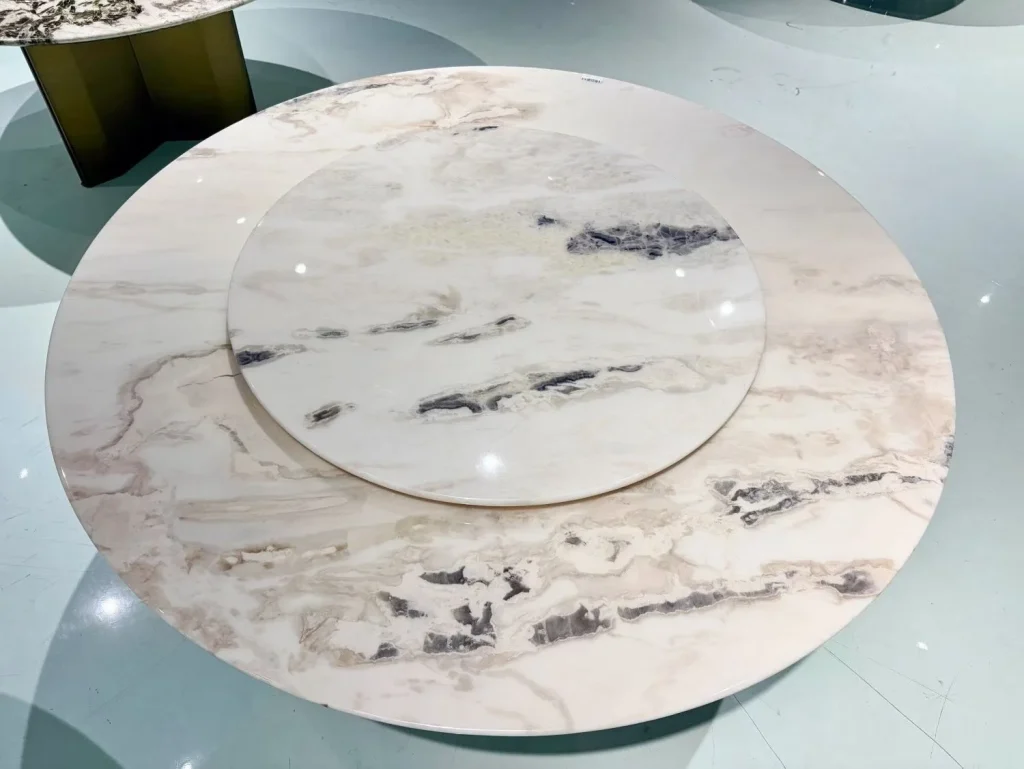
What changes when stone is patterned, cast or sintered?
The manufacturing route changes matching, repair and cleaning. Never specify any option from a photograph alone.
Decorative faux marble is a surface effect
Faux marble may be a decorative laminate, wrapped film or paint. The edge and back reveal whether the pattern continues through the panel. Check span capacity, finished edges and whether heat or moisture can lift the decorative layer.
Cultured marble is a cast composite
Cultured marble commonly combines mineral filler, resin and a gel coat. It is not a natural slab. Heat, solvents and scratches may affect the resin differently from marble, so the exact care sheet controls.
Sintered stone is a fired manufactured slab
Sintered stone is made under industrial pressure and heat. It often has repeatable pattern and good acid or scratch resistance, but body, edge strength and substrate needs vary. Confirm heat and exterior ratings for the named product.
Natural marble is the only option with a quarry face
The catalog includes Calacatta Viola, Arabescato Corchia, Nero Marquina and Verde Alpi. Two slabs can differ under one commercial name. Inspect the actual block before approving a pair or book-match; see the Calacatta Viola material guide.
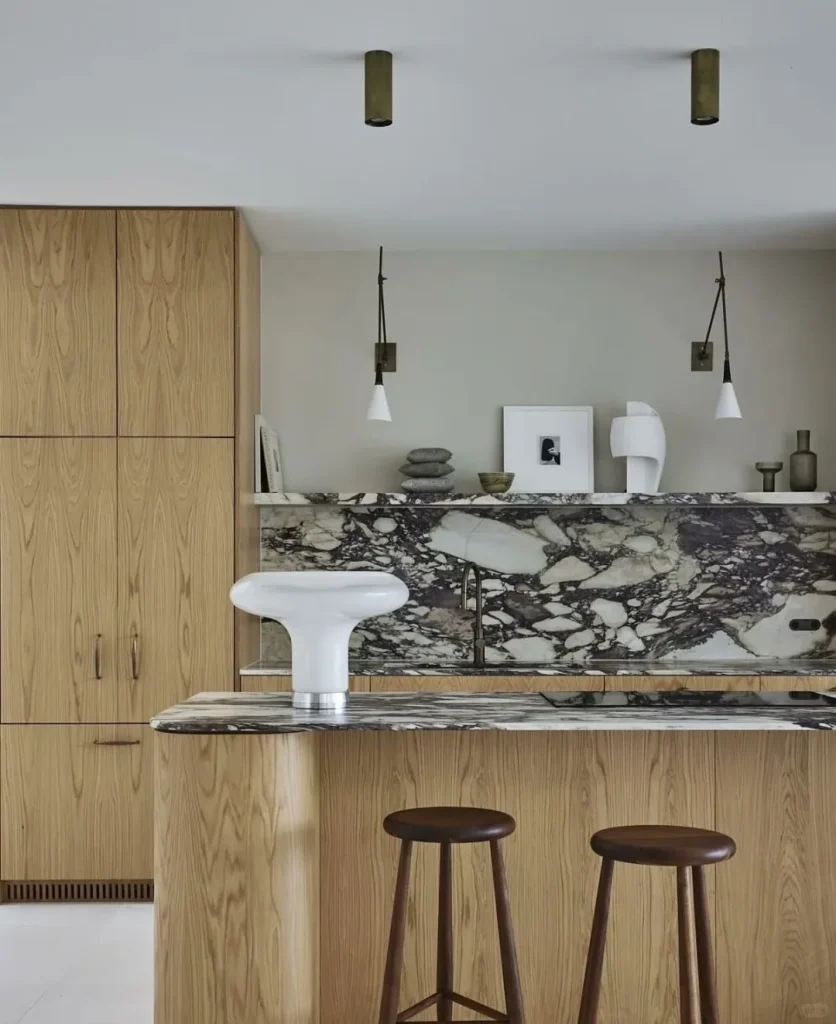
Can you tell real marble from the alternatives at a glance?
No single glance, scratch or drop test proves the material. Use the written declaration first, then inspect the edge, back, pattern repeat and a sample of the actual production finish.
- Read the specification. Look for “natural marble,” “engineered stone,” “cultured marble,” “porcelain” or the manufacturer’s exact product family. A decorative name is not a material declaration.
- Inspect an unfinished edge. Natural stone continues through the slab, although veins can turn. A patterned surface, thin facing or moulded core may show a different substrate.
- Compare pattern repetition. Repeatable faces suggest a manufactured pattern or batch process, but some natural stones can also be book-matched. Repetition is evidence to investigate, not a verdict.
- Check the back and weight. Mesh, resin backing, a substrate or an unexpectedly low weight can indicate a manufactured assembly. A solid stone top still needs a measured density or weight before lifting.
- Ask for the maintenance route. A fabricator should be able to say whether the finish can be rehoned, spot-repaired or only replaced. An instruction to “use mild soap” is not enough for a dining or coffee table.
Do not use a key, acid or boiling cup as a destructive showroom test. Marble is soft enough to be marked by grit, and the result may damage a sample without proving the composition. For a border case, request a laboratory or supplier material statement rather than treating an internet visual test as proof.
When should I choose real marble, and when is manufactured stone better?
Choose real marble when the table is a design object, the exact slab is approved, and the owner accepts variation plus a stone-care routine. Choose a manufactured surface when repeatability, a specific stain or heat requirement, or a lighter assembly is the controlling need.
| Choose natural marble if… | Choose sintered stone if… |
|---|---|
| The specific slab is the focal point and visible variation is desirable. | Two or more tops must repeat closely across a project. |
| A fabricator can rehone, polish or patch the chosen finish. | The product has a documented acid, scratch and heat performance that matches use. |
| Weight, support and delivery access have been checked. | Thin-panel fabrication and substrate requirements are understood. |
| The owner accepts etching risk and will use coasters and trivets. | The owner prefers a simpler routine within the manufacturer’s limits. |
Decorative faux marble belongs in a different decision: choose it only when the decorative surface, substrate and edge detail meet the table’s use. It is not a cheaper grade of the same quarried slab. Cultured marble is a separate composite choice, typically for moulded forms rather than a direct substitute for a large solid table top.
Which stone tables should I compare after choosing natural marble?
Move from the material category to a specific top size, structure and finish before comparing prices. The stone name determines appearance and care, while the base, span, thickness and edge control how the table performs.
For a deep inventory of colours, start with marble and stone coffee tables. Compare Calacatta Viola coffee tables for a dramatic slab face, black marble coffee tables for dark contrast, or white marble coffee tables when the room needs a lighter field. If the top is being replaced rather than bought as a complete table, use the marble table-top collection and read the table-top thickness guide before accepting a span.
What else should a buyer ask before choosing between real and manufactured stone?
The decisive questions are not “real or fake” in isolation. They are whether the exact material suits the room, whether an approved sample is being supplied, and whether the fabricator can support the finished weight and repair the chosen finish.
Is faux marble real marble?
No. Faux marble describes a patterned or coated finish made to look like stone; it is not a slab cut from a quarry. Check the substrate, edge, backing and written material declaration, because faux products vary from laminates to molded composites. A pattern match alone does not establish what the surface is made from.
Is sintered stone a type of cultured marble?
No. Cultured marble is a cast composite commonly built from mineral filler and resin, while sintered stone is a fired manufactured slab. They can look alike, but their fabrication, heat response and repair methods differ. Ask for the manufacturer’s exact composition, finish and test report instead of relying on a showroom label.
Why is a solid marble tabletop so heavy?
A solid marble top is a continuous block of dense stone. At 2.7 t/m³, a 1,200 × 600 × 20 mm top weighs about 38.9 kg (85.7 lb) before the base or packing. Increasing thickness to 30 mm raises that stone estimate to about 58.3 kg (128.5 lb), so lifting and support need checking first.
Can a stained real marble tabletop be restored?
Often yes, depending on stain depth, stone porosity and finish. A fabricator may poultice a stain, rehone a light etch or refinish the surface, but damage beside a filled fissure or deep resin stain may leave a visible trace. Inspect the exact slab and agree on a trial area before treatment.
Which surface resists a hot coffee cup better?
A sintered or porcelain surface is usually more tolerant of brief heat than resin-based cultured marble, although every product and finish has limits. Natural marble can crack under sudden temperature change and may etch from acidic spills. Use a trivet for all four materials and follow the specific manufacturer’s heat guidance.
Who prepared this comparison, and which sources support it?
The editorial team prepared this comparison on 2026-10-27 as a specification aid, not a laboratory identification service. It uses public material definitions and applies them to furniture decisions without assigning an unverified brand rating.
Sources: Marble, Engineered stone, Cultured marble, Mohs hardness scale, and the Natural Stone Institute stone-care guidance.
- Marble is a natural stone whose calcite content makes it vulnerable to acidic cleaners; consult the Marble reference.
- Manufactured quartz surfaces are covered by the public term engineered stone, which is distinct from a quarried slab.
- Cultured marble is a molded composite rather than a natural-stone slab; see the Cultured marble reference.