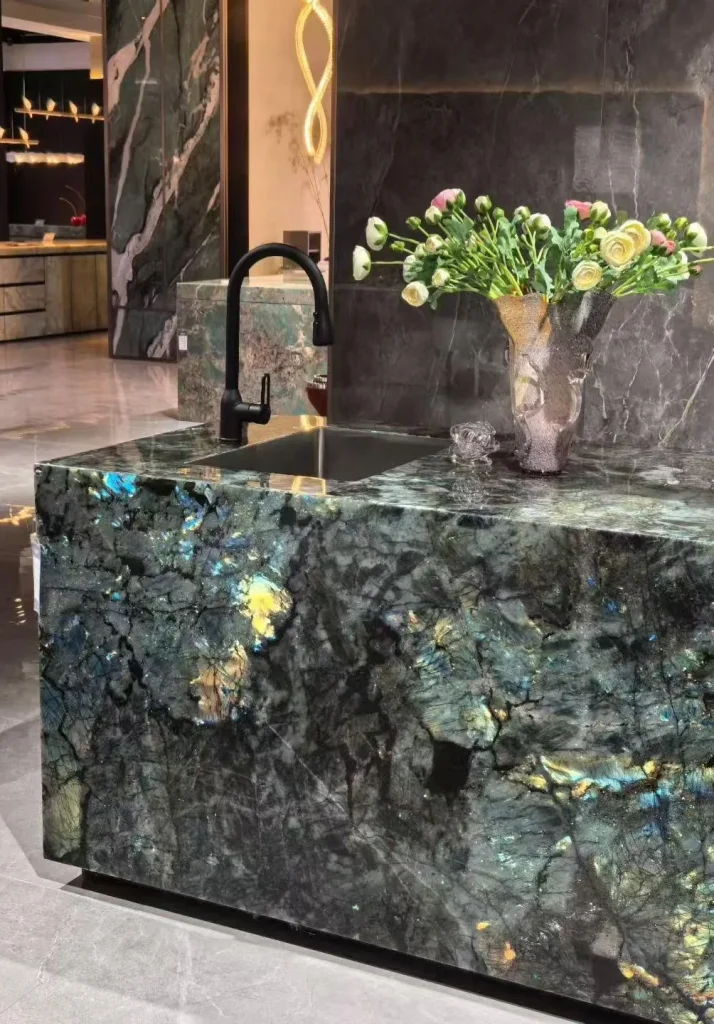
For a busy dining table, choose engineered quartz when a repeatable pattern and easier stain control matter most, granite when acid resistance and a natural mineral pattern dominate, and marble when its veining justifies sealing and careful spill control. At 20 mm thickness, the material choice affects care more than basic support.
How do marble, granite and engineered quartz compare on a tabletop?
The comparison starts with what each material is. Marble and granite are natural stone; “quartz” in furniture usually means engineered quartz surface, not quartzite. That distinction controls acid behaviour, pattern repeat and repair expectations.
| Property | Marble tabletop | Granite tabletop | Engineered quartz tabletop |
|---|---|---|---|
| Material identity | Metamorphic carbonate rock, mainly calcite or dolomite | Natural igneous rock, typically rich in quartz and feldspar | Manufactured slab containing quartz particles in a cured binder |
| Reference mineral hardness | Calcite: 3 on the Mohs scale | Quartz in the rock: 7; other minerals vary | Quartz particles are hard, but the complete slab is product-specific |
| Typical bulk density | 2.5–2.8 t/m³ (156–175 lb/ft³) | No single value applies across granite varieties | Varies by manufacturer and formulation |
| Acid response | Calcite can etch; acid resistance is low | Generally more acid-resistant, but mineral inclusions and finish matter | Binder and product can limit acid damage; follow the maker’s care sheet |
| Stain exposure | Porous face can absorb oil and pigment | Lower absorption is common but not guaranteed for every slab | Usually engineered for low absorption; seams and edges still require care |
| Scratch response | Relatively easy to scratch by grit and hard objects | More scratch-resistant because quartz is harder than calcite | Hard filler resists many scratches, but resin-rich areas require caution |
| Heat response | Thermal shock and scorching can damage finish or fissures | Generally tolerant of higher heat, though thermal shock remains possible | Resin binder can scorch or discolour; use a trivet |
| Pattern | Natural and non-repeating across a slab | Natural mineral movement and speckle | More repeatable, although larger patterns may be book-matched |
| Seams and repairs | Fabricator can grind, fill and repolish compatible areas | Harder to blend; mineral structure makes repair less predictable | Repairs depend on the system and colour-matched kit |
| Routine cleaning | pH-neutral stone cleaner; blot spills | pH-neutral stone cleaner; avoid unknown acidic cleaners | Cleaner specified by the slab manufacturer |
| Best table role | Feature dining, console and coffee tables with controlled use | High-use family tables and surfaces needing mineral character | Repeatable hospitality, retail or multi-unit table programmes |
| Main risk to manage | Etching and pigment absorption | Slab variation, seams and unverified mineral content | Heat marks, visible seams and manufacturer-specific limits |
The density figure for marble comes from the USGS stone glossary; the mineral references come from the Mohs scale. These are comparison anchors, not a test certificate for a specific slab.
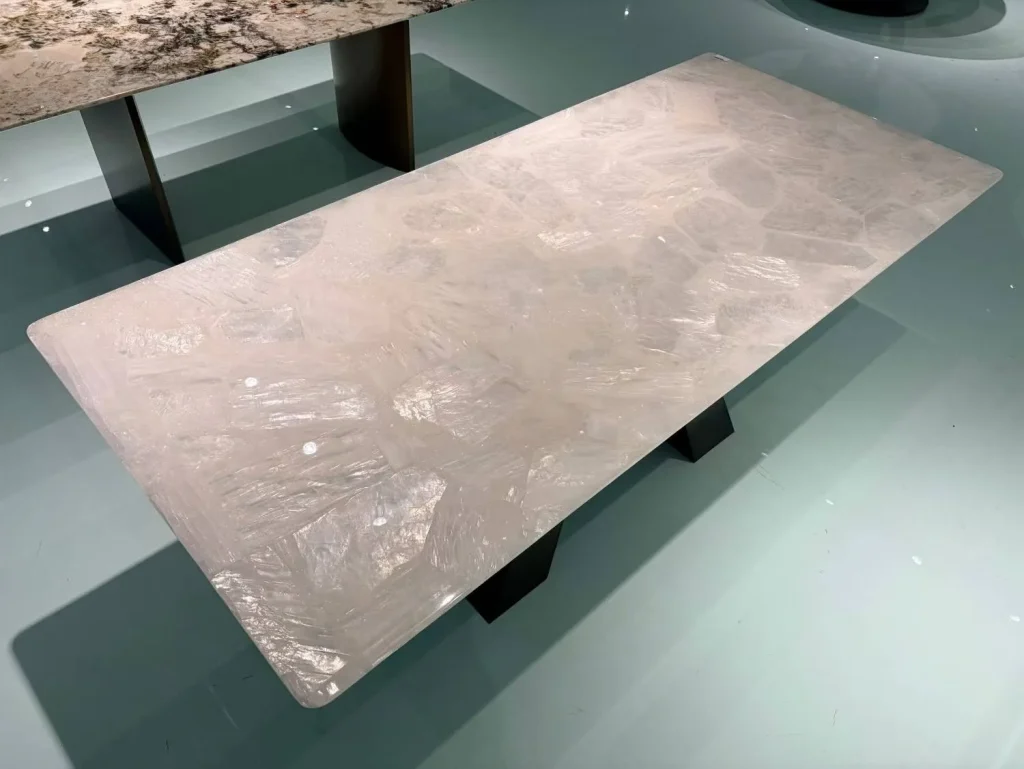
Which material handles dining spills with the least supervision?
Engineered quartz normally gives the most repeatable spill routine, provided the fabricator supplies the slab maker’s cleaner and heat warnings. Its low-absorption construction reduces the pigment-taking risk that makes marble maintenance visible. The advantage is conditional: seams, cut edges and unsuitable cleaners can still create problems.
Granite usually sits between engineered quartz and marble on acid sensitivity. Its quartz and feldspar minerals are not attacked like calcite, but “granite” is a commercial grouping rather than one uniform recipe. A slab may contain minerals that react, and a honed or textured finish can hold residue differently from a polished face.
Marble is the least forgiving of acidic food and drink because calcite reacts with acid. A sealed marble table is not acid-proof. A penetrating sealer can slow absorption, but lemon juice, vinegar and some bathroom cleaners can dull the surface. The Natural Stone Institute care guidance is a useful baseline for cleaners and spill response.
Where do scratches and heat change the buying decision?
For scratch resistance, granite and engineered quartz have an advantage because quartz is much harder than calcite. That does not make either surface indestructible: grit dragged under a ceramic object can mark any finish, and a quartz-rich slab can still chip at an unsupported edge.
Heat is the bigger hidden constraint for engineered quartz. The stone particles may tolerate heat, but the resin binder can discolour or blister when a hot pan is placed directly on the surface. Granite and marble are natural stone, yet both can suffer thermal shock at a fissure or edge. A trivet and a stable support structure remain necessary.
For a 20 mm (0.79 in) top, a 1,200 × 600 mm (47.2 × 23.6 in) marble slab at 2.7 t/m³ weighs about 38.9 kg (85.7 lb). A heavier 30 mm (1.18 in) slab increases lifting demand by roughly half before the base is counted. Thickness and span should be reviewed together; hardness does not cancel the need for support.
Does pattern consistency favour quartz or natural stone?
Engineered quartz favours consistency. Its slab pattern is produced to a declared design, which helps when a retailer needs several tables to look alike. This is an appearance benefit, not proof that every production batch will match. Confirm the approved batch or sample for a repeat order.
Marble and granite make batch matching part of the specification. Book-matched marble can create a deliberate centre line, while a granite countertop may need seam placement planned around mineral clusters. The natural variation is the reason to select the actual slab, especially where a dining table is the visual centre of a room.
Repair also changes the ranking. A marble fabricator can often refinish etches and blend filled faults because the material is relatively soft. Granite is harder and its internal pattern is less predictable to match. Engineered quartz depends on the manufacturer’s repair system and the visibility of the affected zone. Ask for a sample repair before treating any option as maintenance-free.

How can a buyer tell engineered quartz from natural stone?
Read the written material declaration first; appearance alone is unreliable. The table below shows what to ask for at sample approval and what each answer does and does not prove.
| Check | Marble | Granite | Engineered quartz |
|---|---|---|---|
| Written declaration | Natural marble and commercial stone name | Natural granite and source or grade if known | Manufacturer, product name and composition |
| Slab face | Veins can continue unpredictably through fissures | Mineral speckle and large crystals vary | Pattern may repeat across slabs or copies |
| Edge detail | Fabricator reveals stone body | Fabricator reveals mineral body | Look for consistent matrix and manufacturer marking |
| Repair guidance | Refinishing and filling may blend | Harder to match; test first | Only use the approved repair method |
| Useful question | Which slab and finish are being supplied? | Which mineral or inclusion could react? | What are the heat and cleaner limits? |
Do not use a scratch test on an installed table. A laboratory petrographic examination is the reliable way to classify rock, while a manufacturer’s declaration controls a fabricated slab. Visual clues are buying checks, not proof of geological identity.
Which tabletop should each type of buyer specify?
The right choice follows the operating conditions rather than a universal material ranking. The current collection includes nine 1,000 × 600 × 300 mm cube coffee-table models in marble, plus 84 engineered-stone designs; granite and quartzite are not listed as separate categories.
| Use case | Strong first choice | Condition to add before approval |
|---|---|---|
| Daily family dining | Engineered quartz or granite | Confirm heat resistance, seam plan and edge protection |
| Veined feature table in a low-spill room | Marble | Approve sealer, finish and cleaning routine |
| Hotel or retail repeat order | Engineered quartz | Lock the product, batch tolerance and replacement source |
| Outdoor or uncontrolled exposure | Neither assumed suitable | Require a project-specific tested specification |
| Very large or cantilevered top | Any stone only after engineering | Specify thickness, substrate and support |
Which product groups put each comparison into practice?
Start with the furniture format, then use the material pages to control the face. A marble dining table and a matched coffee table can use the same stone family but need different slab selection and support decisions.
For a formal table where the face is the design decision, compare the marble dining table collection and the material limits in Marble for Furniture. For compact seating groups, the marble coffee table collection includes cube and shaped formats. Review Real Marble vs Engineered Stone before comparing a natural slab with a manufactured surface, and continue to Marble vs Quartzite when a supplier uses “quartz” for natural quartzite.
Frequently Asked Questions
Who wrote this marble, granite and quartz comparison?
Amazstone Editorial Team · Updated 28 October 2026