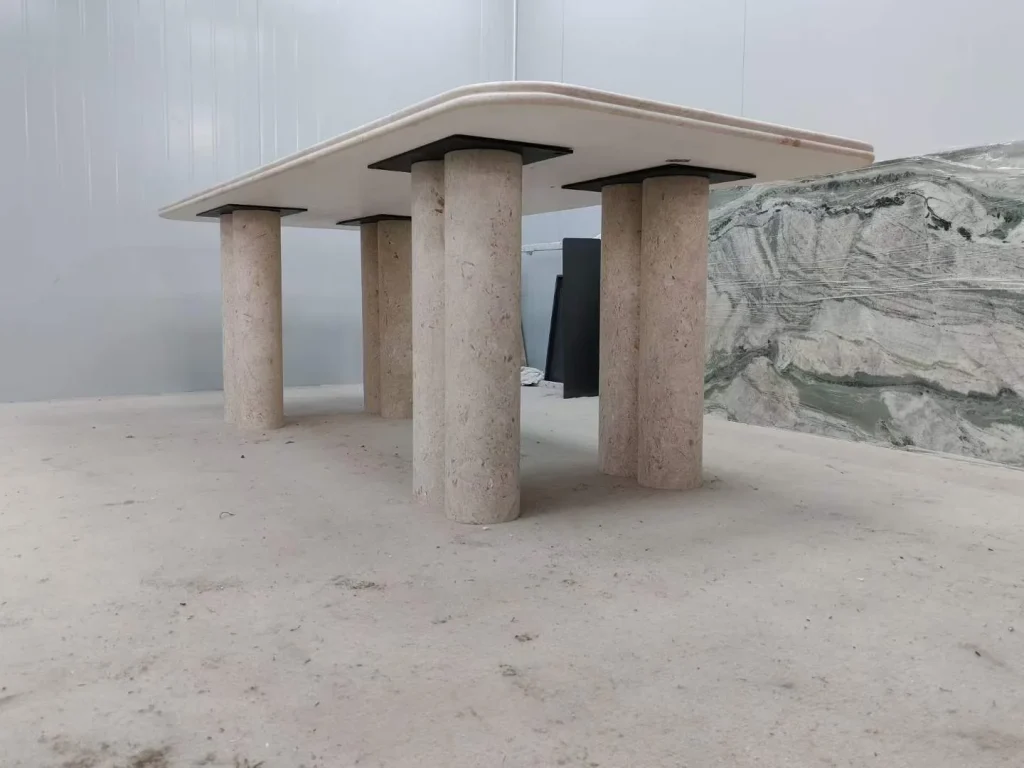
Choose travertine when you want visible movement and accept filled voids; choose limestone when a quieter, finer surface suits the room and the exact grade has suitable absorption and strength. For a 1,200 × 600 × 20 mm top, both reference density bands produce roughly 30–39 kg (67–86 lb), so support and slab testing matter more than the label.
What are the main differences between travertine and limestone for furniture?
Travertine is a form of limestone, so the practical comparison is between two carbonate materials with different visual habits and performance ranges. Use the table to write questions for a slab supplier, not to approve a stone from its name alone.
| Property | Travertine | Limestone | Source or buying check |
|---|---|---|---|
| Geological group | A form of limestone deposited by mineral springs | A sedimentary carbonate rock that includes many rock types | Travertine; limestone |
| Main chemistry | Usually calcium carbonate | Usually calcium carbonate, with other minerals in some beds | Wikipedia definitions; verify the named stone |
| Acid resistance | Low; acidic liquids can etch carbonate | Low to variable; acidic liquids can etch carbonate | Stone care and mineral composition |
| Hardness reference | Calcite is 3 on the Mohs scale | Calcite is 3 on the Mohs scale | Mohs scale |
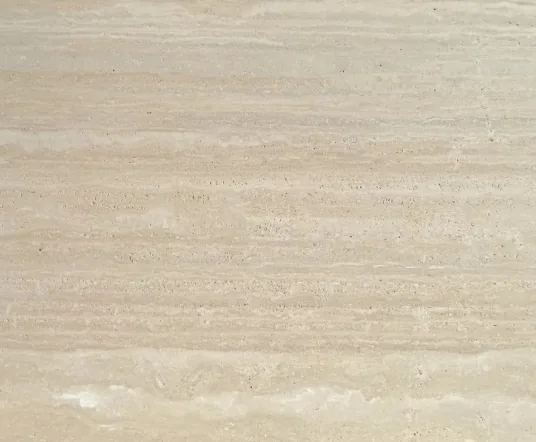
| Visible pattern | Often layered, fibrous or linear | More variable; can be fine, fossil-rich or mottled | Appearance, not a lab identification |
| Surface voids | Distinct elongated pores may be present | Can be fine or absent; beds vary | Inspect the actual slab before filling |
| Reference density | 2.2–2.7 t/m³ (137–169 lb/ft³) | 2.1–2.7 t/m³ (131–169 lb/ft³) | General reference bands; commercial grades vary |
| 1,200 × 600 × 20 mm (47.2 × 23.6 × 0.79 in) top | About 31.7–38.9 kg (69.8–85.7 lb) | About 30.2–38.9 kg (66.7–85.7 lb) | Calculated with nominal dimensions |
| Common furniture finish | Filled and honed; unfilled when the voids are part of the design | Honed or brushed; polishing depends on the slab | Actual finish sample required |
| Sealing | Stone, finish and exposure determine the product | Stone, finish and exposure determine the product | Test a manufacturer-approved sealer |
| Outdoor suitability | Conditional on freeze-thaw and absorption testing | Conditional on grade, finish and drainage | Do not approve from stone type alone |
| Best furniture role | Top where visible texture is welcome | Top where a quieter field is preferred | Editorial recommendation after sample review |
| Price comparison | Grade-, size- and finish-specific | Grade-, size- and finish-specific | Travertine and limestone slab or finished-piece quotes on request through Contact |
| Technical specification | ASTM C1527 applies to travertine dimension stone | Confirm the relevant limestone specification with the supplier | ASTM C1527 |
Which differences actually change the furniture decision?
The meaningful differences are not “natural versus synthetic” or simply “rough versus smooth.” They are the combination of void structure, density, finish, acid exposure and support. Those variables determine whether a selected slab suits the table.
Is travertine just a softer limestone?
No. Travertine belongs to the limestone family, but it forms at mineral springs and commonly develops a characteristic layered or porous structure. Limestone is a wider category formed through several sedimentary processes and can range from fine and dense to fossil-rich and absorptive.
You still need to confirm the commercial name, grade and finish of the exact slab. A dense travertine can outperform a porous limestone in a furniture application, while a carefully selected limestone can be quieter and more uniform than an open travertine. Asking only which stone is “better” hides the grade that controls the result.
Which stone is more porous?
Travertine is known for visible voids, but “porous” is not a single universal rating. Fillers can close the face, and limestone beds vary widely. Ask for the measured absorption of the proposed material and finish, and inspect whether the sample came from the same lot as the production slab.
A filled travertine has a flatter work surface but may show the filler under raking light. An unfilled top exposes the voids and is harder to wipe clean, especially with crumbs, liquids or small objects. For a dining or coffee table, review both the face and a close view of the edge.
How does acid affect each stone?
Both are carbonate materials, so vinegar, citrus, wine, some cleaning agents and acidic food debris can etch the surface. Etching is chemical removal or alteration of the finish; a sealer may reduce absorption but does not make either stone acid-proof.
Use coasters, wipe spills promptly and choose a pH-neutral stone cleaner. A honed finish can make some etching less reflective than a polished finish, but it does not eliminate the reaction. For a busy table, the practical question is whether the owner accepts a patina and a maintenance routine.
Which one is heavier?
The reference density bands overlap almost completely: travertine is listed at 2.2–2.7 t/m³ and limestone at 2.1–2.7 t/m³. On the same 1,200 × 600 × 20 mm top, the difference is only about 1.5 kg (3.3 lb) at the opposite ends of those bands.
A thicker slab or solid carved base usually changes weight more than the choice between the two names. Weigh the proposed assembly or calculate from the actual density and dimensions. Add the base, reinforcement, crate and packaging before planning freight or installation.
Can either stone go outdoors?
Travertine and limestone can both be specified for exterior work, but neither label proves that a particular furniture piece will survive open rain and freezing. Water entering pores, seams and joints can remain there through freeze-thaw cycles. Salt and pollution add another exposure.
A drained base, sheltered setting and slab-specific test results are more useful than a generic claim. Avoid an unfilled surface where water can collect, and do not rely on a sealer as the only defense. The outdoor stone furniture guide gives a fuller exposure checklist.
Which is easier to maintain?
Dense, filled and honed samples are generally easier to wipe than open or deeply textured faces, but the exact stone and finish still control the result. Neither material is scratch-proof. Grit under objects and abrasive cleaners can dull either surface.
Maintenance aligns them more than the material label suggests: prompt spill removal, coasters, a mild stone-appropriate cleaner and a tested sealer when specified. The travertine care guide explains how to handle filled and unfilled surfaces.
How can you tell travertine from limestone before fabrication?
Start with the slab face, edge and wet sample, then confirm the written commercial name. Appearance narrows the question but cannot replace the supplier’s declaration.
| Check | Travertine clue | Limestone clue | Limit of the check |
|---|---|---|---|
| Face pattern | Linear bands, fibrous movement or repeated elongated pores | Fine grain, mottling or fossil detail with less directional banding | Cutting direction changes the pattern |
| Edge | Voids may appear as open channels | Pores may be smaller or absent | Filling and resin can hide the edge |
| Wet sample | Water can reveal absorption and pore structure | Absorption varies with the bed | A visual test is not a measured absorption test |
| Stone identity | Commercial travertine name and grade | Commercial limestone name and quarry bed | Confirm in writing before cutting |
When should you choose travertine or limestone?
Choose travertine if you want an unmistakable linear or porous character and will approve the filled or unfilled face. Choose limestone if you prefer a quieter field, but only after the dense grade, finish and maintenance response have been checked on the actual slab.
| Choose travertine if… | Choose limestone if… |
|---|---|
| The table should show layered movement across the top | The room needs a finer, less directional stone field |
| A filled face with visible pore traces suits the design | A dense, relatively uniform finish is available from the selected bed |
| The exact slab passes the indoor or outdoor exposure requirements | The exact sample passes absorption, strength and finish checks |
| You accept prompt cleaning around visible voids | You will confirm care and sealing for the named limestone |
Where can you see these materials applied to furniture?
The current URL map has direct travertine furniture collections; limestone should first be qualified as a slab and then carried into the relevant custom furniture brief. Do not treat a collection label as an outdoor or performance guarantee.
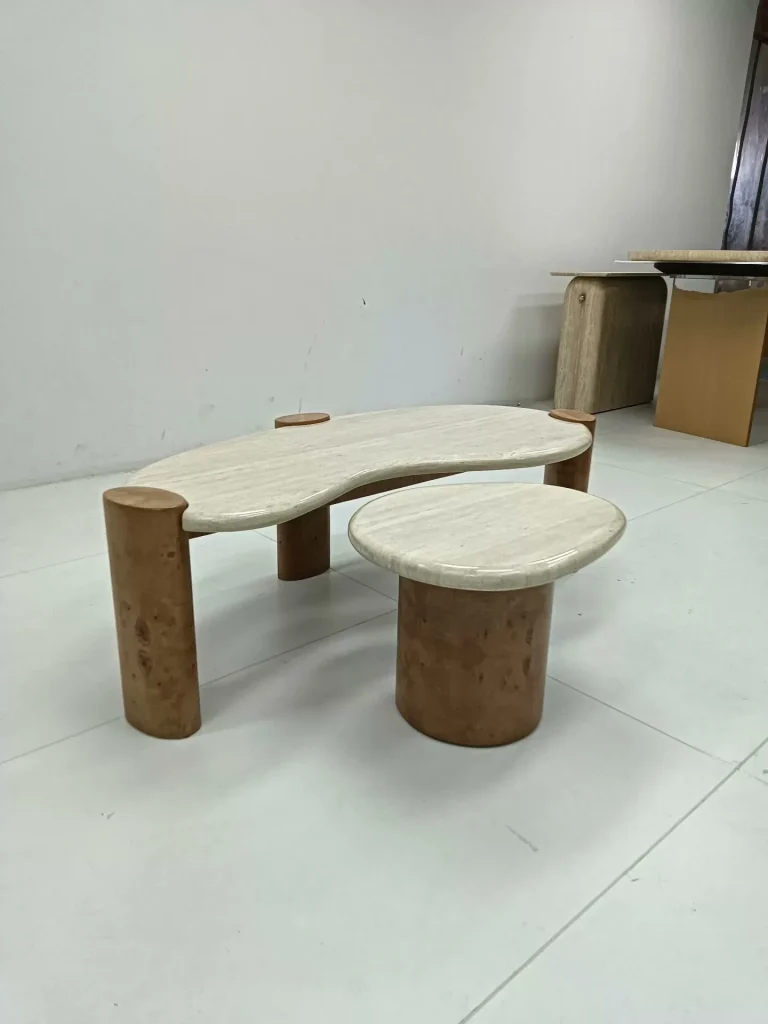
Travertine appears in travertine dining tables and travertine coffee tables. For a limestone proposal, use the samples, finishes and edge profiles process to approve the actual slab and face before fabrication.
Frequently asked questions about travertine and limestone
Is travertine a type of limestone?
Yes, travertine is a form of limestone deposited by mineral springs. That shared carbonate chemistry does not make every travertine and limestone interchangeable. Travertine commonly has distinct voids and banding, while limestone covers a broader range of textures and densities. Compare the named slab, finish and test document.
Is limestone suitable for a dining table?
A dense, properly selected limestone can be suitable for a protected dining table. It remains carbonate stone, so acidic food and drink can etch the finish. Confirm absorption, strength, filling and edge details for the exact slab, then use coasters, prompt cleaning and a suitable sealer where the fabricator specifies one.
Which is better outdoors, travertine or limestone?
Neither name proves outdoor suitability. Repeated freeze-thaw cycles, salt, rain and the exact finish matter more than the broad stone type. A tested travertine may perform well in one climate while an absorptive limestone fails; the reverse is also possible. Require slab-specific weathering evidence and drainage details.
How can you tell travertine from limestone?
Travertine often shows linear banding and elongated voids, while limestone can be more uniform or contain fossils. Filling, honing and cutting can hide those clues. Treat appearance as a first check, then confirm the commercial stone name and slab document rather than relying on a visual identification.
Who wrote this travertine and limestone comparison?
The Amazstone Editorial Team used public geological and stone-care references, the industry specification for travertine, and Amazstone’s October 2026 material collection. Product and price decisions remain conditional on the named slab.
- Travertine is a form of limestone deposited by mineral springs, which explains its relationship to limestone and its characteristic void structure.
- Limestone is a sedimentary carbonate rock; composition and texture vary, so this page treats limestone as a family rather than one specification.
- ASTM C1527 provides a travertine dimension-stone specification; compliance with one standard does not establish suitability for every finish or exposure.
- The October 2026 material collection contains 13 travertine and 33 limestone options, including Travertino Navona, Jura beige and Fatima Cream; these counts are collection totals, not inventory.