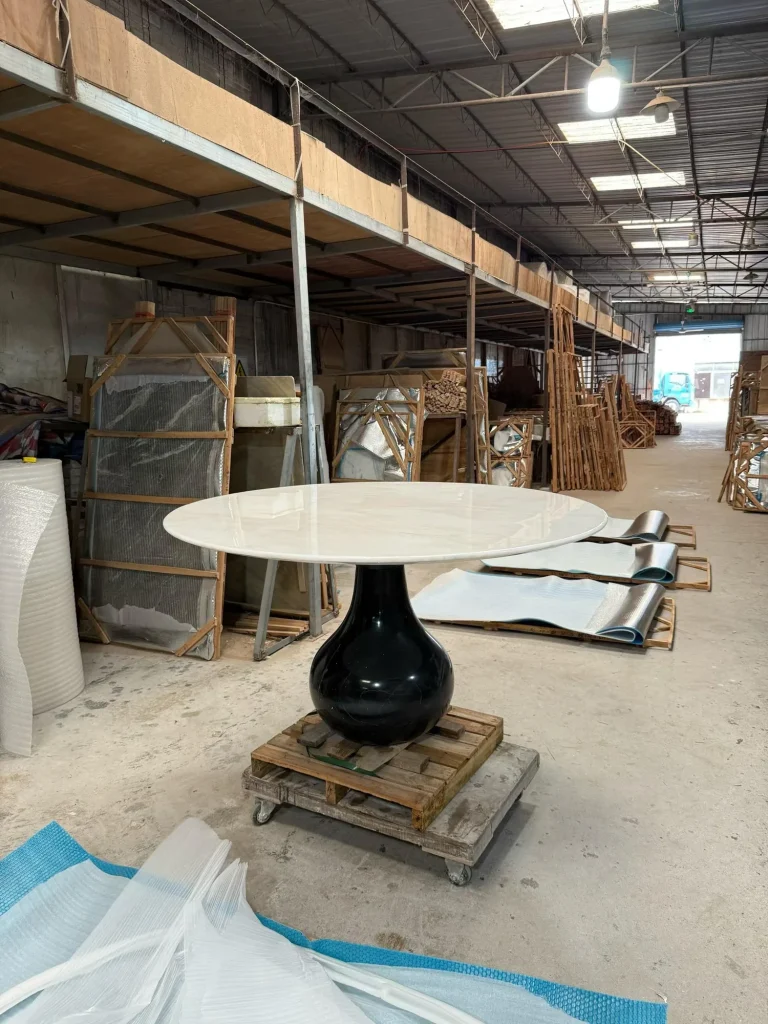
For ordinary furniture, a 20 mm (0.79 in) marble top is a practical starting point for a well-supported coffee or dining table; use 12 mm (0.47 in) only for small, low-load tops with continuous backing, and 30 mm (1.18 in) when span, cantilever, edge mass or handling calls for more than 20 mm (0.79 in).
What thickness should I choose for each table type?
Choose from the support and edge drawing, not from table category alone. The quick-reference table separates thickness, intended role and the condition that makes it defensible.
| Top build | Useful starting point | Required condition | Main trade-off |
|---|---|---|---|
| 12 mm (0.47 in) | Small coffee, side or low-load decorative table | Continuous rigid substrate and approved attachment | Low weight and a slim edge; limited independent stiffness |
| 20 mm (0.79 in) | Most residential coffee and dining-table tops | Continuous support under the top and seams | Balanced weight and proportion; check long spans |
| 30 mm (1.18 in) | Larger, heavier-looking or more edge-exposed tops | Base, lifting plan and overhang reviewed for the extra load | More visual mass with much more weight |
| 20 + 20 mm (0.79 + 0.79 in) built-up edge | A 40 mm-looking edge (1.57 in) with a 20 mm (0.79 in) field | Fabrication drawing for the bonded and reinforced edge | Edge proportion without a solid 40 mm (1.57 in) slab |
| 12 + 20 mm (0.47 + 0.79 in) build-up | A 32 mm-looking edge (1.26 in) over a backed 12 mm (0.47 in) field | Shop-approved substrate, bond and edge joint | Slim field and controlled material use |
These are construction starting points. They do not replace the fabricator’s review of the actual slab, vein structure, cutouts, seam positions and base.
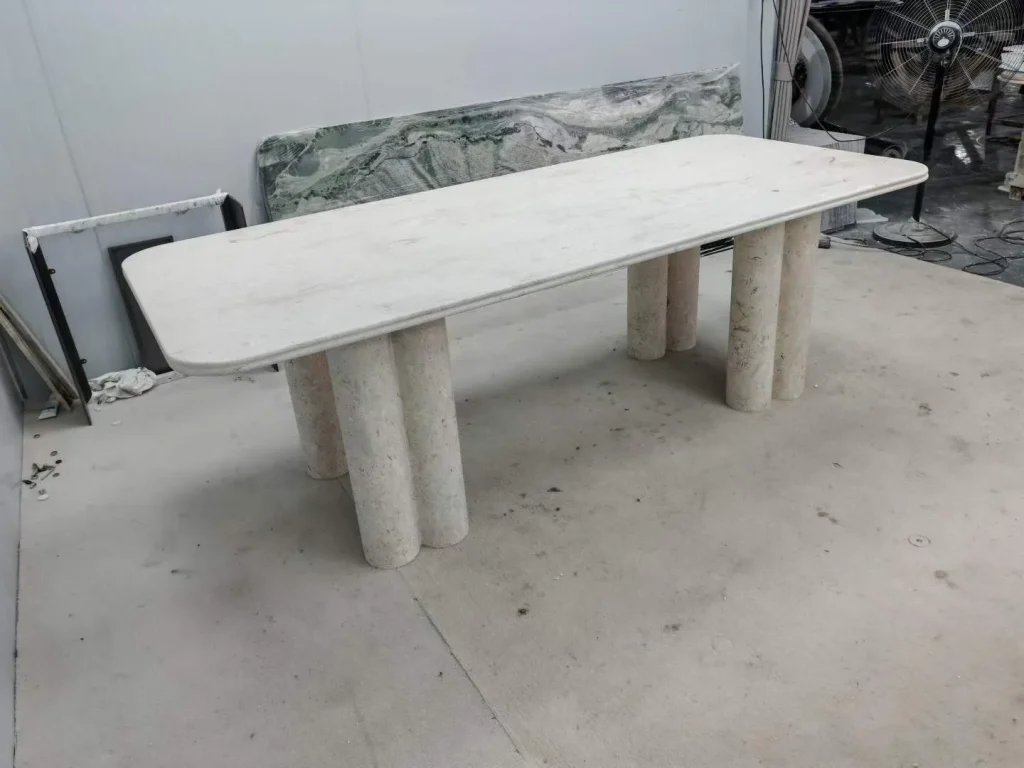
Why do 12, 20 and 30 mm solve different problems?
The numbers describe material thickness, but a tabletop’s behavior also depends on support, plan size, edge construction and handling. A thin top can be stiff when bonded to a frame; a thick top can still crack if it is unsupported or poorly packed.
What is 12 mm marble good for?
Twelve millimetres is best treated as a facing layer on a rigid substrate. It reduces weight and permits a slim profile, but it gives the fabricator little room to shape a deep edge or repair the underside. A 12 mm (0.47 in) top should not be described as structurally equivalent to a 20 mm (0.79 in) slab merely because both have a polished face.
When is 20 mm the sensible baseline?
Twenty millimetres supplies enough substance for common residential table edges and is lighter than 30 mm (1.18 in). It still needs continuous bearing at the frame, careful support around cutouts and a seam plan that avoids unsupported joins. A large dining top or narrow pedestal may demand extra reinforcement regardless of the nominal thickness.
When does 30 mm earn its weight?
Thirty millimetres gives a stronger visual edge and more material for shaping, but it also adds handling difficulty and load on the base. Use it when the design needs that mass or when the fabricator specifies it for the slab and structure. The extra depth does not by itself make a cantilever safe.
How does a 20 + 20 mm edge differ from a 30 mm top?
A 20 + 20 mm (0.79 + 0.79 in) build-up is a 20 mm (0.79 in) field with a deeper attached edge. It can create a 40 mm (1.57 in) edge while keeping the central top lighter than a solid 40 mm (1.57 in) slab. The vertical strip, adhesive, joint reinforcement and finishing are part of the design. Ask to see the section drawing and a finished edge sample.
What weight and commercial data should drive the decision?
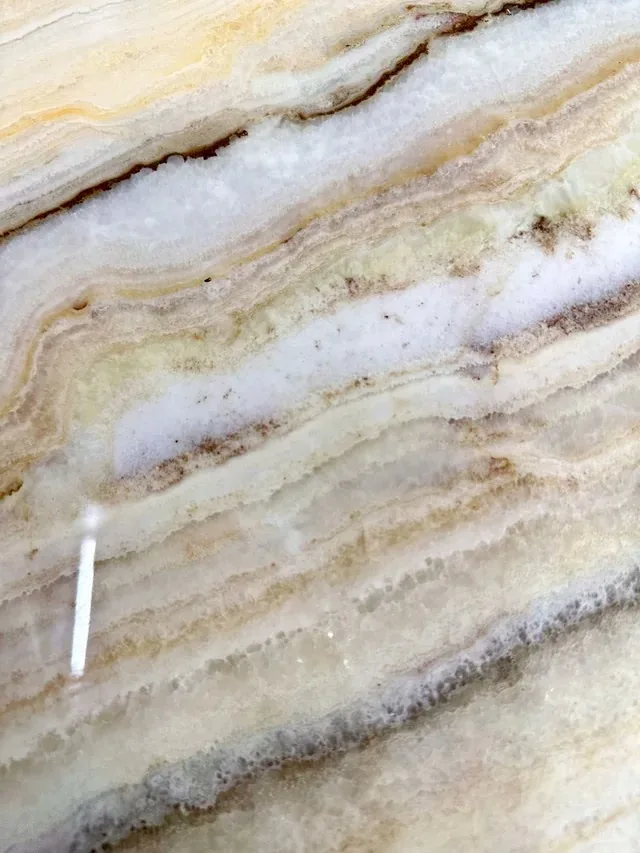
Weight is predictable from volume and density. At a reference density of 2.7 t/m³ (168.6 lb/ft³), the table below shows the calculated top weight before edge build-up, packing and base. A 20 mm (0.79 in) top becomes 50% heavier at 30 mm (1.18 in) on the same footprint.
| Top size | 12 mm (0.47 in) | 20 mm (0.79 in) | 30 mm (1.18 in) |
|---|---|---|---|
| 1,200 × 600 mm (47.2 × 23.6 in) | 23.3 kg / 51.4 lb | 38.9 kg / 85.7 lb | 58.3 kg / 128.6 lb |
| 1,800 × 900 mm (70.9 × 35.4 in) | 52.5 kg / 115.8 lb | 87.5 kg / 192.9 lb | 131.2 kg / 289.2 lb |
| 2,400 × 1,000 mm (94.5 × 39.4 in) | 77.8 kg / 171.5 lb | 129.6 kg / 285.7 lb | 194.4 kg / 428.6 lb |
These figures use the 2.7 t/m³ (168.6 lb/ft³) reference from the project brief, not a measured slab. Replace it with the supplier’s tested density when one is available. Packing, frame, edge strips and crating add further weight.
Prices are not published as fixed figures. Send the table type, dimensions, finish, quantity and destination through Contact for a quotation. Compare offers with the selected slab, thickness or built-up edge, base and freight shown separately so a heavier construction is not compared with a lighter one on price alone.
How do I specify thickness without guessing?
Specify in this order: size and seating plan, base and support path, slab and vein layout, edge construction, then thickness. Changing the edge after the frame is designed can force a new cut or a heavier top.
- Mark the planned top dimensions and every unsupported overhang on the base drawing.
- Ask the fabricator which slab thickness is acceptable for that support and handling route.
- Choose solid 20/30 mm (0.79/1.18 in) or a built-up edge, then draw the section at the edge and seam.
- Calculate weight with the stone furniture weight calculator.
- Approve lifting, doorway clearance, seam support and the dry-fit or shop drawing before cutting.
Which marble furniture needs a different thickness review?
A marble coffee table with a compact footprint often uses a thinner visual edge than a large marble dining table, but the base matters more than the label. A narrow marble and stone side table can use a small crop, yet a pedestal connection concentrates load.
Compare these decisions with is marble heat resistant for hot-serving risks and the marble family guide for acid and sealing behavior. Read the Natural Stone Institute care guidance before choosing a finish that will be cleaned frequently.
FAQ
Is 12 mm marble thick enough for a coffee table?
A 12 mm top can work on a small, low-load coffee table when it is continuously bonded to a rigid substrate and the fabricator approves the edge, cutouts and attachment method. It is not a self-supporting slab in the same way as a 20 mm or 30 mm top. Do not use the thickness alone as structural approval.
Is 20 mm or 30 mm better for a marble dining table?
A 20 mm top commonly works with a continuous frame and approved fabrication; 30 mm adds weight and a more substantial edge, but still needs a base designed for the span. Choose between them from the slab, overhang, seam layout, edge detail and handling route, not from appearance alone.
Does a double marble edge make the whole top thicker?
No. A 20 mm top with a 20 mm attached edge strip creates about a 40 mm visible edge, while the central field remains 20 mm. This is a built-up edge detail, not a solid 40 mm slab. The join, adhesive, reinforcement and finishing must be shown in the fabrication drawing.
How much heavier is a 30 mm marble top than a 20 mm top?
At the same area and density, 30 mm is 50% heavier because it is 1.5 times the thickness. At 2.7 t/m³, a 1,200 × 600 mm top rises from about 38.9 kg (85.7 lb) at 20 mm to 58.3 kg (128.6 lb) at 30 mm. Use measured slab density for final planning.
Which marble edge profile makes a top look thicker?
A deeper square or built-up apron gives a stronger visual edge than a thin bevel. A bullnose softens the line but can make a top read slimmer. Ask for a full-size or scaled edge sample in the chosen stone because color, veining and polish affect the perceived thickness.
Sources, internal links and review note
- Project density reference: marble 2.5–2.8 t/m³ (156.1–174.8 lb/ft³); worked weight table uses 2.7 t/m³ (168.6 lb/ft³).
- Brief calculation check: 1,200 × 600 × 20 mm (47.2 × 23.6 × 0.79 in) at 2.7 t/m³ (168.6 lb/ft³) = 38.9 kg (85.7 lb).
- Marble — carbonate composition and material context.
- Natural Stone Institute — care and sealing guidance.