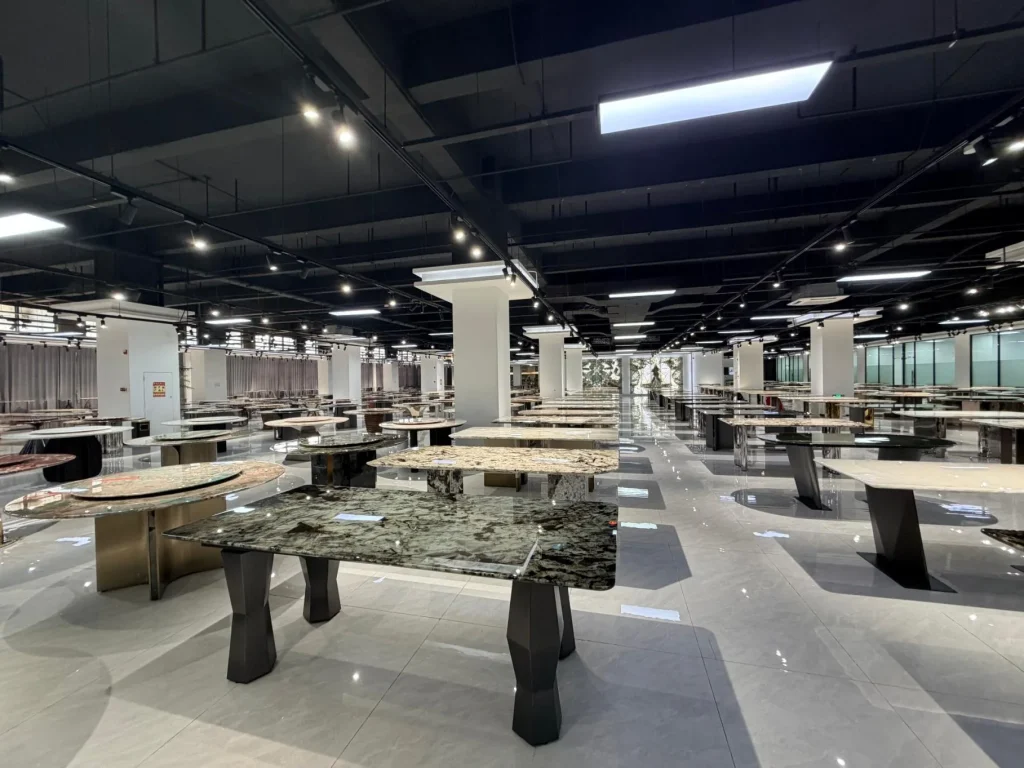
A 1,200 mm diameter marble dining top, 20 mm thick (47.2 × 0.79 in), weighs about 61 kg (135 lb) at 2.7 t/m³. It commonly plans for four diners. Treat that as a solid top blank, not a finished-table weight.
Which diameter creates the dining plan?
Seat count follows usable edge and chair positions more closely than listed diameter alone. The table below uses common planning relationships, not a promise that every chair fits.
| Diameter | Planning capacity | Condition |
|---|---|---|
| 1,200 mm (47.2 in) | Often 4 | Chairs clear the base. |
| 1,500–1,600 mm (59.1–63.0 in) | Often 6 | Check chair width and base. |
| 1,800 mm (70.9 in) | Often 8 | Test room access. |
| Height | 720–760 mm (28.3–29.9 in) | Check knee clearance. |
| Edge allowance | About 600 mm (24 in) per diner | Chair arms may need more. |
How does a round top change dining-room circulation?
A round table removes projecting corners, but its curved edge still needs chair pull-out and a walking route beyond the seat zone. Its central size may make a compact room feel easier to move around than a similar-capacity rectangle.
Stock and custom production are available with a minimum order of 1 piece; request this category's product list.
Request product listMeasure chairs pulled out and the path around them. Check elevator, stair and doorway before choosing an 1,800 mm (70.9 in) top.
More stone dining tables in selected finishes
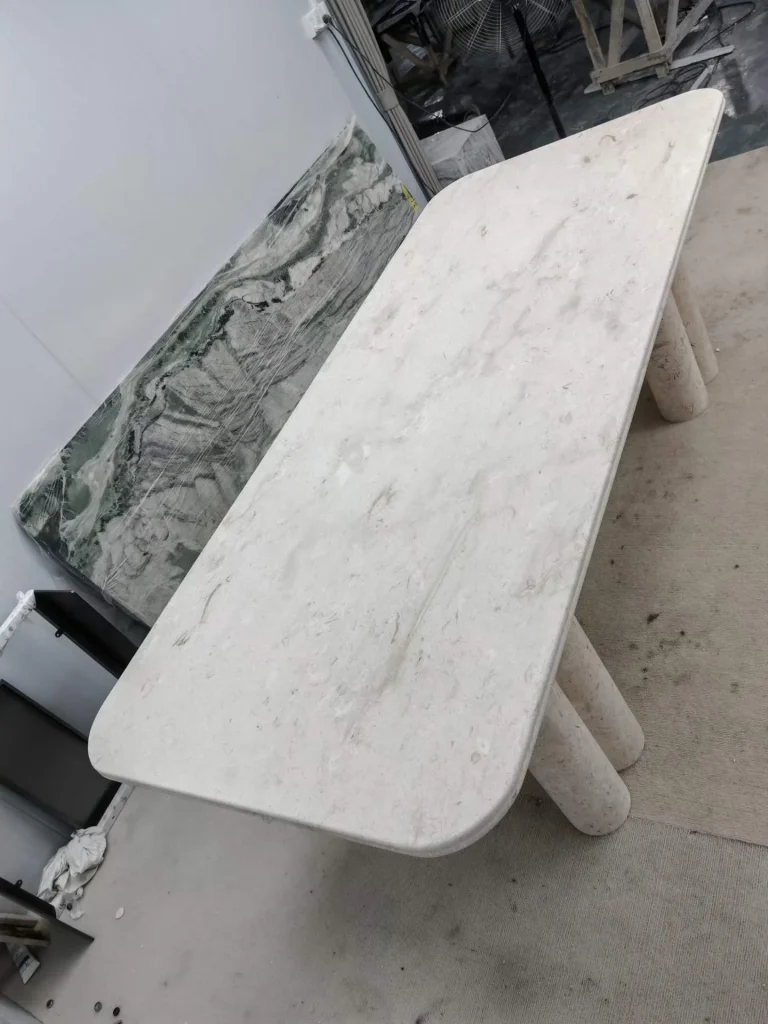
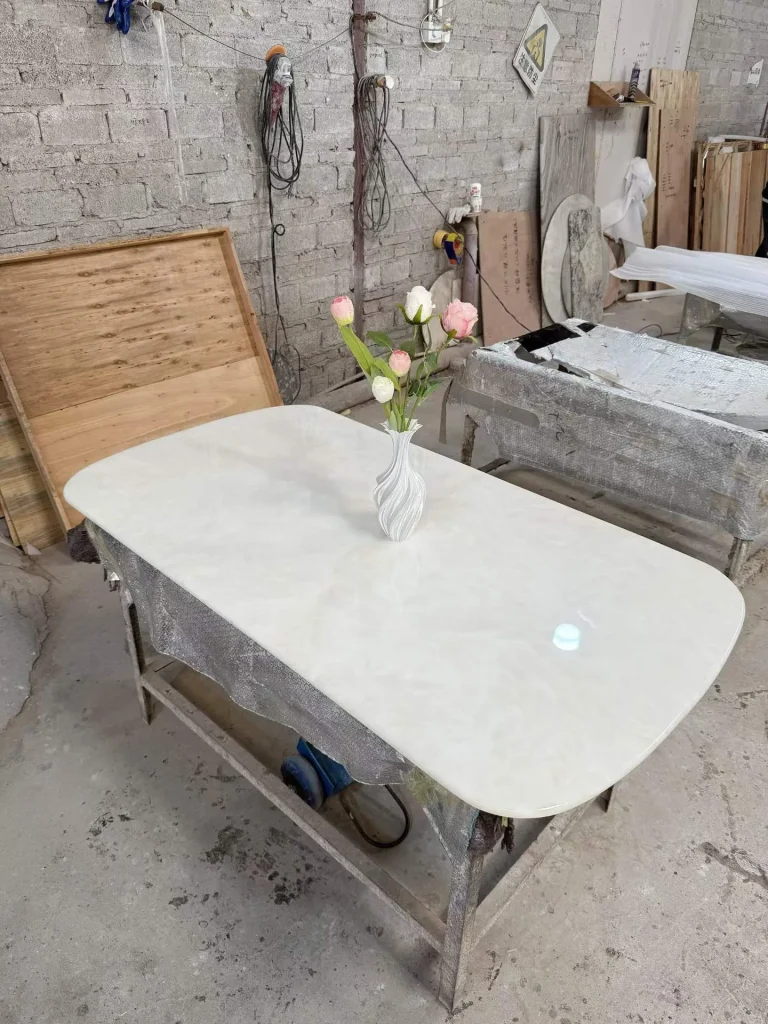
Is marble suitable for a round dining table?
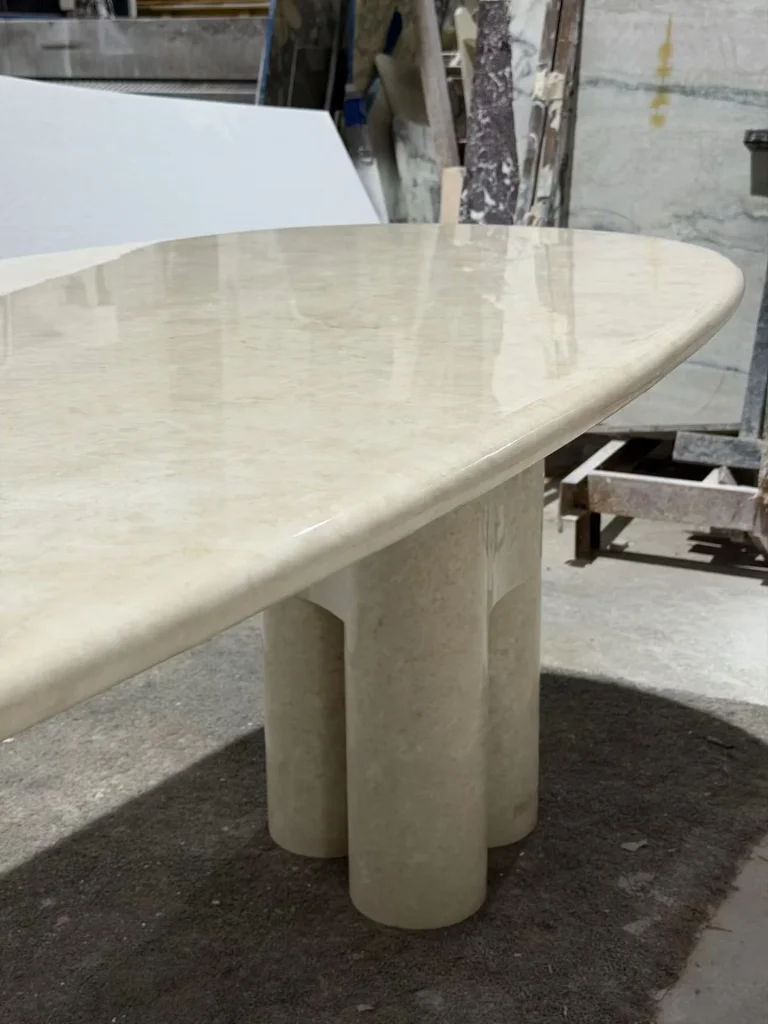
Yes, if the slab is sound, sealed appropriately and supported under the full top. Marble is acid-sensitive and relatively soft, so daily dining includes maintenance.
| Top thickness | Estimated top blank | Support condition |
|---|---|---|
| 20 mm (0.79 in) | 61 kg (135 lb) at 1,200 mm; 96 kg (212 lb) at 1,500 mm | Design a base or apron. |
| 30 mm (1.18 in) | 92 kg (203 lb) at 1,200 mm; 143 kg (315 lb) at 1,500 mm | Heavier handling load. |
| Laminated edge | Follow the actual build-up | Show hidden support. |
The F1 weight chart shows the same calculation for other dimensions.
Which marble pattern suits a large circular top?
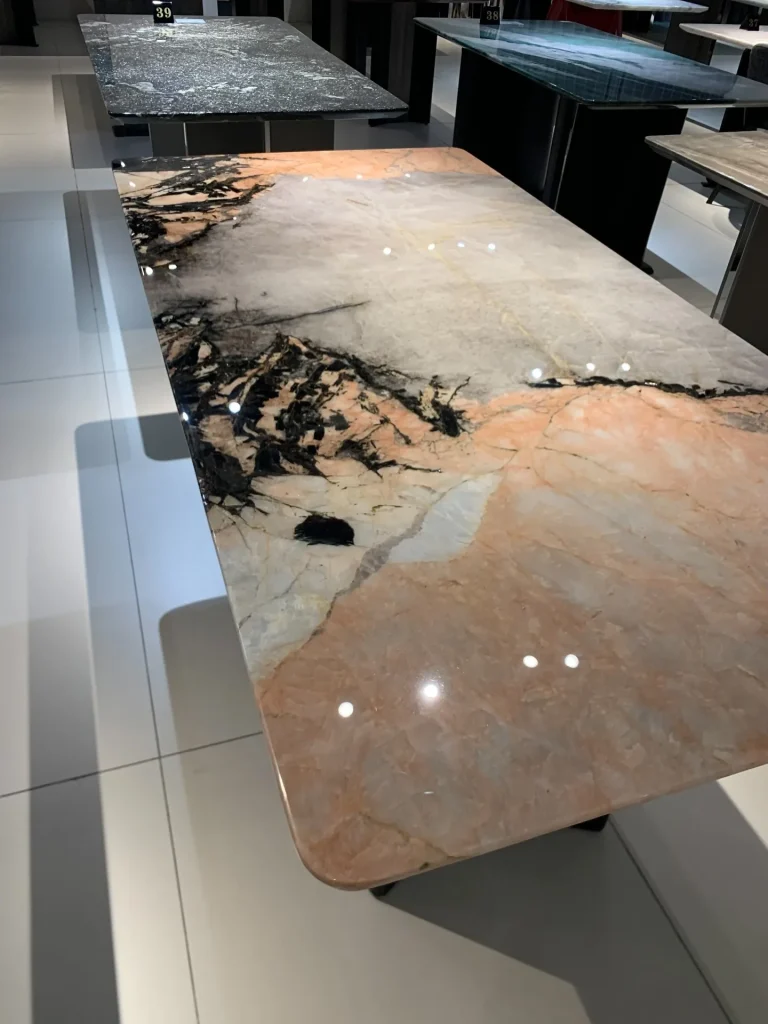
A quiet pattern lets roundness dominate; strong veining creates a focal point but makes matching harder. Choose slab and base together.
| Pattern direction | Visual result | Selection check |
|---|---|---|
| Fine gray veins | Calmer circle | Check drift and fissures. |
| Bold white veins | Strong focal point | Mark the circle. |
| Dark background | More visual mass | Check light and chips. |
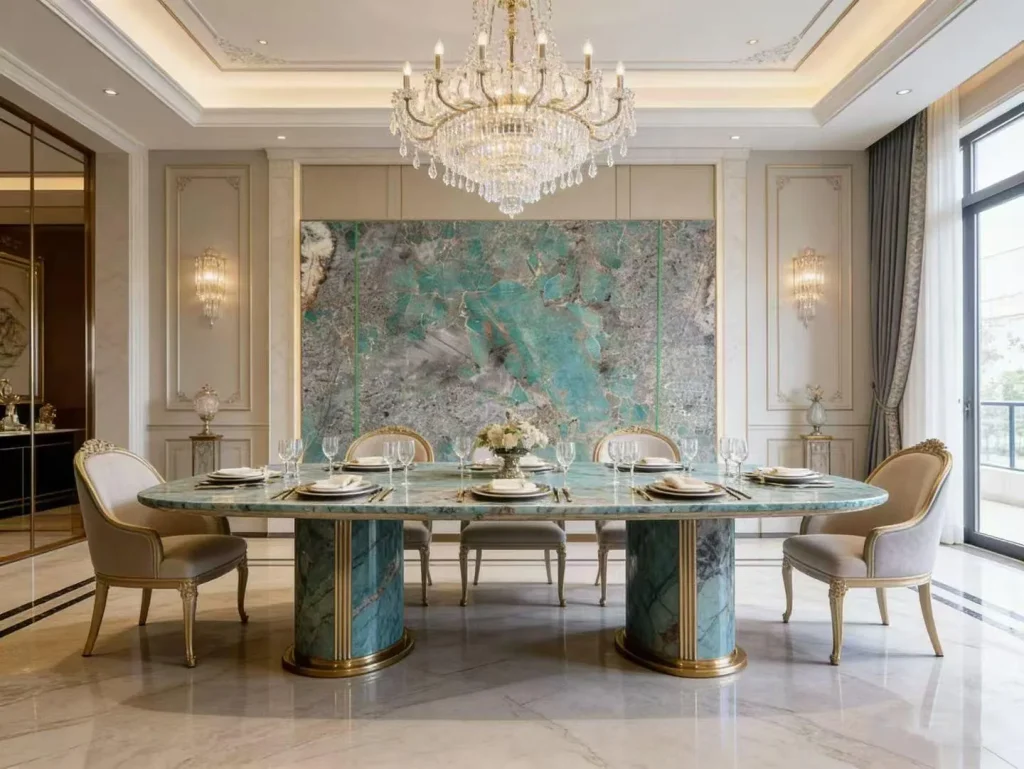
| Green marble | Distinctive minerals | Confirm subtype and repairs. |
Ask for the usable slab outline, finished diameter, seam plan and structural veins affecting the cut.
What dining-table commercial terms require a quote?
Order size, production timing and price remain open until stone, diameter, base, edge and destination are defined.
| Commercial field | Required confirmation |
|---|---|
| Minimum order | 1 piece |
| Production time | About 20 days production + about 30 days shipping; production starts after deposit receipt and drawing confirmation |
| Price band | Dining-table quote on request through Contact |
A quotation without the base, sealing, crating and delivery scope cannot be compared with a complete dining-table package.
How does round marble compare with travertine and quartzite?
Marble usually has higher density than travertine. Quartzite is quartz-rich and generally harder; onyx is separate and varies by slab.
| Stone | Reference density | Dining-top implication |
|---|---|---|
| Marble | 2.5–2.8 t/m³ (156–175 lb/ft³) | Acid care and precise support. |
| Travertine | 2.2–2.7 t/m³ (137–169 lb/ft³) | Choose fill and sealing. |
| Quartzite | 2.6–2.9 t/m³ (162–181 lb/ft³) | Generally harder; test the slab. |
| Onyx | 2.4–2.7 t/m³ (150–169 lb/ft³) | Approve repairs and backing. |
See the Marble and Travertine family pages before changing material.
How should a marble dining table be protected?
Use coasters and trivets, wipe acidic food promptly and clean with pH-neutral stone product. Avoid vinegar, citrus cleaner and abrasives.
- Vacuum grit before wiping the top.
- Dry the edge and underside.
- Check chair bumpers and loose chair screws.
- Test sealers on an offcut from the same stone.
Inspect the edge because chairs strike it below the face. The Marble care guide explains residue and etching.
Which round marble dining-table choices need testing first?
How many people can sit at a 1,200 mm round marble dining table?
A 1,200 mm (47.2 in) table is commonly planned for four diners, but chair width, base clearance and room access can change that. Allow roughly 600 mm (24 in) of edge width per person and check knee clearance. A larger table is not comfortable if knees hit the base.
Does a round marble dining table need a pedestal base?
No, but a central pedestal can leave more knee room. It must be wide or weighted enough to resist tipping under a heavy stone top. Four or more legs can work if they do not obstruct diners. Compare the base drawing rather than assuming one style is stable.
What room size does a 1,500 mm round marble dining table need?
The table uses 1,500 mm (59.1 in), and chairs need space beyond it. A room around 3.3–3.6 m (10.8–11.8 ft) across can work in some layouts, but door swings and sideboards change the plan. Measure the complete zone.
How much overhang is safe on a round marble dining top?
No universal overhang is safe because stone strength, thickness, attachment and frame all matter. A 20 mm (0.79 in) top generally needs support closer to the edge than a 30 mm (1.18 in) top. Give the engineer stone and base drawings; thickness alone does not justify a cantilever.
Where should I compare round dining-table formats?
Project inquiry
Request a stone furniture quote
Send dimensions, material direction and quantity for a comparable reply.
Useful details include product type, finished dimensions, quantity and destination.
Who prepared this round dining-table plan?
- Marble is conventionally carbonate rock at 2.5–2.8 t/m³ (156–175 lb/ft³). Marble reference
- The 600 mm (24 in) per-diner allowance is planning guidance, not guaranteed knee clearance. USGS glossary
- Weights use a solid round blank; base and cut-outs alter the finished table. ASTM C503
- Sealing does not prevent acid etching. Natural Stone Institute