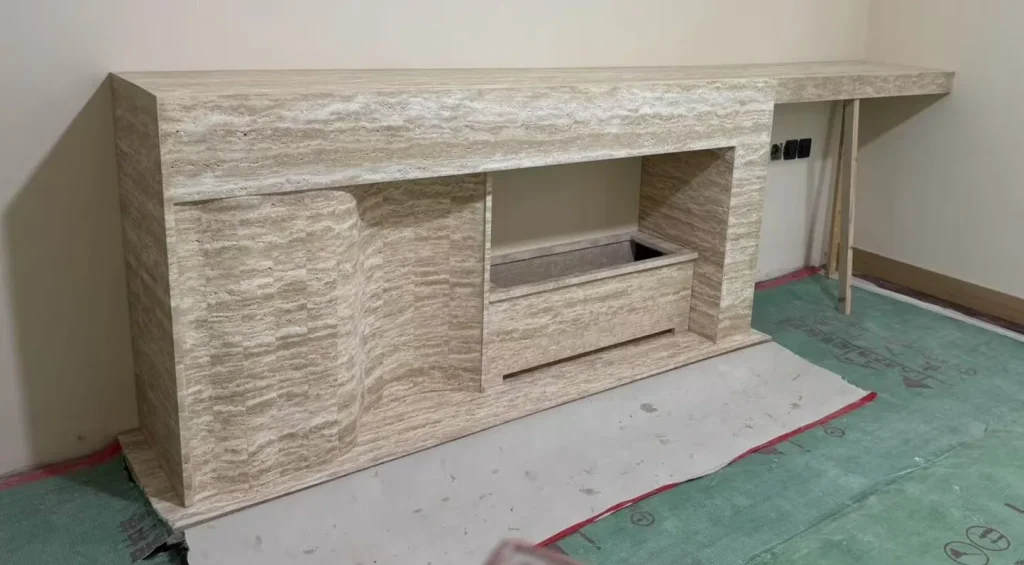
This 1,200 × 400 mm (47.2 × 15.7 in) travertine top at 20 mm (0.79 in) thickness weighs 23 kg (51 lb) at 2.4 t/m³ (149.8 lb/ft³) before the base. For entryways, use depth near 350–450 mm (14–18 in), specify filled, sealed stone, and support long spans; unfilled stone suits dry settings.
What should a travertine console specification settle?
The drawing should settle width, depth, height, void treatment, support and fixing. On a narrow console, a few millimetres and a poorly placed leg matter greatly.
| Decision | Specification to confirm |
|---|---|
| Travertine names | Romano Classico, Bianco, Silver, Beige, Golden or Rosso in our current catalog. |
| Dimensions | Height 750–900 mm (30–35 in); depth 300–450 mm (12–18 in); length set by wall and walkway. |
| Slab mass | At 2.4 t/m³ (149.8 lb/ft³), a 20 mm (0.79 in) top is 23.0 kg (51 lb) at 1,200 × 400 mm (47.2 × 15.7 in); a 30 mm (1.18 in) top is 48.6 kg (107 lb) at 1,500 × 450 mm (59.1 × 17.7 in). Base excluded. |
| Surface | Filled or unfilled; honed, polished, brushed or tumbled; sealed as approved. |
| Support | Wall bracket, end supports, plinth, frame or concealed steel, with a plan for a long central span. |
| Commercial terms | 1 piece minimum. About 20 days production plus about 30 days shipping, starting after deposit receipt and drawing confirmation. Pricing depends on travertine grade, console size and quantity; send dimensions and a stone photo for a quote. Stock is available; sizes and quantities are not published. |
The stone-weight calculator tests the top alone; brackets and packing add weight.
Which console shape fits a hallway, entry or sofa wall?
A straight rectangle is the most predictable wall fit; curved and plinth forms alter circulation and storage.
Straight rectangular consoles
A narrow rectangle keeps the passage clear. Confirm permissible overhang and avoid heavy objects at an unsupported end.
Demilune and curved consoles
A curved front softens a tight entry but reduces usable top area. It also requires more stone and a template.
Plinth and trestle forms
A solid plinth blocks access below; open trestles keep the floor visible. Both need level support and fixing.
Stock and custom production are available with a minimum order of 1 piece; request this category's product list.
Request product listMore stone console tables in selected finishes
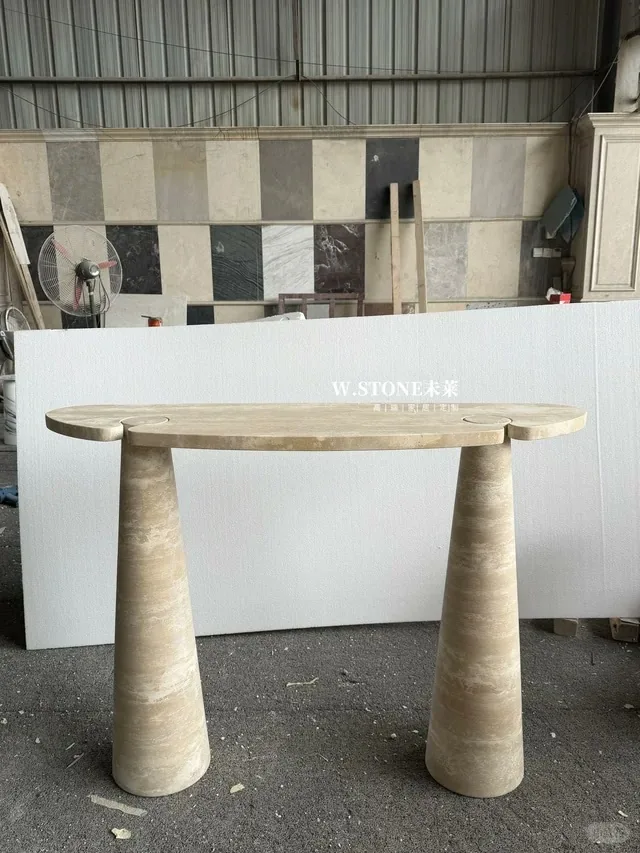
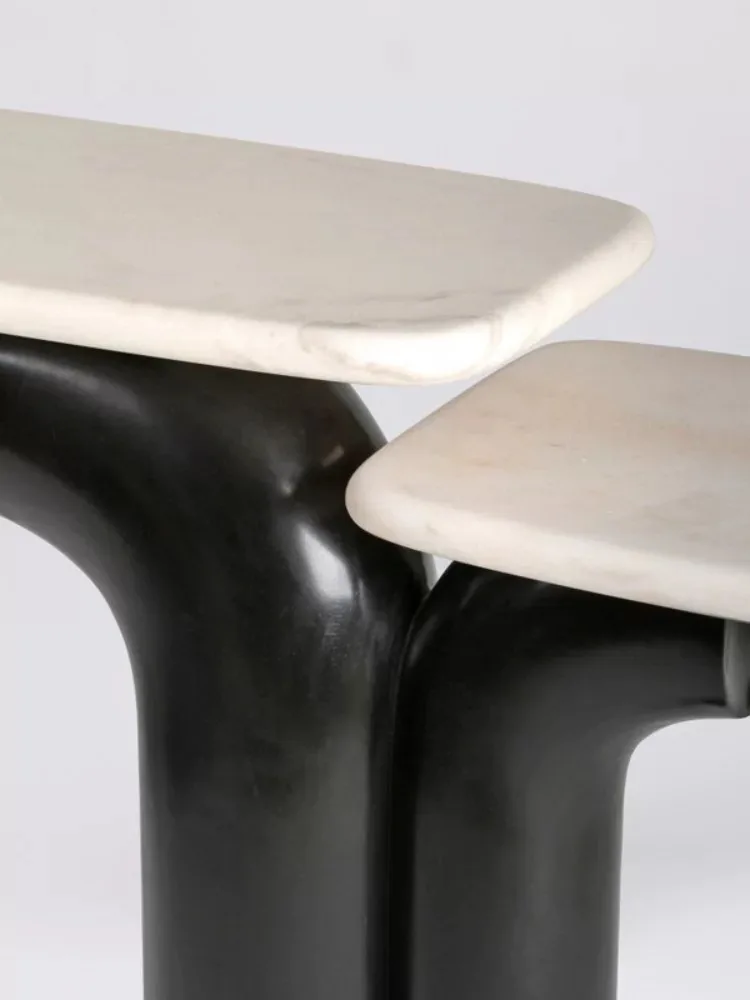
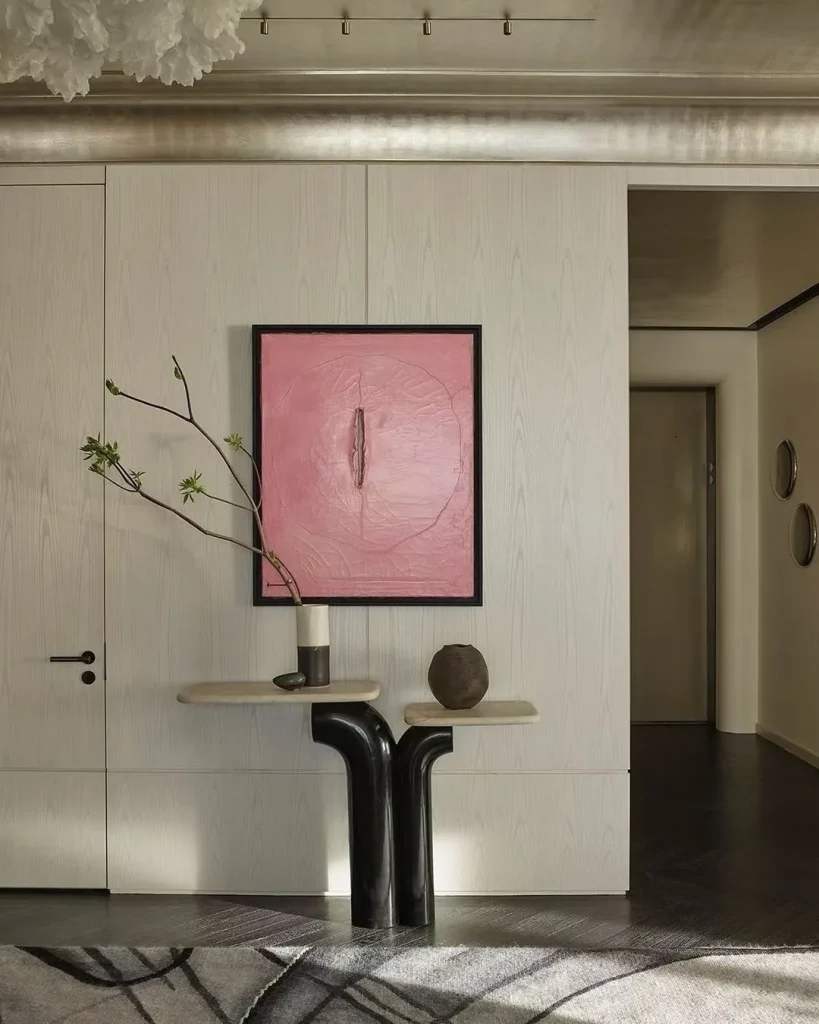
Is travertine suitable for an entryway console?
Travertine is suitable when pits are filled and the surface is sealed; unfilled stone suits a dry display. Its visible voids should not be judged like a nonporous engineered surface.
| Placement | Fit | Condition |
|---|---|---|
| Busy hallway | Filled top. | Seal; wipe spills. |
| Behind a sofa | Good visual fit. | Keep cables and sockets accessible. |
| Wet entry | Demanding. | Use filled, sealed stone. |
| Narrow corridor | Shallow depth. | Preserve walking clearance. |
Which travertine should a console table use?
Roman and beige travertines are warmer; silver is cooler and red creates a stronger accent. Face direction controls whether voids read as lines or clouds.
| Catalog name | Look to compare | Best direction |
|---|---|---|
| Travertino Silver | Cool grey-buff. | Plaster and dark metal. |
| Travertino Bianco | Light field. | Quiet entries. |
| Beige Travertino | Warm cream-tan. | Timber and brass. |
| Travertino Rosso | Red-brown accent. | Color feature. |
Inspect the slab in its intended direction and approve which pits remain open.
What changes a travertine console quote?
Slab yield, void filling, curved templates and hidden support drive cost. A plinth needs a different cutting and packing plan from a light frame.
Ask for slab, fill method, finish, fixing hardware, base, packing and delivery in one quotation. Check the dimensioned mass before wall-mounting a long top.
How does travertine compare with marble, onyx and limestone?
Travertine and limestone are related sedimentary carbonates; marble is metamorphic, while onyx is a commercial category with stronger banding.
| Stone | Console character | Condition | Density band |
|---|---|---|---|
| Travertine | Voids and warm texture. | Choose filled or open pits. | 2.2–2.7 t/m³ (137.3–168.6 lb/ft³) |
| Marble | Flowing veins. | Control acids and grit. | 2.5–2.8 t/m³ (156.1–174.8 lb/ft³) |
| Onyx | Bold, possibly translucent bands. | Approve cracks and backing. | 2.4–2.7 t/m³ (149.8–168.6 lb/ft³) |
| Limestone | Fine, earthy texture. | Confirm porosity. | 2.1–2.7 t/m³ (131.1–168.6 lb/ft³) |
The travertine versus limestone comparison explains the related pair.
How do you care for a travertine console?
Keep the filled face dry and blot spills before they enter voids. Use pH-neutral stone cleaner, a soft cloth and coasters.
Dust regularly because grit collects under objects. See the travertine cleaning guide and Natural Stone Institute cleaning guidance.
Travertine console-table questions
Is travertine too porous for a hallway console?
Unfilled travertine has open pits that hold dust and spilled liquid, so it is less convenient on a busy hallway top. Filled, honed and sealed travertine reduces that problem while retaining the linear pattern. Clean spills promptly and avoid acidic cleaners, because the stone is still acid-sensitive.
Should a travertine console table be filled or unfilled?
Filled is more practical for keys, mail, lamps and other everyday objects because the surface is easier to wipe. Unfilled keeps the open pits visible, which suits a dry decorative placement. Specify the choice on the drawing and approve the actual slab, since the amount and pattern of voids vary.
How deep should a travertine console table be?
For an entryway, 350–450 mm (14–18 in) is a useful planning range because it supports a lamp or tray without using the full passage. Shallow 300 mm (12 in) consoles suit narrow corridors; deeper tops work behind sofas or in broad halls. Keep a clear walking zone and check socket locations.
Where can you continue planning a travertine console?
Use the console hub for range, material pages for color and guides for care. The trade page covers packing.
Project inquiry
Request a stone furniture quote
Send dimensions, material direction and quantity for a comparable reply.
Useful details include product type, finished dimensions, quantity and destination.
Sources and review history
- Travertine is limestone deposited by mineral springs, characterized by voids.
- Console mass examples use 2.4 t/m³ (149.8 lb/ft³) within the 2.2–2.7 t/m³ (137.3–168.6 lb/ft³) travertine band.
- The ASTM C1527 specification covers travertine dimension stone; the Natural Stone Institute publishes care guidance.