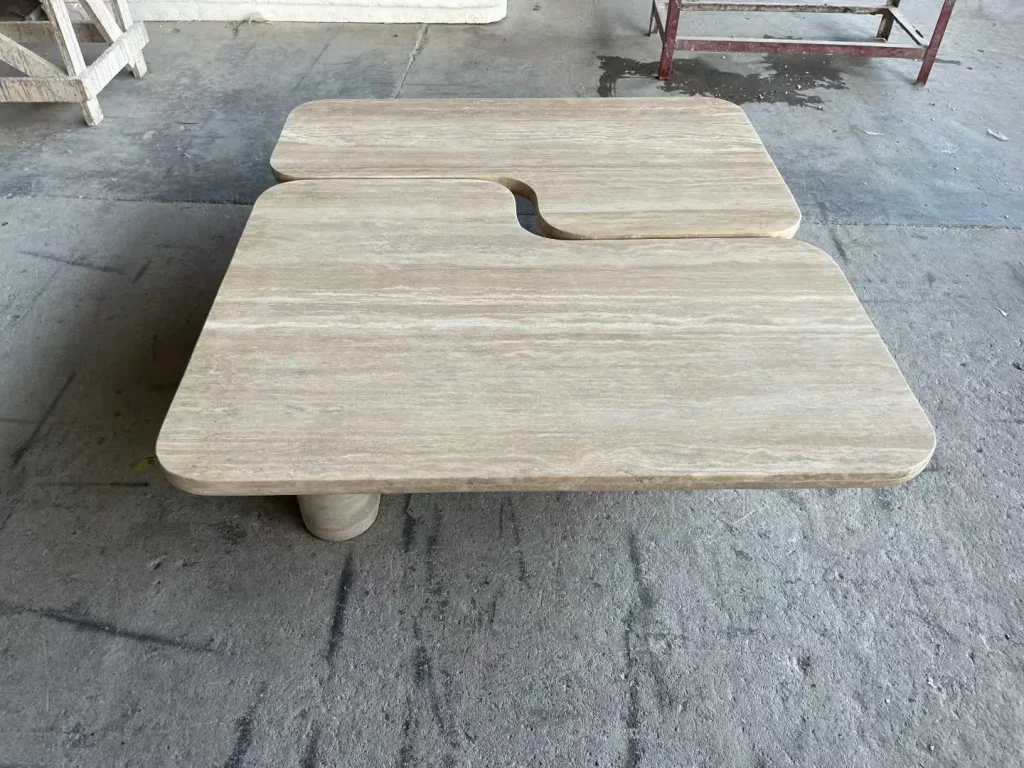
A solid round travertine top at 900 mm diameter and 20 mm thick (35.4 × 0.79 in) weighs about 31 kg (67 lb) at 2.4 t/m³; the figure changes with slab density and thickness. Filled, sealed travertine suits daily use when the top has continuous support and spills are wiped promptly.
What dimensions and weight should a round travertine coffee-table quote show?
A useful quote fixes diameter, thickness, base footprint, fill, edge and sealing before it gives a weight.
| Specification | Planning basis and condition |
|---|---|
| Diameter | 800–1,000 mm (31.5–39.4 in) suits many two- and three-seat sofas. |
| Height | 400–450 mm (15.7–17.7 in) for many lounge settings. |
| Thickness | 20 mm (0.79 in) needs support; 30 mm (1.18 in) adds weight. |
| Top weight | At 2.4 t/m³: 800 × 20 mm ≈ 24 kg (53 lb); 900 × 20 mm ≈ 31 kg (67 lb); 1,000 × 20 mm ≈ 38 kg (84 lb). |
| Approval | Inspect the top slab in the specified finish. |
How do round, oval and square travertine tables change the room plan?
Choose round when people pass close to the table; it reduces projecting corners but still needs a stable base. Oval tops hold more books or a tray, while square tops align with rectilinear seating.
Stock and custom production are available with a minimum order of 1 piece; request this category's product list.
Request product listThe grid follows collection filters and is not evidence of stock. Check the lift, stair and turning circle before production.
More stone coffee tables in selected finishes
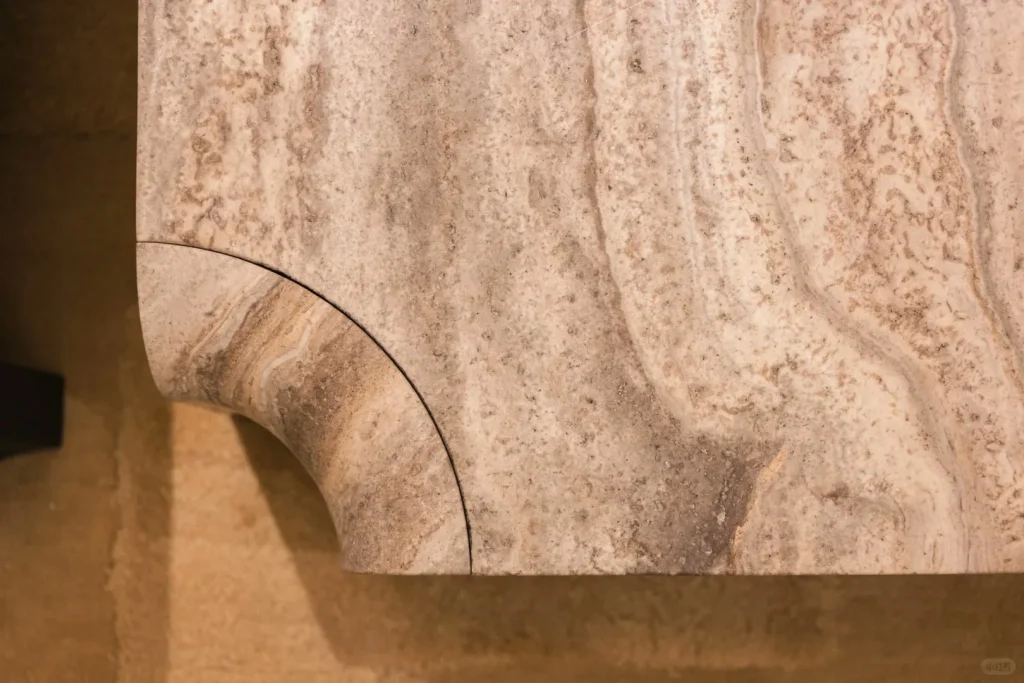
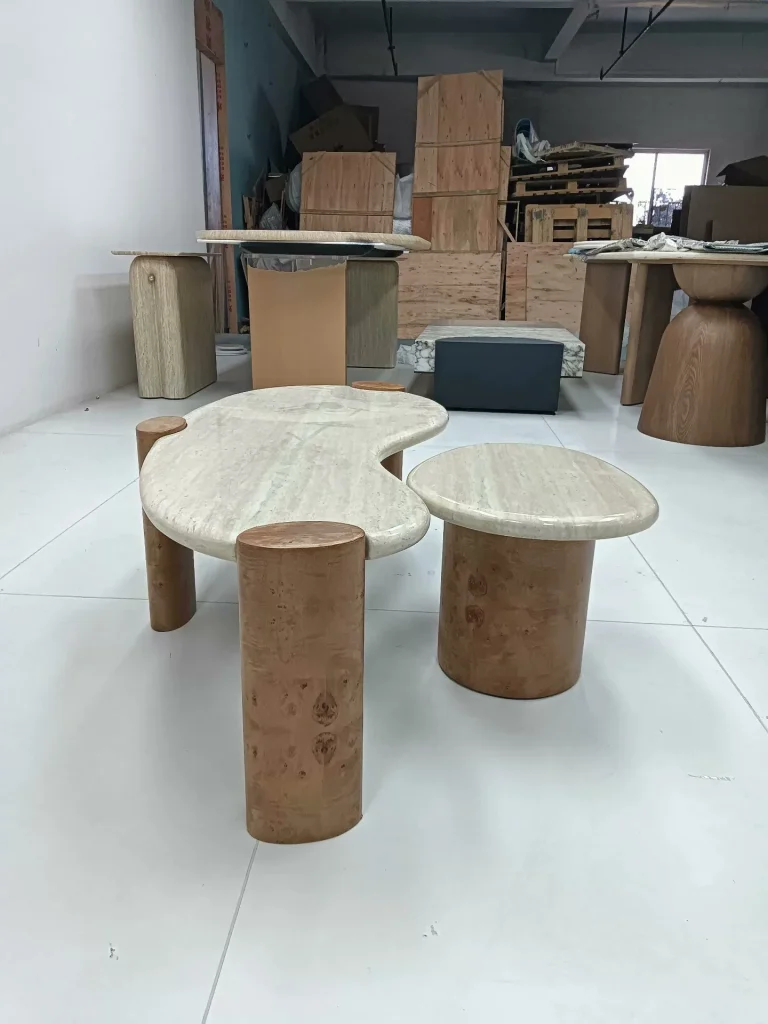
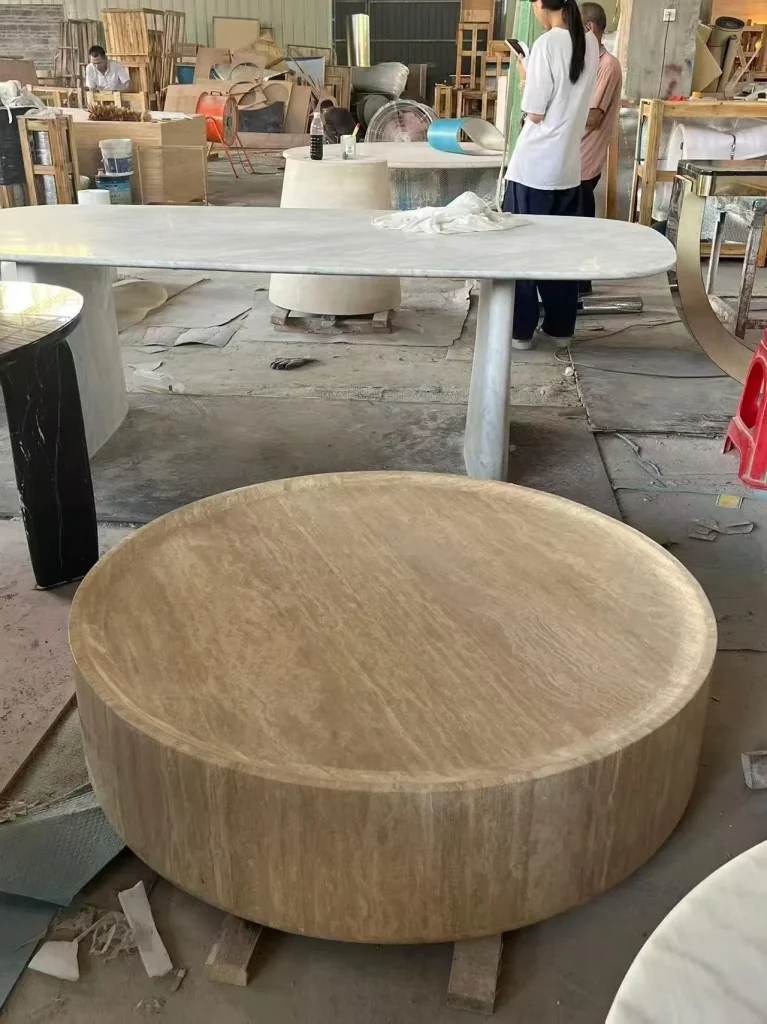
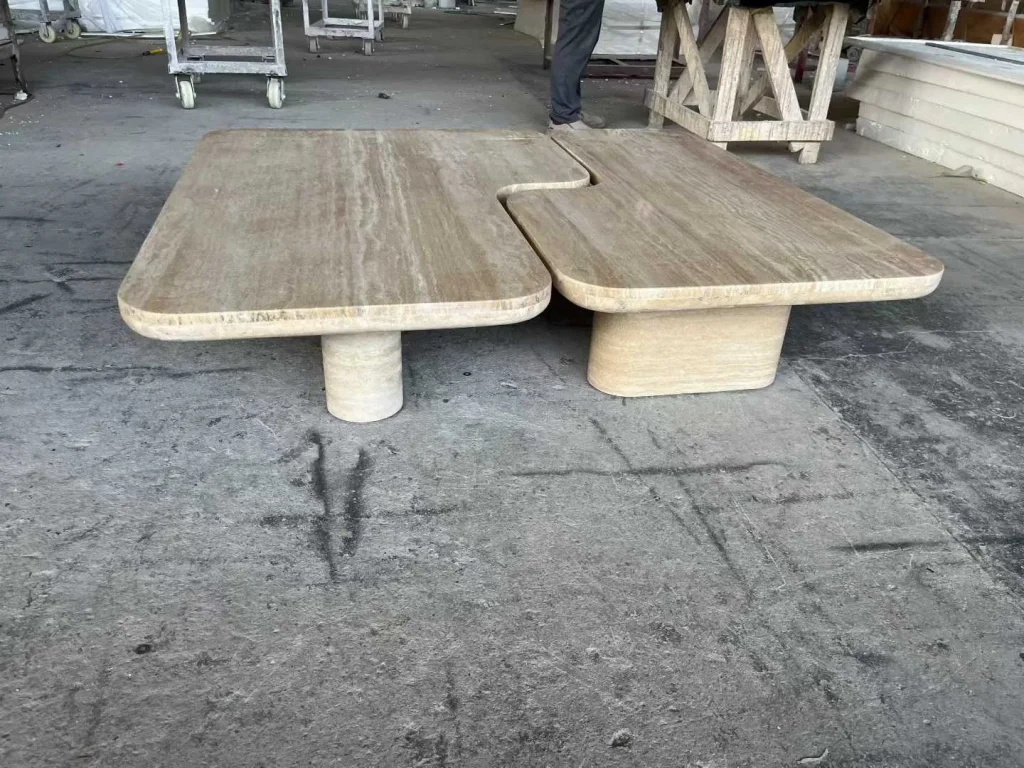
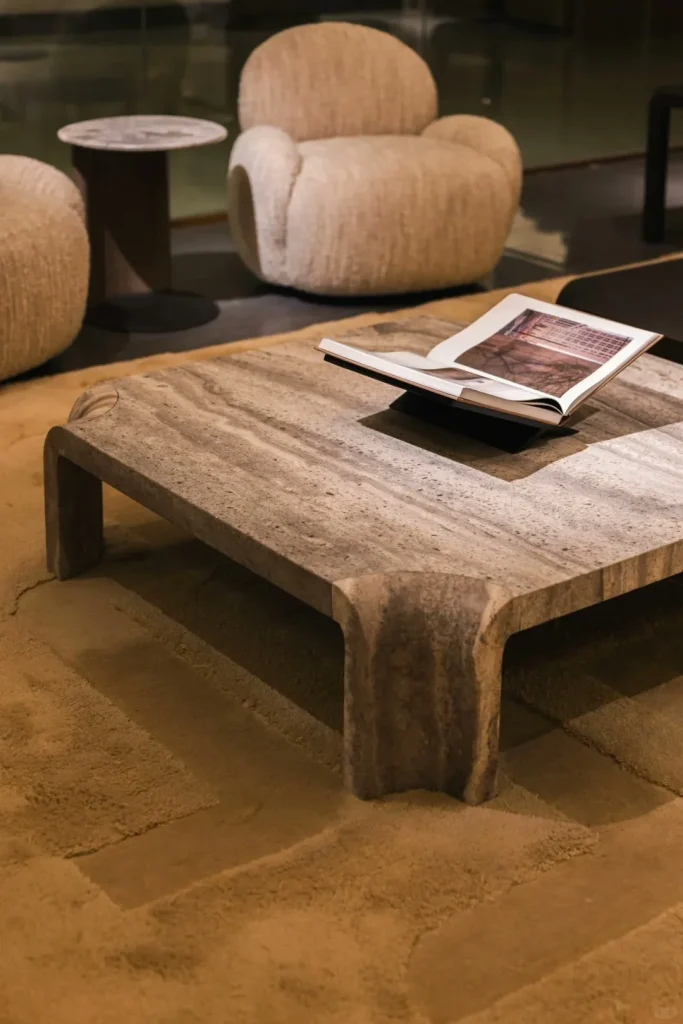
Is travertine good for a round coffee-table top?
Yes, when filled, sealed and supported; open travertine suits low-traffic use where pits are intended. Calcium carbonate makes either surface acid-sensitive.
| Finish | Effect | Use condition |
|---|---|---|
| Filled, honed | Low sheen; marks show less. | Everyday use with prompt cleaning. |
| Filled and polished | Reflective; rings and etching show readily. | Controlled use with coasters. |
| Unfilled | Open voids trap crumbs and moisture. | Dry, low-traffic or rustic settings. |
| Textured | Changes touch and softens the edge. | Approve the exact sample. |
Sealer slows absorption but does not make travertine acid-proof. Wine, citrus, vinegar and some bathroom cleaners can dull a polished face.
Which travertine name should be approved for the slab?
Choose the visible slab, not its commercial color word. Catalog names do not standardize quarry, fill or finish.
| Catalog name | Name cue | Slab check |
|---|---|---|
| Travertino silver | Cooler gray-brown | Band contrast and fill. |
| Beige Travertino | Warm cream | Light shift across the circle. |
| Travertino bianco | Pale background | Dirt, fill and staining. |
| Travertino rosso | Warm red-brown | Color variation and edge match. |
Mark the circle before cutting. Keep a repaired void away from the seating edge and inspect both faces when exposed.
Which commercial facts must be confirmed before comparing quotations?
Minimum order, time and price remain quotation fields, not public facts.
| Commercial field | Current evidence status |
|---|---|
| Minimum order | 1 piece |
| Production time | About 20 days production + about 30 days shipping; production starts after deposit receipt and drawing confirmation |
| Price band | Coffee-table quote on request through Contact |
Two quotes match only when support, slab, sealing and packing scope also agree.
How does round travertine compare with marble and onyx for a coffee table?
Travertine generally weighs less than marble at identical dimensions. Both are carbonate stones; onyx varies heavily by slab.
| Stone | Density | Distinctive issue | Design consequence |
|---|---|---|---|
| Travertine | 2.2–2.7 t/m³ (137.3–168.6 lb/ft³) | Pits and voids | Choose fill; seal the edge. |
| Marble | 2.5–2.8 t/m³ (156.1–174.8 lb/ft³) | Acid-sensitive calcite | Expect more weight; inspect veins. |
| Onyx | 2.4–2.7 t/m³ (149.8–168.6 lb/ft³) | Strong slab variation | Approve slab and backing. |
| Limestone | 2.1–2.7 t/m³ (131.1–168.6 lb/ft³) | Variable porosity | Confirm sealing for the stone. |
These are reference bands, not slab tests. See the Travertine reference and ASTM C1527.
What daily care keeps a filled travertine coffee table from staining?
Remove spills quickly, dust with a dry cloth and use pH-neutral stone cleaner. Place coasters under wine, coffee and citrus.
- Blot a spill instead of spreading it into the pits.
- Rinse with clean water and dry the surface after cleaning.
- Check the sealer on a spare sample and follow its label for reapplication.
document the cleaner and sealer. Identify whether a persistent mark is residue, absorbed liquid or an etch before polishing. The Natural Stone Institute care guidance explains finish-specific care.
Which round travertine choices do buyers ask about most?
Is travertine good for tabletop?
Yes, filled and sealed travertine can work when the slab is sound and continuously supported. A filled surface is easier to wipe around drinks than open pores, but its linear voids remain visible. Avoid acidic cleaners because the carbonate stone can etch.
How much floor space should a 900 mm round travertine table leave?
A 900 mm (35.4 in) top covers about 0.64 m² (6.8 sq ft), and the base needs additional room. Mask the tabletop and a 450–600 mm (18–24 in) walking zone on the floor. Check door swings and sofa access before fixing the diameter.
Why are travertine coffee tables so expensive?
Price reflects usable slab area, pattern matching, cutting, filling, finishing, sealing, support, packing and freight. A 900 mm circle wastes more slab than its area suggests. Compare quotes only when diameter, thickness, fill, finish and base match, and ask for scope.
Which edge profile works on a 30 mm travertine top?
A flat-polished edge, small chamfer or restrained bullnose can suit a 30 mm (1.18 in) top. The profile affects comfort and apparent thickness. Ask for an edge sample in the approved travertine: a deep round-over exposes more pits, while a sharp square edge chips more readily.
Where should I go next after choosing a round travertine table?
Project inquiry
Request a stone furniture quote
Send dimensions, material direction and quantity for a comparable reply.
Useful details include product type, finished dimensions, quantity and destination.
Who wrote and checked this page?
- Travertine is often porous limestone; public density is 2.2–2.7 t/m³ (137.3–168.6 lb/ft³). Travertine reference
- Weights use a solid-cylinder calculation at 2.4 t/m³ (149.8 lb/ft³). ASTM C1527
- Sealing does not make calcium-carbonate stone acid-proof. Natural Stone Institute
- Catalog names do not establish quarry, grade or stock. USGS glossary