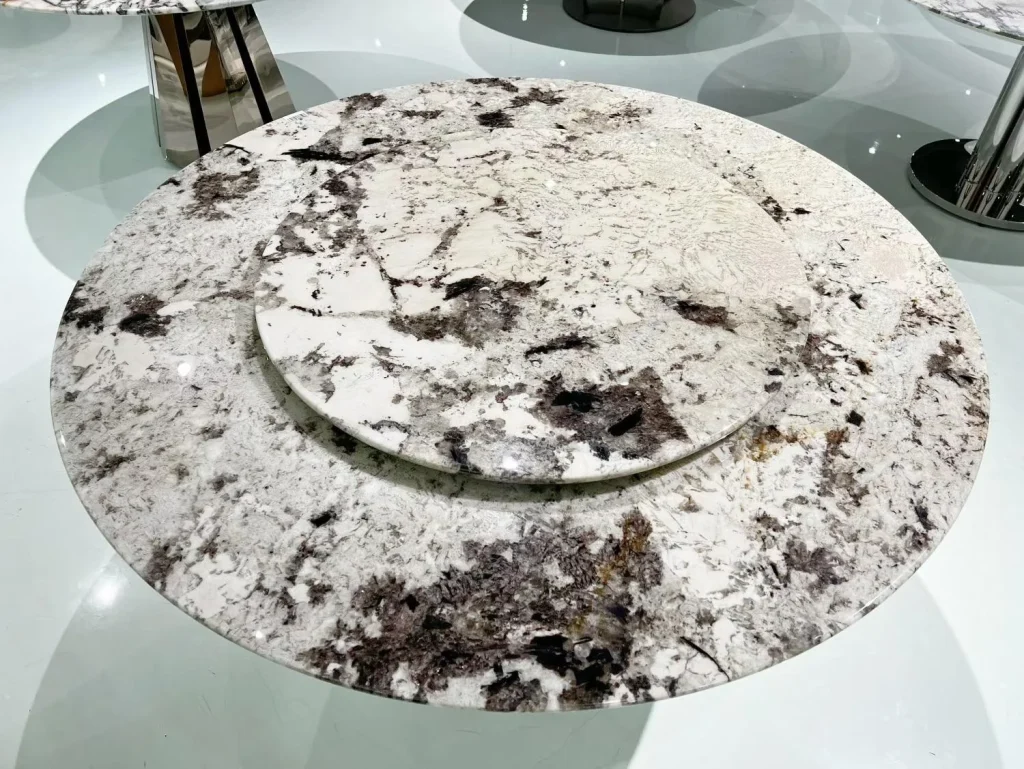
For frequent dining, choose a medium-tone marble with low-contrast movement and a honed finish, such as Daino Reale or Century Beige. A six-seat 1,800 × 900 mm (70.9 × 35.4 in) top at 20 mm (0.79 in) and 2.7 t/m³ (168.6 lb/ft³) weighs about 87.5 kg (193 lb). Confirm thickness, support and slab.
Which marble should be the default choice for a dining table?
The best default is a visually calm, repairable marble whose slab can produce the finished top without an awkward seam. White-and-violet showpieces are valid choices when the room is designed around the stone and the household will manage acidic spills.
| Marble | Typical appearance | Dining-table role | Condition to check |
|---|---|---|---|
| Daino Reale | Beige and gray marble | Calm everyday option | Confirm the selected slab’s actual tone, finish and variation |
| Century Beige | Beige marble | Low-contrast warm surface | Check whether the face is quiet enough for the table size |
| Calacatta Viola | White field with violet and burgundy movement | Feature table for a controlled dining room | Approve slab yield, seam and acid-spill routine |
| Statuario | White field with gray veining | Bright, graphic dining surface | Check contrast against chairs, floor and service ware |
| Arabescato Corchia | Gray-white with strong veining | Distinctive but more patterned | Plan the seam through the strong movement, not across it |
| Nero Marquina | Black field with white veining | High-contrast statement table | Check dust visibility and pale etch marks under room light |
| Emperador | Brown with dark and light variants | Warm, lower-glare room palette | Distinguish the exact commercial variant before approving |
| Verde Alpi | Green field with white movement | Strong colour-led interior | Inspect fissures, backing and the exact name on the slab |
These names describe color and movement; they do not confirm quarry, hardness or current stock. For a named slab, request its technical sheet and inspect the face and edges.
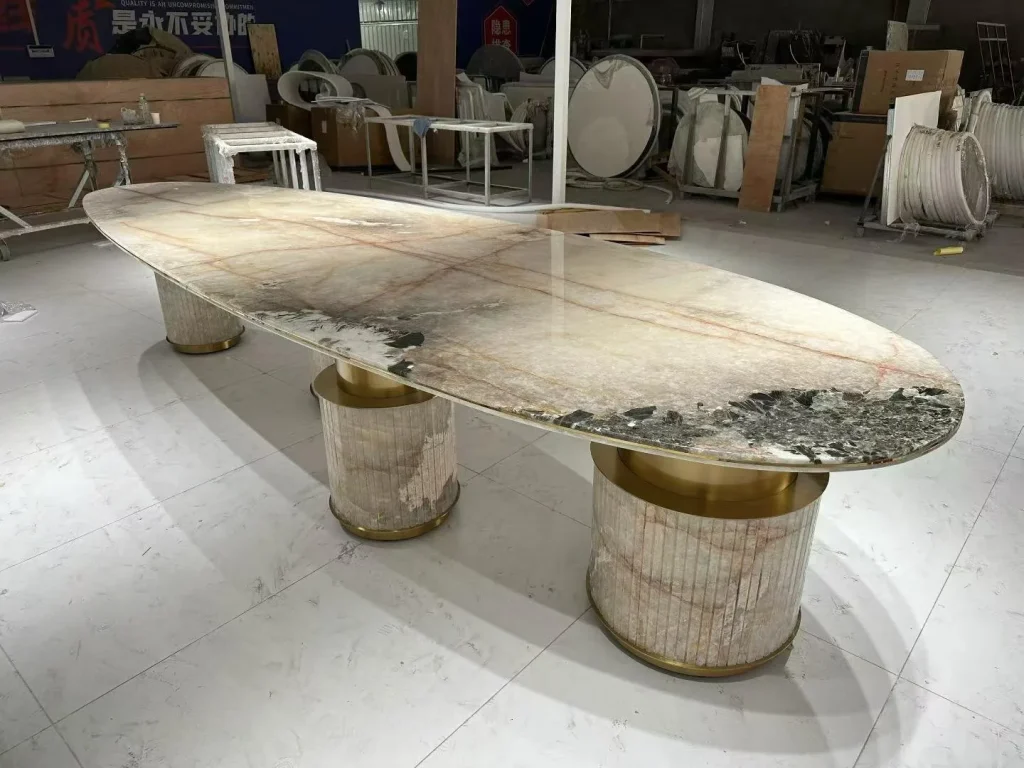
What makes one marble better at mealtimes than another?
Dining performance comes from the combination of visual contrast, surface finish, slab layout and structure. A beautiful white marble with an inconvenient seam or an unsupported overhang can still make a poor dining table.
Why is a lower-contrast stone easier to live with?
A pale, highly veined top makes every dark crumb, glass ring and oil splash a separate visual event. A medium-tone field with quieter movement blends small marks better while keeping the stone recognizable. This is a visual argument, not a claim that the surface becomes stain-proof.
Dark marble flips the problem: it may hide some wine colours but reveal flour, chalky etch marks and fingerprints. Match the dining routine and lighting to the stone rather than assuming one color is universally easier.
Does honed or polished marble make a better dining top?
A honed finish is usually the better starting point for a dining table because it scatters light and keeps reflections calmer. Fine surface marks can be less obvious than on a mirror polish. Polished marble sharpens vein contrast and reflects place settings, but a dull etch interrupts that reflection clearly.
Neither finish changes the acid reaction of carbonate marble. Compare the two using the honed versus polished marble guide, then ask for a physical sample in the intended lighting.
How many people can a given slab size serve?
Use a planner allowance near 600 mm (24 in) of table edge per diner, plus shared serving space. A six-seat rectangular table commonly lands around 1,800 × 900 mm (70.9 × 35.4 in), but seating depth, bench use, chair arms and circulation still need checking with the actual base.
| Planner layout | Nominal top | Top weight at 20 mm (0.79 in) | Top weight at 30 mm (1.18 in) |
|---|---|---|---|
| Four diners | 1,200 × 900 mm (47.2 × 35.4 in) | 58.3 kg (129 lb) | 87.5 kg (193 lb) |
| Six diners | 1,800 × 900 mm (70.9 × 35.4 in) | 87.5 kg (193 lb) | 131.2 kg (289 lb) |
| Eight diners | 2,400 × 1,000 mm (94.5 × 39.4 in) | 129.6 kg (286 lb) | 194.4 kg (429 lb) |
Weights use 2.7 t/m³ (168.6 lb/ft³) and exclude edge build-up, backing and base. For sizing details, see the dining table size guide.
When does a marble dining table need a seam?
A seam is needed when the finished top cannot be recovered from the selected usable slab area while preserving the required pattern, edges and supports. Two smaller tables may each fit one slab, but an eight-seat top may require a joint and book-matched pair.
A seam through an active vein can become nearly invisible if selected deliberately; a random break can make the pattern look interrupted. Ask for a scaled drawing that marks the joint, slab number and visible face. Avoid choosing a seam point from a rectangle alone.
How does the table base affect the marble choice?
A busy stone with a visually deep edge may need a simpler base; a calm stone can carry a more sculptural pedestal. Structurally, the base must support the load at the specified overhang without obstructing knees. A stone with fissures or backing can also have a different acceptance check than a sound slab.
The top thickness must be selected together with the span. Use the marble tabletop thickness guide for the structural decision, and ask the supplier to confirm the finished thickness, support layout and calculated mass for the exact drawing and material.
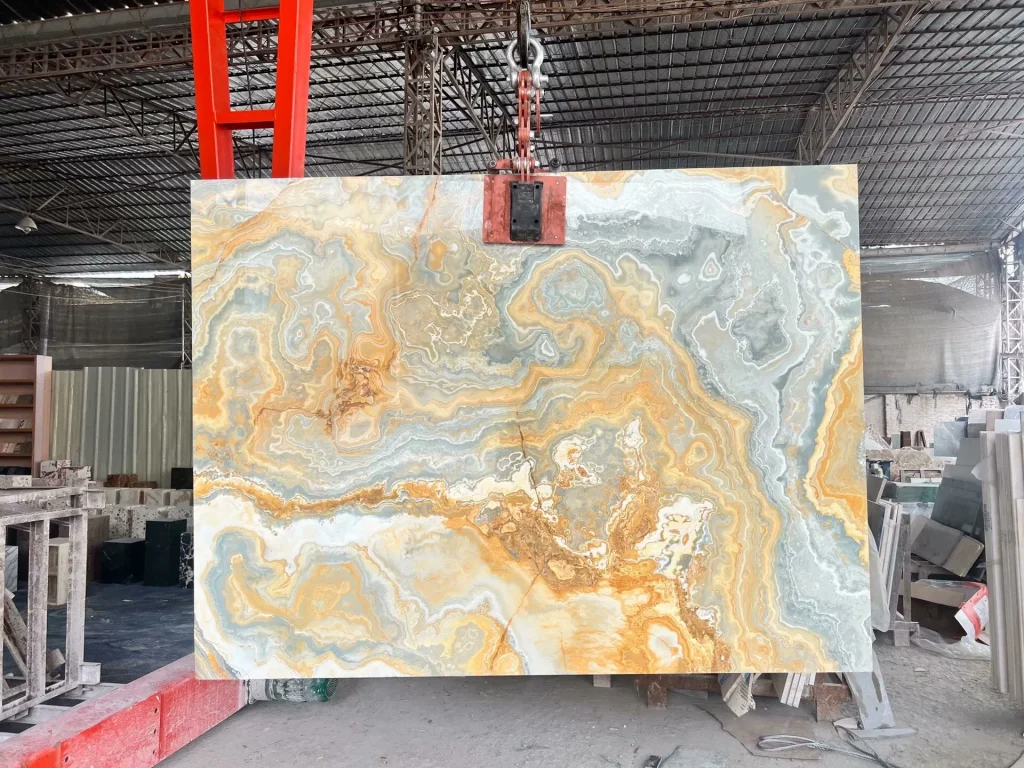
What belongs on a marble dining-table approval sheet?
A useful approval connects the named slab to a furniture drawing and a care expectation. Without that link, a change in thickness, seam or finish can be lost between the showroom and production.
| Approval field | What it should capture |
|---|---|
| Stone identity | Commercial name, alias, slab number, region only if verified, and finished face |
| Top drawing | Length, width, thickness, seam, edge section, overhang and cutouts in mm and in |
| Support drawing | Base footprint, fixing method, bearing points and chair clearance |
| Surface sample | Finish name and a physical sample viewed in the dining room or equivalent light |
| Care plan | Neutral cleaner, tested sealer if used, coasters for acidic drinks and spill response |
No measured workshop slab-yield result is claimed here. Slab evidence and available dimensions must be confirmed for the exact slab offered at quotation.
How do you choose a dining-table marble without regret?
Work from the way the table will be used, then filter stones by whether their slabs can make the required top.
- Measure the room, seating positions and access route before choosing a stone or table length.
- Rank the brief by color contrast, maintenance tolerance and whether the top should be a focal point or a quiet background.
- Shortlist two or three materials and request actual slab photographs, not only a sample chip.
- Draw the finished top with seam, edge and base support. Calculate weight at the intended thickness.
- Approve finish and slab in person or through calibrated, date-stamped photographs under the specified lighting.
- Write down the care routine and the person who will respond to spills. An unsigned routine tends to become nobody’s routine.
The final choice should have a fallback slab. If the first slab is rejected during layout, the fallback should be visually and technically comparable rather than merely another stone of the same name.
Which marble dining tables best express these stone choices?
Start with the room’s dominant direction, then choose the collection whose stone movement and table geometry support it. The table shape affects both seating and how much uninterrupted face remains.
Browse marble and stone dining tables for the category, round marble dining tables for more conversation-led seating, and oval marble dining tables where corners and circulation matter. For bright interiors, compare white marble dining tables; for a darker room, review black marble dining tables.
Use marble for furniture to compare the material family, or read Calacatta Viola’s specific variation notes before treating it as a visual alternative to a calmer beige.
Which dining-marble compromise is usually worth making?
Calm movement and a reliable slab layout are usually worth more than a famous name. Thickness can be increased with structure or edge design, but a slab that is too short or heavily flawed cannot be made larger.
Which marble color is most forgiving on a dining table?
A medium-tone beige or gray marble with low-contrast movement is usually more forgiving than a bright white field with dense veins. Dark stone can hide some spills but show dust and pale etching clearly. Honed surfaces scatter reflections and can make small marks less obvious than a high polish.
Is white marble unsuitable for a dining table?
White marble is suitable if the table is protected, promptly wiped and accepted as a surface that will age. Wine, citrus, vinegar and some cleaners can etch carbonate stone, and dark stains are conspicuous on a pale field. A honed finish and a calm vein pattern reduce visual disruption, but neither prevents chemical damage.
Can an eight-seat marble dining table be cut from one slab?
It can only be confirmed against the selected slab’s actual dimensions. A planner size near 2,400 × 1,000 mm uses substantial area, and matching the perimeter may leave too little usable field. Ask for a scaled cutting diagram showing slab size, flaws, seam and edge direction. Do not assume a nominal slab size is available.
Which edge profile is best for a marble dining table with children?
A softly eased or small-radius edge reduces the hard, abrupt corner compared with a square edge, but no edge profile makes a heavy stone top child-safe. The top still needs stable support, controlled overhang and secure attachment. Use a small rounded edge only when the furniture drawing and upholstery clearance allow it.
Who wrote this dining-table marble guide?
- Wikipedia’s marble reference identifies marble as a metamorphic carbonate rock; the named stones still need slab-specific technical details from the supplier.
- The Mohs scale places calcite at 3, supporting the distinction between everyday scratching and acid etching.
- Natural Stone Institute care guidance recommends pH-neutral cleaners and prompt treatment of acidic spills on natural stone.