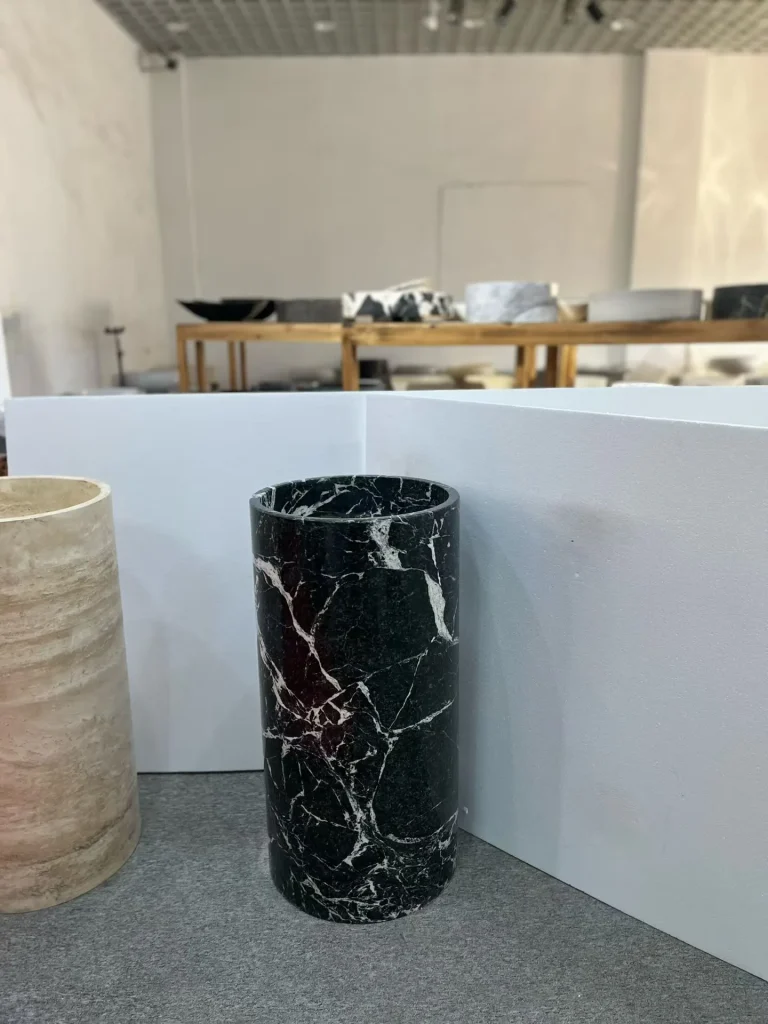
A display plinth is stable when its top exceeds the object’s base by 50–100 mm (2–4 in) per side and remains within floor-load and circulation limits. A 300 × 300 × 900 mm (11.8 × 11.8 × 35.4 in) marble block weighs 218.7 kg (482 lb), so decide hollow construction and lifting route before finish.
What information defines a marble plinth or pedestal?
Overall height, top footprint, bearing area and construction define the piece more clearly than a product name. The same outline can be solid stone, hollow stone or a thin stone skin, with very different weight and stability.
| Specification | Why it changes the result |
|---|---|
| Overall height | Sets the object’s display level and the visual relationship to nearby furniture |
| Top footprint | Provides bearing area and determines the visible reveal around the object |
| Top thickness | 20 mm (0.79 in) suits a protected indoor top; 30 mm (1.18 in) gives a stronger exposed edge where structure allows |
| Construction | Solid, hollow or stone-clad sections differ in weight, fixing and impact resistance |
| Base contact | A broad, level bearing area spreads load and reduces rocking |
| Finish and terms | Surface choice affects visible dust; confirm quantity and schedule in a quotation |
Which type of marble base matches the object?
Use a low plinth for a tabletop object, a waist-high pedestal for sculpture, and a taller column for eye-level display.
- Travertine console tables show how a stone support can sit beneath a long top.
- Round marble coffee tables are an alternative when the display surface also needs to be used.
- Marble and stone nightstands apply similar height and wall-clearance thinking beside a bed.
- Stone and marble benches demonstrate the effect of a wide plinth base under a supported seat.
Which plinth and pedestal documents can I compare?
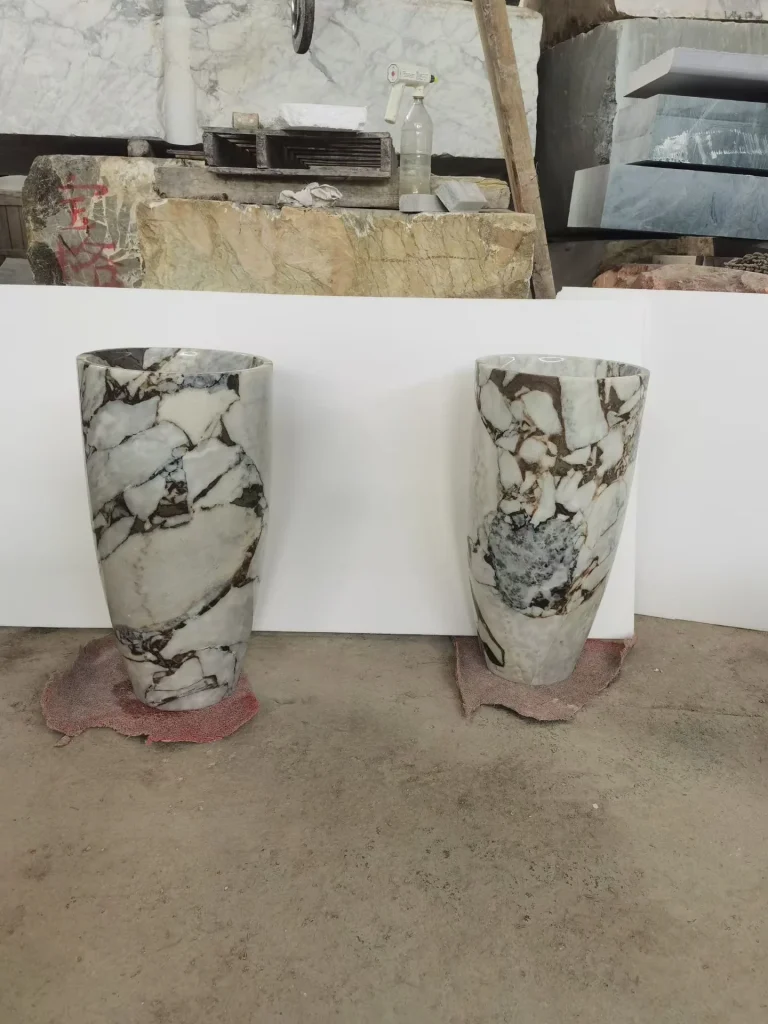
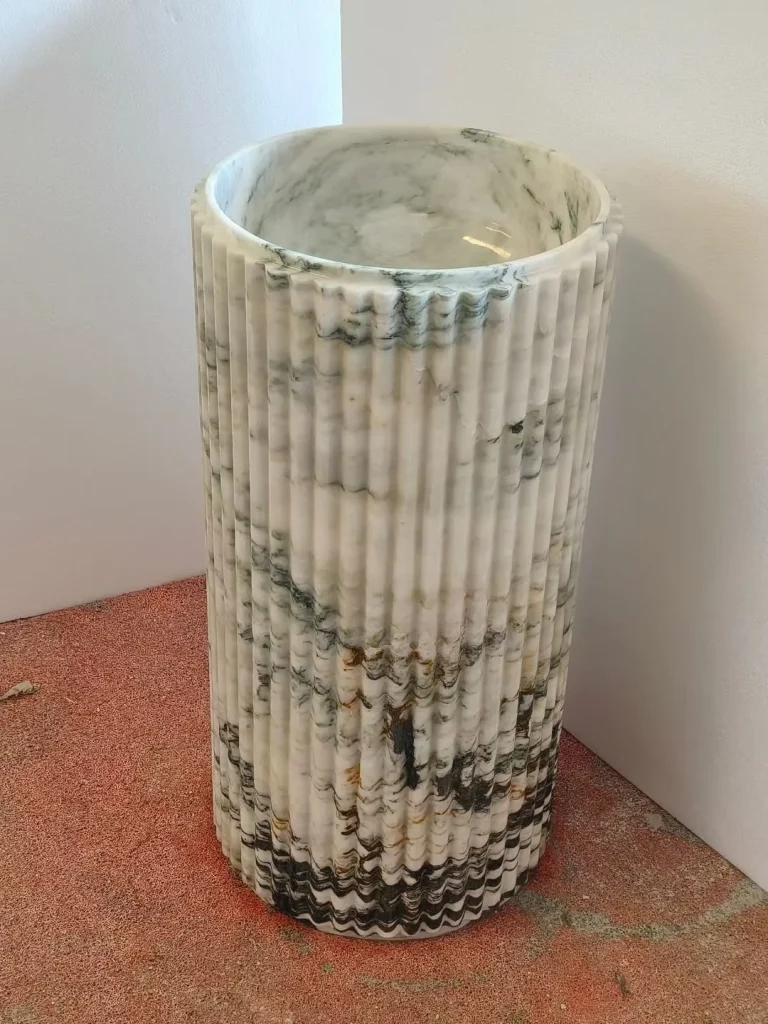
Compare the silhouette, top-bearing area and construction note before treating a photograph as a fabrication specification. A short pedestal can look similar to a tall block while needing a different internal support.
Stock and custom production are available with a minimum order of 1 piece; request this category's product list.
Request product listStone stone plinths and pedestals in our collection
Which stone works best for a display plinth?
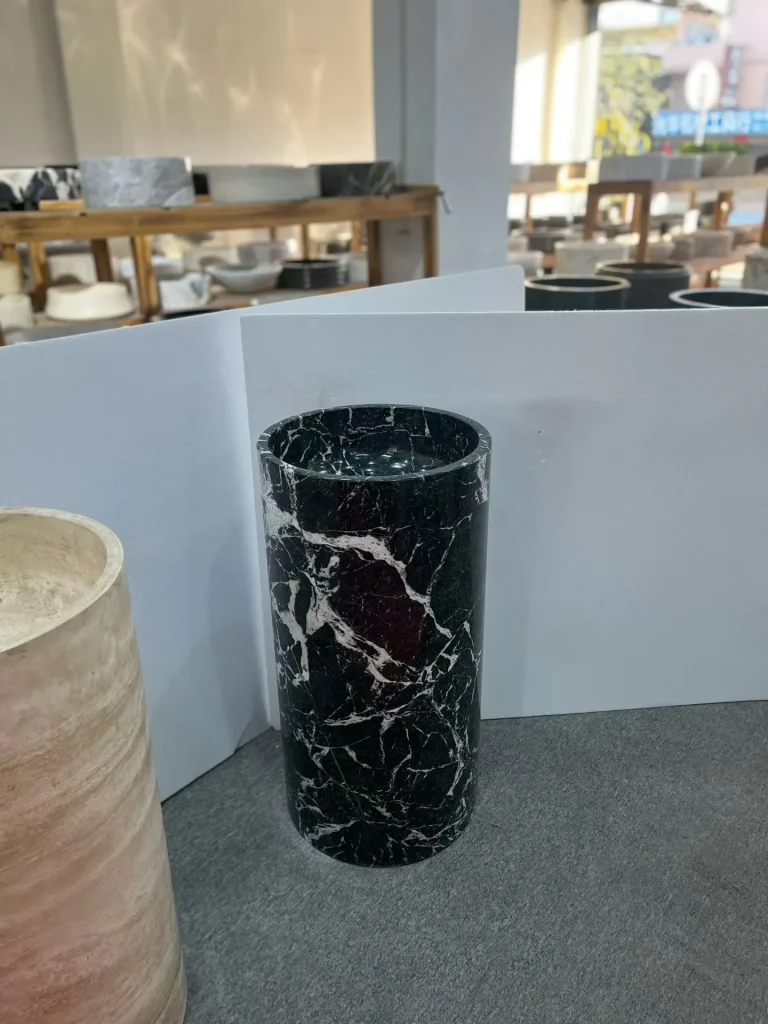
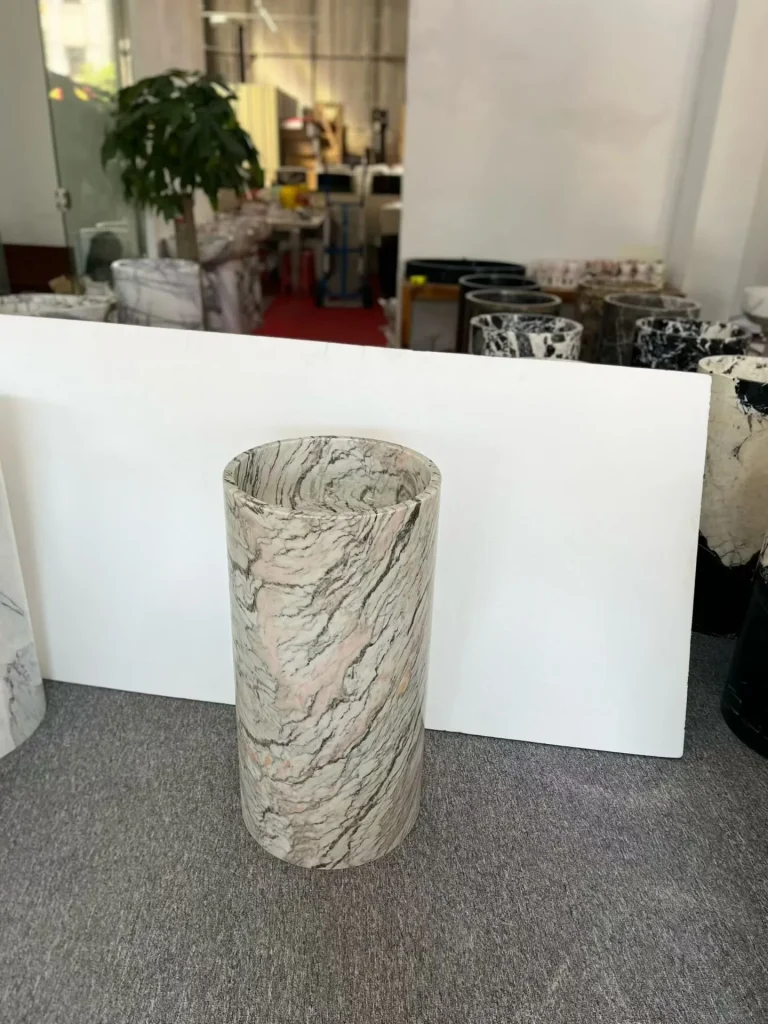
Marble gives controlled colour and veining, travertine offers linear texture, and onyx can create a more dramatic block when its fragility is accepted. Quartzite may suit a demanding setting only after the exact slab, finish and structural detail are confirmed.
| Stone | Visual character | Key constraint |
|---|---|---|
| Marble | Veins, clouds or uniform fields | Calcite-rich surfaces can etch when acids remain on the finish |
| Travertine | Linear bands and pores | Filling changes how the surface reads and how easily it catches dirt |
| Onyx | Banding and directional movement | Use where the top is protected from impact and prolonged water |
| Quartzite | Often crystalline or mineral-rich | Do not infer performance from the broad family name |
Approve visible faces together because a slab cut can change pattern and proportion.
What size plinth will display the object safely?
Set the top width and depth from the object’s actual base, then choose the height from the viewer’s sightline and the surrounding furniture. A plinth that is visually narrow can still be stable if the bearing area and centre of gravity are controlled.
| Intended object | Common display height | Footprint check |
|---|---|---|
| Vase, bowl or tabletop object | 300–600 mm (12–24 in) | Allow about 50–100 mm (2–4 in) around the base |
| Small sculpture | 600–1,000 mm (24–39 in) | Check weight, top overhang and viewing angle |
| Bust or feature artwork | 1,000–1,400 mm (39–55 in) | Address overturn risk and the object’s fixing method |
| Architectural fragment | Height set by the room and sightline | Verify the floor-load path through the base |
These are planning ranges, not load ratings; test the empty base for rocking.
How is a marble plinth made safe to move and display?
The base needs a level bearing area, and any hollow core needs wall thickness and top support suited to the object. A heavy display object should transfer its vertical load toward the middle of the top rather than the thinnest unsupported corner.
| Construction | What to verify |
|---|---|
| Solid block | Finished weight, lifting equipment and floor capacity |
| Hollow column | Wall thickness, core access and reinforcement at the top |
| Stone skin | Joint layout, substrate and edge treatment |
| Top and object fixing | Isolation, reversible attachment and overturn restraint |
| Delivery route | Door width, turning space and protective handling plan |
A 350 × 350 × 1,000 mm (13.8 × 13.8 × 39.4 in) solid column at 2.7 t/m³ (168.6 lb/ft³) is about 330.7 kg (729 lb).
How should a marble plinth be cleaned and handled?
Dust the sides with a soft cloth and blot spills with water and a pH-neutral stone cleaner; do not let acidic drinks or cleaners sit on polished marble. Inspect the top and base corners before moving an object.
- Place a soft pad under a display object if the object’s base could scratch the stone.
- Do not lift a plinth by its top slab or thin edge.
- Keep outdoor plinths drained and clear of soil, leaf litter and continuously wet packing.
- Recheck felt or isolation pads after the object has settled.
What should a custom plinth or pedestal quotation include?
A useful quotation states the object that will be displayed, not only a height and colour. It should show the top plan, bearing area, visible faces, construction and how the piece reaches installation.
| Item | Required answer |
|---|---|
| Order quantity | 1 piece |
| Production timing | About 20 days production + about 30 days shipping; production starts after deposit receipt and drawing confirmation |
| Budget | Plinth quote on request through Contact |
| Availability | Yes, stock is available. Sizes and quantities are not published. |
Provide the object’s base dimensions, weight and centre of gravity; for a set, state matching requirements.
Which practical checks prevent a plinth from looking wrong or feeling unsafe?
Check the object footprint, viewing height, empty-base stability and delivery route together. A plinth that fits the room but cannot pass through the door is not a finished specification.
Can a marble plinth hold a sculpture?
A marble plinth can hold a sculpture when its top bearing area, height and stability are designed for that object. Confirm the sculpture’s weight, centre of gravity and fixing needs rather than sizing from photographs. Keep the object footprint within the supported top, allow a small reveal, and anchor or secure the object if it is tall, narrow or exposed to knocks.
What is the difference between a plinth and a pedestal?
A plinth is usually the block-like base directly below an object, sculpture or column, while a pedestal is a freestanding support that may have its own base, shaft and cap. The words overlap in furniture listings. Ask for an elevation with top size, overall height, bearing area and construction so the intended form is clear.
Should a display plinth be hollow?
A hollow plinth is useful when a solid block would be too heavy to move or would put unnecessary load on the floor, but the empty section must leave adequate wall thickness and a supported top. A plinth made from thin panels can look similar while behaving very differently. Compare finished weight, joint positions and the way the top transfers load.
Where should I go next for stone bases and display furniture?
Use the material pages to narrow a finish and the furniture pages to compare how the same stone behaves at a different scale. The destinations below are part of the published URL map.
Project inquiry
Request a stone furniture quote
Send dimensions, material direction and quantity for a comparable reply.
Useful details include product type, finished dimensions, quantity and destination.
What evidence supports these plinth dimensions and weights?
The page combines display conventions with calculated solid-stone volume and public stone references. Neither a design range nor a calculated mass replaces the selected construction drawing or floor assessment.
- A 300 × 300 × 900 mm (11.8 × 11.8 × 35.4 in) solid marble block at 2.7 t/m³ (168.6 lb/ft³) calculates to 218.7 kg (482 lb). Weight method
- A 350 × 350 × 1,000 mm (13.8 × 13.8 × 39.4 in) solid column at the same density calculates to 330.7 kg (729 lb). ASTM C503
- A plinth is generally a supporting base, while a pedestal can comprise its own base, shaft and cap. Pedestal reference
- Natural Stone Institute care guidance supports pH-neutral cleaning and finish-appropriate products. Stone care