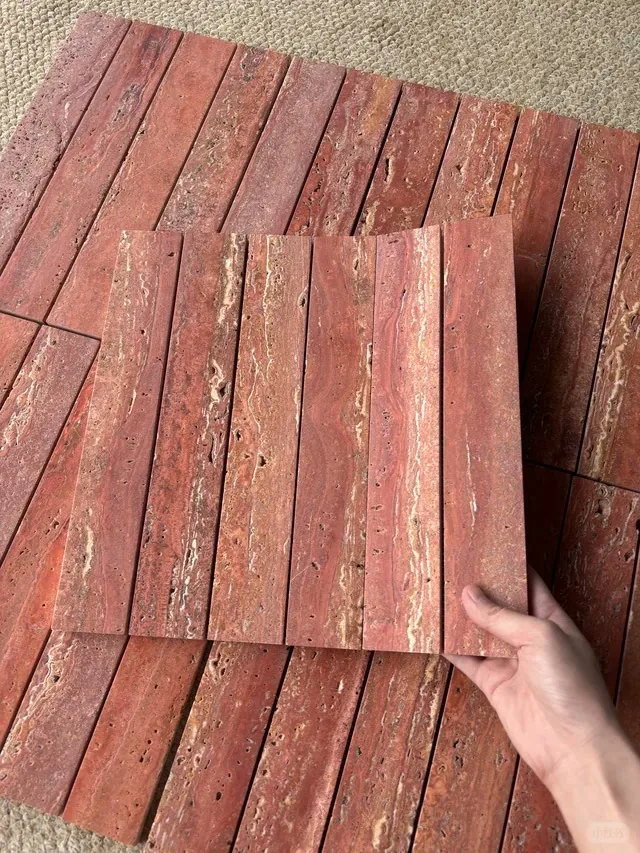
Red Travertine can suit coffee, side and dining tables when the slab is filled, sealed and supported. Its family density is 2.2–2.7 t/m³ (137–169 lb/ft³); exposed pores and directional voids make finish and spill care more important than color alone.
What should I know before choosing Red Travertine?
Red Travertine describes a red-to-coral travertine, but a single quarry, slab size, fill state, finish or current stock cannot be assumed for every slab sold under the name. Ask the supplier to confirm those details in writing for the actual slab, which therefore controls the specification.
| Property | Reference for this page | What remains slab-specific |
|---|---|---|
| Stone family | Travertine, a sedimentary limestone | Exact quarry and commercial grade |
| Working appearance | Red-orange field with linear voids | Pore size, band direction and color uniformity |
| Bulk-density reference | 2.2–2.7 t/m³ (137–169 lb/ft³) | Measured density and reinforcement needs |
| Porosity range | About 10–70% in fresh travertine; older deposits may be about 2% | Whether pores are filled, healed or still open |
| Acid behavior | Calcium carbonate reacts with acids | Sealer, finish and repair compatibility |
At the family density range, a 1,200 × 600 mm (47 × 24 in) top weighs about 32–39 kg (70–86 lb) at 20 mm (0.79 in), and 48–58 kg (105–129 lb) at 30 mm (1.18 in). Those are calculated estimates, not measured product weights.
How can a photo hide problems in red travertine?
A photo can make an unfilled surface look smoother than it feels and can hide rounded pore edges, filler shrinkage or mismatched repairs. Ask for close, neutral-light images before and after filling, plus photographs of both slab faces.
For a tabletop, mark how the linear voids will cross the visible face. Voids that add direction along a long coffee table may look disordered around a small round top. Repairs and filler should be visible enough to judge, not concealed by strong highlights.
Why do cross-cut and vein-cut travertine look different?
The cutting direction changes the visible pattern. A vein-cut slab shows long directional bands and elongated pores; a cross-cut slab usually reveals a more mottled field. Neither cut is automatically better for furniture: the choice depends on the table shape and whether the design wants movement or a quieter field.
| Finish or cut | Visible result | Furniture consequence |
|---|---|---|
| Vein-cut, filled, honed | Linear bands with a level, low-glare surface | Strong direction; seams must follow the pattern |
| Cross-cut, filled, honed | Broad color field with distributed pores | Easier to crop for a compact side table |
| Unfilled, honed | Open texture and deeper pore shadows | More cleaning attention around food and drink |
| Polished | Clearer color contrast and reflected light | Confirm slip resistance and visible wear in use |
Which furniture suits the texture of Red Travertine?
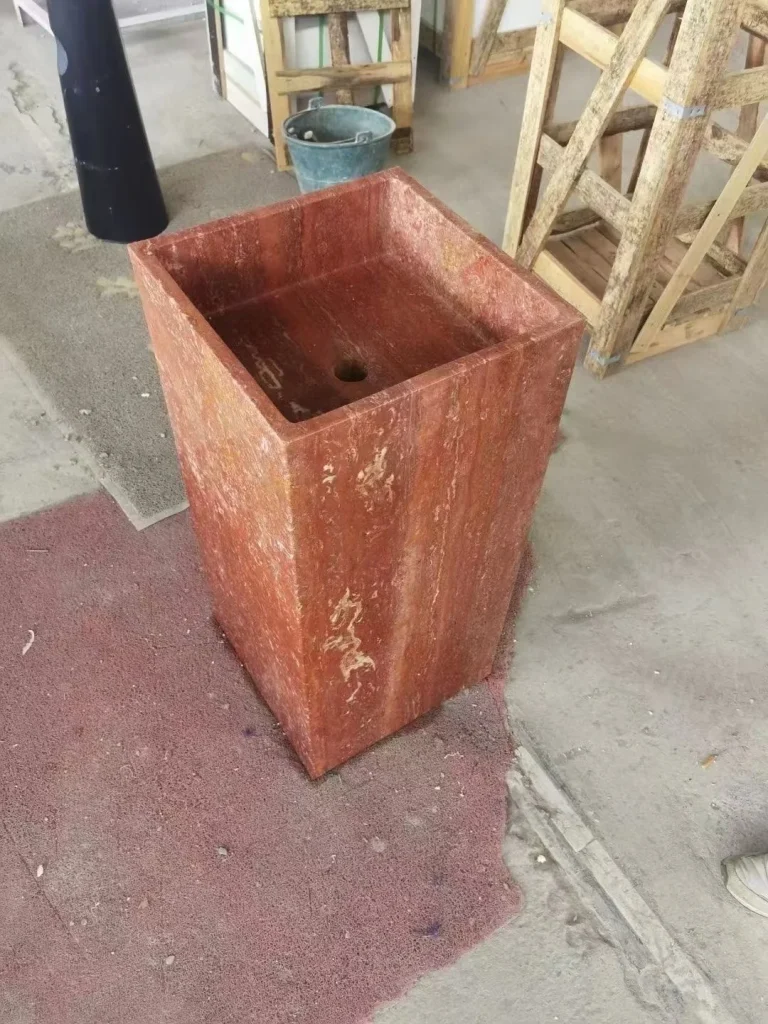
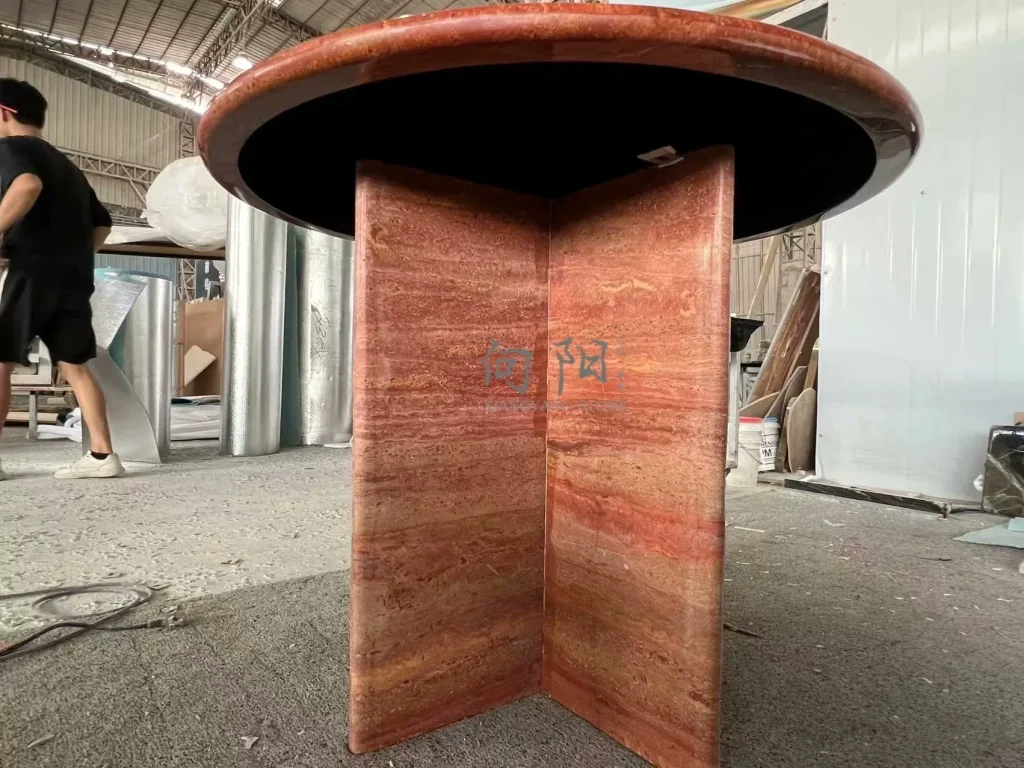
Stone coffee tables and side tables can make the horizontal pore pattern the feature, provided the surface is filled for everyday use. A dining table needs a large enough slab, a flat supporting frame and careful edge treatment around open pores.
Large tables should use a support package reviewed by the fabricator. Do not infer strength from thickness alone, and do not place an open pore on an exposed edge where it can catch fabric or collect residue. The marble tabletop thickness guide gives a framework for comparing 20 mm and 30 mm construction.
What colors work with red and coral travertine?
Warm cream and sand let the red field carry the room; olive and charcoal add contrast without competing. Use textiles and metals that differ from the stone in texture, then check samples under daylight and evening lighting.
| Palette | Effect | Check before approval |
|---|---|---|
| Chalk white and oat linen | Fresh contrast for a red-orange field | Compare warm whites for a harmonious match |
| Olive and mushroom | Muted earth tones support the texture | Keep adjacent saturation below the slab |
| Charcoal steel | Graphic contrast for a compact table | Confirm the visual weight suits the top size |
| Walnut and aged bronze | Warm, textured pairing | Test both finishes against the slab’s undertone |
Which price variables change a Red Travertine table?
Quote amounts vary with the selected Red Travertine slab grade, finished size and quantity. Share a slab photo and the finished dimensions on the Contact page for pricing. Fill method and usable slab area can change the result even when the surface color looks similar.
What are the main weaknesses of Red Travertine?
Open pores hold soil, filling can shrink or become conspicuous, and acids can damage the calcium-carbonate surface. Dust or blot with a soft cloth, use a pH-neutral stone cleaner and wipe spills promptly. Avoid vinegar, citrus cleaners and abrasive pads unless the fabricator approves a controlled repair procedure.
Travertine’s sedimentary origin and variable porosity are described in the Wikipedia travertine reference. Its visible texture is not damage by definition, but open pores require a deliberate fill and maintenance decision.
Which lighter and denser stones should be compared?
Compare Beige Travertine for a quieter warm field, Burgundy Marble for a denser red-violet appearance, or the travertine family guide for formation and finish context.
| Alternative | Visual difference | Trade-off to review |
|---|---|---|
| Beige Travertine | Lighter beige-to-yellow field | Similar pore care, different color layering |
| Burgundy Marble | More even red-violet field | Carbonate marble remains acid-sensitive |
| Azul Macaubas Quartzite | Blue field and denser quartz-led appearance | Confirm the actual slab’s subtype and repairs |
What should be fixed before Red Travertine is cut?
Approve the slab number, cut direction, fill method, finish, visible face and seam layout before fabrication. Mark any fragile pore cluster or patch repair, and ask for the table base drawing with support beneath seams and overhangs. Confirm the lifting route for the finished top.
Browse stone side tables or marble and stone coffee tables to shortlist forms. Use the stone furniture weight calculator for early planning, then replace its assumed density with the measured density of the actual slab.
FAQ
Sources and further reading
- Travertine — sedimentary formation, porosity and color range.
- Limestone — carbonate-rock context for the travertine family.
- Natural Stone Institute — neutral cleaning and sealing guidance.
- Amazstone catalog, 2026: no dedicated Red Travertine entry with quarry or finish details.