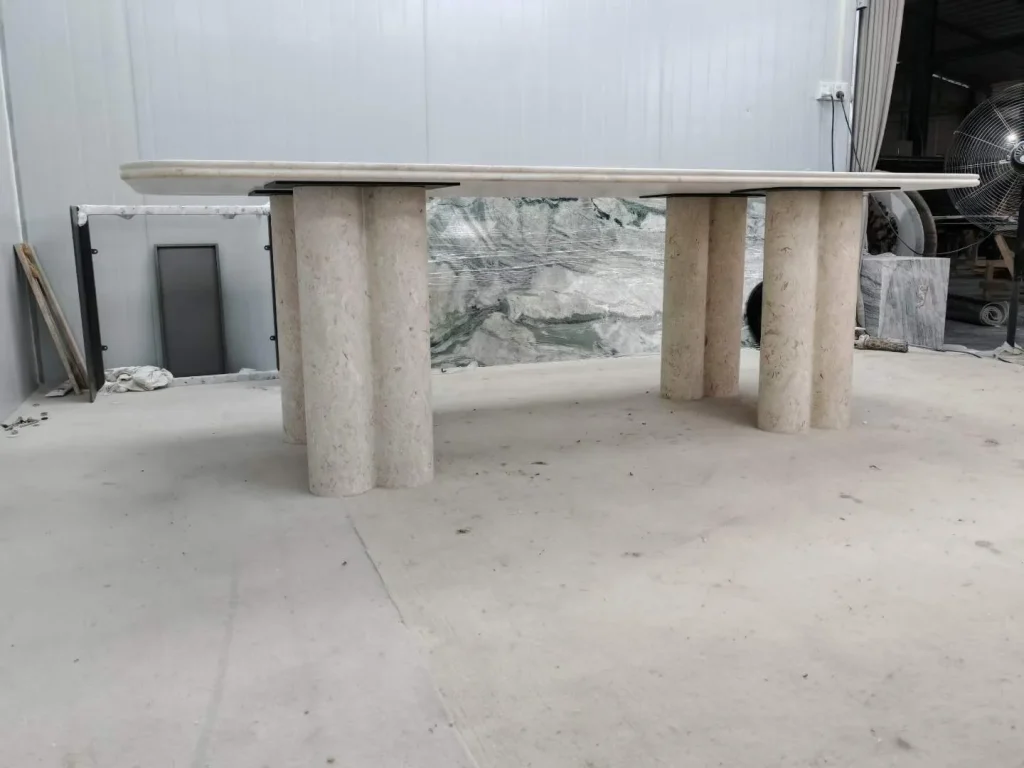
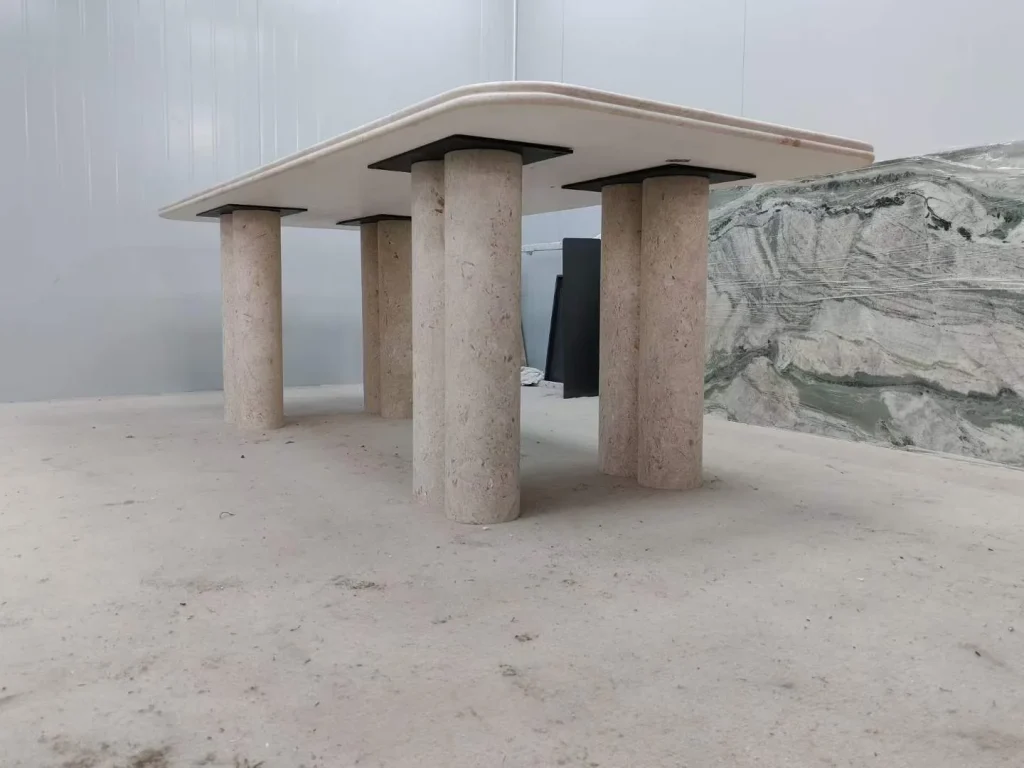
Plan a travertine dining table 720–760 mm (28–30 in) high, with about 600 mm (24 in) of edge per diner and chair pull-out checked before choosing a 1,400 mm (55 in) four-seat or longer top. A 20 mm (0.79 in) slab needs engineered support; 30 mm (1.18 in) still needs a frame.
Diner clearance sets the dining-table length before the stone pattern does
Use diner count, chair width, and circulation to establish a working length. For two diners per long side, the planning lengths below provide about 600 mm (24 in) per place before room clearance.
| Dining plan | Working top size | Seating condition | 20 mm (0.79 in) solid weight |
|---|---|---|---|
| Four diners | 1,400 × 800 mm (55 × 31 in) | Two per long side; verify chair arms | 49.3–60.5 kg (108.7–133.4 lb) |
| Six diners | 1,800 × 900 mm (71 × 35 in) | Three per long side; check ends if used | 71.3–87.5 kg (157.2–192.9 lb) |
At 30 mm (1.18 in), that 1,800 × 900 mm (70.9 × 35.4 in) top is about 106.9–131.2 kg (235.7–289.3 lb), excluding base and crate.
Match the top shape to the room’s circulation, not only the room’s style
Rectangular tables maximize settings along two sides, oval tables soften corners, and round tables change reach and circulation. The filtered grid shows matching documents; dimensions and base geometry still require a drawing.
Stock and custom production are available with a minimum order of 1 piece; request this category's product list.
Request product listCheck chair-back clearance for a deep rectangular top; for a round table, verify the widest diameter and chair pull-out.
More stone dining tables in selected finishes
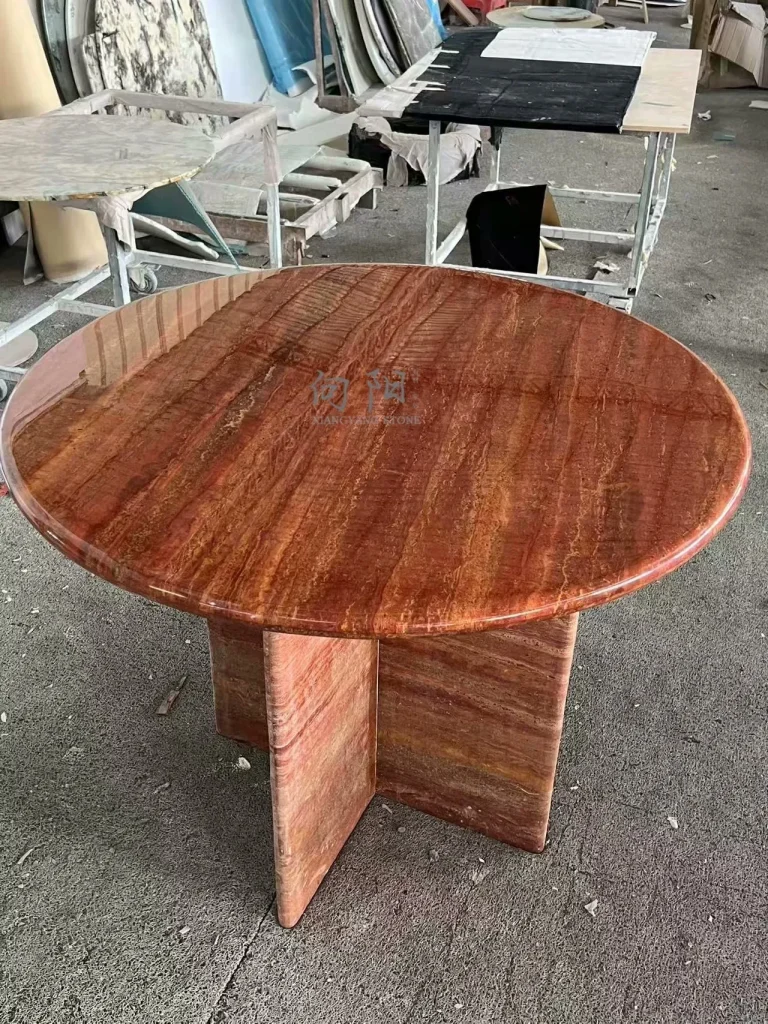
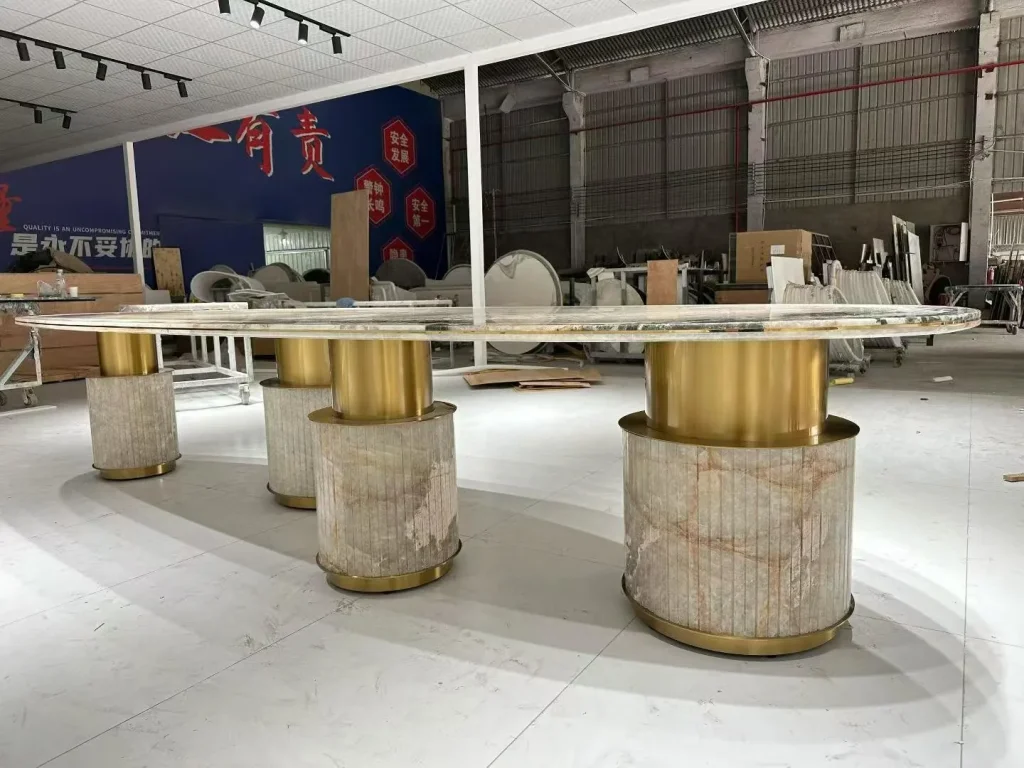
Filled travertine is easier to maintain where food and drink land daily
Travertine can suit a dining table when the fill, finish, and support are specified for daily use. Filled stone reduces open pits that can hold crumbs and liquid; unfilled stone keeps stronger texture but needs more deliberate cleaning around the voids.
| Dining exposure | Filled travertine | Unfilled travertine |
|---|---|---|
| Crumbs and table salt | Wipe from a flatter surface | Brush or vacuum pits |
| Wine, citrus, vinegar | Blot promptly; calcite can still etch | Prevent pooling and blot immediately |
| Hot serving dishes | Use a trivet; sealer is not heatproof | Use a trivet and avoid steam traps |
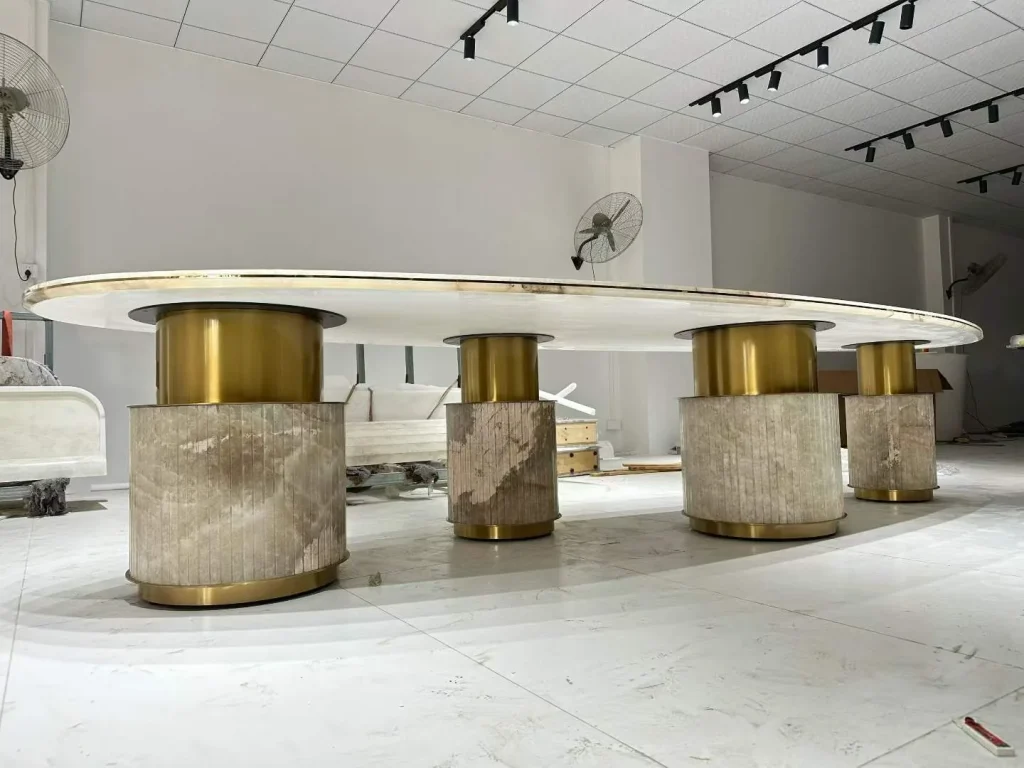
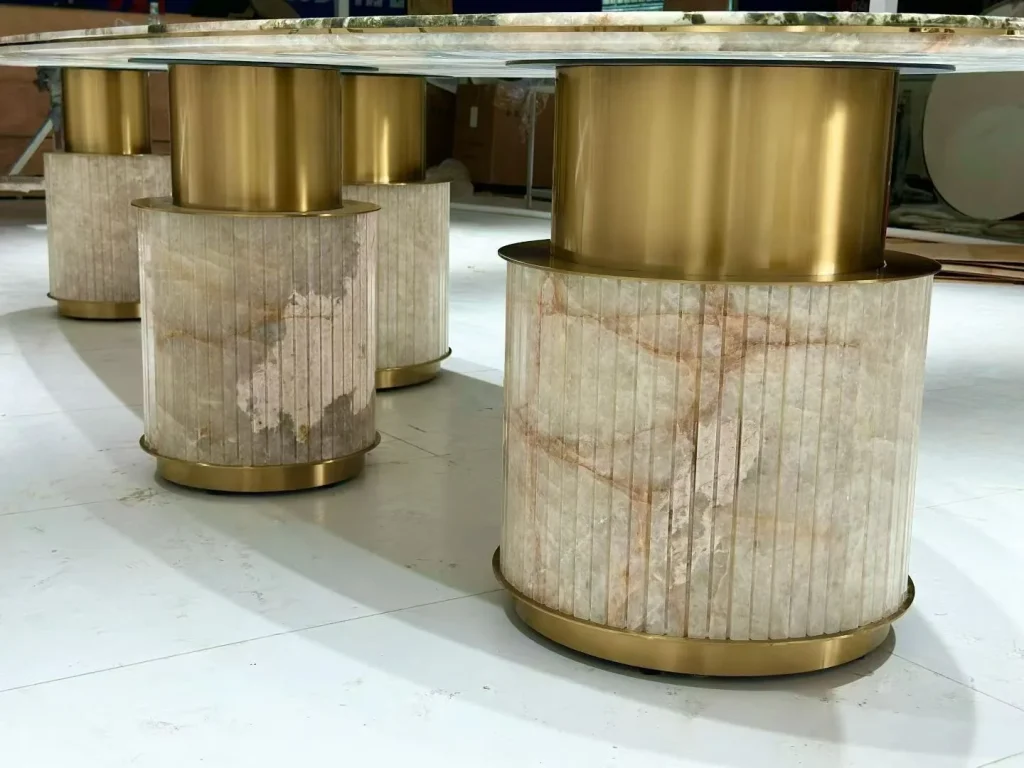
A pedestal or trestle must connect to the stone through an approved frame; a narrow central support is not a load path for a long overhang.
Slab direction and edge detail change the table’s apparent span
The catalog lists travertine labels including White Travertino, Silver Travertino, Beige Travertino, Crawford Travertino, Golden Travertino, and Red Travertino. Review the actual slab for band direction, pit distribution, and color change before committing a dining-top layout.
Run linear movement along the long axis for a calm table, or across it when the pattern is the focal point. A thick-looking edge can be a laminated build-up around a thinner structural slab, so ask for a section drawing rather than judging thickness from the outer edge.
Dining-table terms depend on drawing, stone and delivery scope
Compare quotes only when they use the same size, fill, edge, base, packing, and sale basis.
| Commercial term | Information to approve |
|---|---|
| Order quantity | 1 piece |
| Production schedule | About 20 days production + about 30 days shipping; production starts after deposit receipt and drawing confirmation |
| Price basis | Dining-table quote on request through Contact |
| Stock position | Yes, stock is available. Sizes and quantities are not published. |
Travertine’s lower density band does not make a large top easy to move
The travertine range is 2.2–2.7 t/m³ (137.3–168.6 lb/ft³), compared with 2.5–2.8 t/m³ (156.1–174.8 lb/ft³) for marble and 2.4–2.7 t/m³ (149.8–168.6 lb/ft³) for commercial onyx. Size and thickness drive the finished weight.
| Material | Reference density | Visible character | Dining-table check |
|---|---|---|---|
| Travertine | 2.2–2.7 t/m³ (137.3–168.6 lb/ft³) | Bands and pits | Fill, linear direction, support |
| Marble | 2.5–2.8 t/m³ (156.1–174.8 lb/ft³) | Veining and clouding | Finish and acid tolerance |
| Commercial onyx | 2.4–2.7 t/m³ (149.8–168.6 lb/ft³) | Strong banding or translucency | Mineral type, backing, slab approval |
See the travertine guide for the broader material explanation.
Dining care means controlling heat, acid and chair-edge impact
Use coasters, trivets, and prompt blotting rather than relying on sealer alone. Calcite-bearing travertine can etch when acidic food or cleaner sits on the surface, and a filled pit is still a maintenance point rather than a permanent liquid barrier.
- Wipe food and drink from the top and edge after each meal.
- Place hot serving dishes on trivets.
- Use a pH-neutral stone cleaner and a soft cloth.
- Follow the finish-specific sealer interval rather than applying sealer by habit.
What should a travertine dining-table drawing settle?
How much clearance should a travertine dining table have for chairs?
Start with about 600 mm (24 in) of table edge per diner and test the chair pull-out against the wall or sideboard. Leave enough room behind a pulled-out chair for a person to pass; the exact distance depends on chair depth and the route. Tape the table and chair positions on the floor before approving a custom top.
Is a 20 mm travertine dining top enough for six diners?
A 20 mm (0.79 in) top can work when the frame, apron, pedestal connections, and overhang are engineered together, but thickness alone does not prove a safe span. For a six-person table, approve the full support drawing and calculate the stone, base, and packing loads rather than assuming a 20 mm (0.79 in) slab is universally adequate.
How heavy is an 1,800 mm travertine dining top?
An 1,800 × 900 × 20 mm (70.9 × 35.4 × 0.79 in) solid top weighs about 71.3–87.5 kg (157.2–192.9 lb) across the 2.2–2.7 t/m³ (137.3–168.6 lb/ft³) travertine density band. At 30 mm (1.18 in) it is roughly 106.9–131.2 kg (235.7–289.3 lb). Packing, the base, and the delivery route add further load.
Continue from dining dimensions to support, shape and material care
Project inquiry
Request a stone furniture quote
Send dimensions, material direction and quantity for a comparable reply.
Useful details include product type, finished dimensions, quantity and destination.
Source notes for travertine dining-table planning
- Travertine is a limestone formed at mineral springs, and its public density range here is 2.2–2.7 t/m³ (137.3–168.6 lb/ft³). Travertine reference
- The 600 mm (24 in) per-diner allowance and height range are planning conventions, not guarantees of chair fit. USGS glossary
- The weight table calculates solid travertine volume at 20 mm (0.79 in) thickness. ASTM C1527
- Cleaning and sealing must suit the supplied finish. Natural Stone Institute care