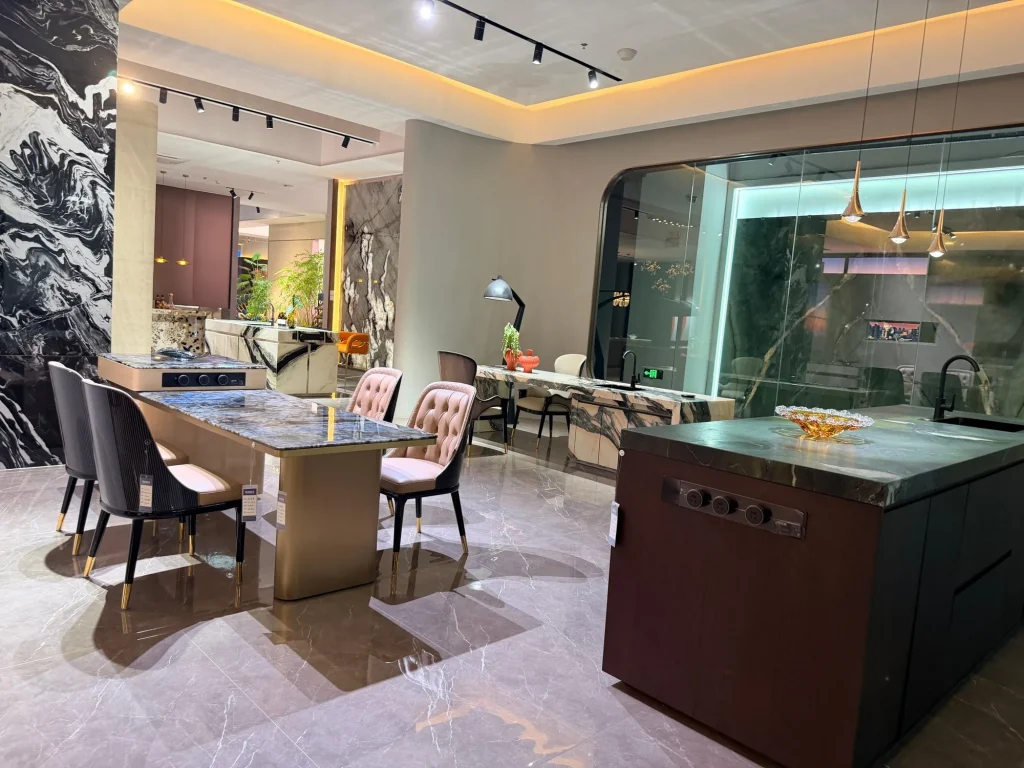
Choose honed marble for a low-reflection furniture top that hides small gloss interruptions; choose polished when crisp veining and a mirror sheen matter more than visible etching. A 1,200 × 600 × 20 mm top weighs about 38.9 kg (85.7 lb) at 2.7 t/m³ in either finish. Both need neutral cleaners and acid-spill control.
Which surface differences matter most in furniture use?
The finish changes how light and marks appear, but it does not change the stone into a different material. A honed top and a polished top can be cut from the same marble yet behave differently under cleaning, inspection and repair.
| Property | Honed marble | Polished marble | Practical consequence | Source |
|---|---|---|---|---|
| Surface appearance | Matte to low-satin | Mirror-like gloss | Honed suits quieter interiors; polished intensifies movement | Natural Stone Institute |
| Reflection | Scattered, low-definition | Sharp reflections | Small marks interrupt a polish more visibly | Visual inspection under raking light |
| Vein contrast | Softer and flatter | Sharper and deeper | The same slab can read calmer or more graphic | Approved finish sample on the actual stone |
| Fine scratch visibility | Usually less obvious | Usually more obvious | Neither finish prevents scratching | Mohs scale |
| Etch visibility | A pale patch can blend with low sheen | Dull mark interrupts gloss | Acid damage remains a risk on both | Stone care |
| Fingerprints and oils | Oil can darken the surface | Fingerprints sit visibly on gloss | Test with the intended sealer and lighting | Physical sample |
| Water visibility | Drying boundary can appear broad | Droplets and rings contrast sharply | Wipe and dry after cleaning | Physical sample |
| Acid resistance | No improvement from honing | No improvement from polishing | Carbonate marble can etch in either finish | Marble chemistry |
| Sealer behaviour | Finish-specific preparation required | Finish-specific preparation required | Follow product instructions; never assume gloss seals pores | Stone care |
| Repair direction | Restore a consistent hone | Restore gloss progressively | Blending a patch into the whole visible face matters | ASTM C503 |
| Furniture use | Dining, coffee and vanity tops where reflection should stay calm | Feature tables and quieter rooms where gloss is wanted | Match the finish to lighting and maintenance tolerance | Specification and sample approval |
| Outdoor use | Not made weather-safe by the finish | Not made weather-safe by the finish | Shelter, drainage and freeze-thaw assessment still apply | USGS glossary |
| Price | Quote-specific | Quote-specific | Labor, yield and finish sequence must be quoted on the same basis | Dated supplier quotation |
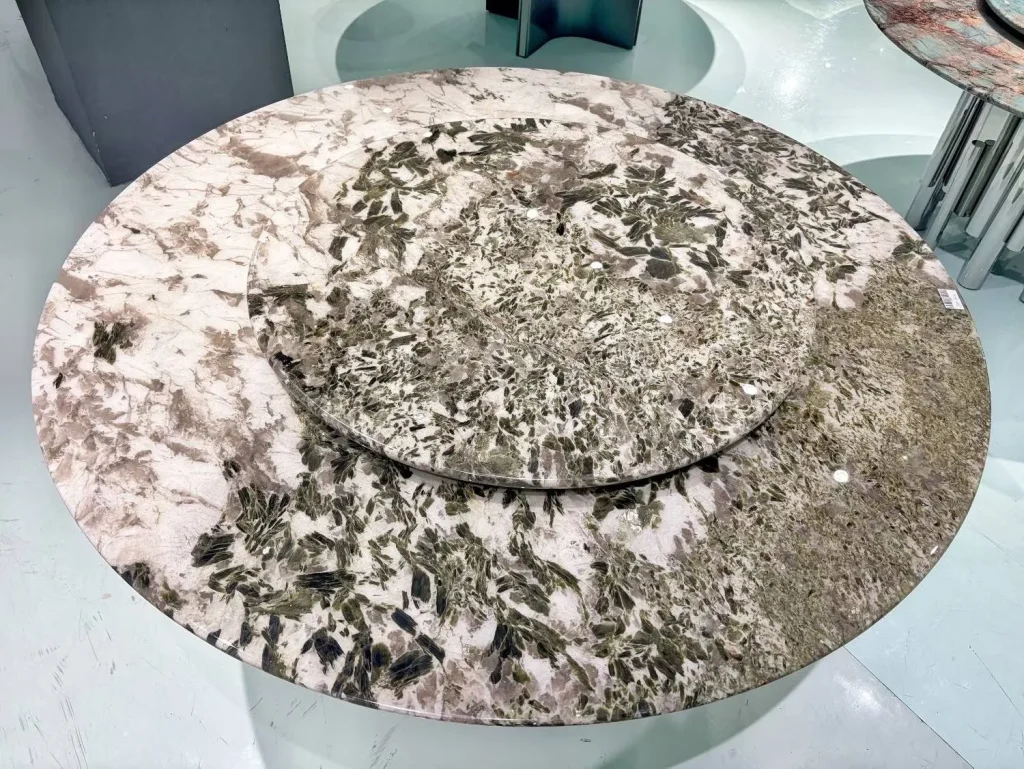
Where do honed and polished marble behave differently?
The differences are easiest to understand as visibility, cleaning and repair. Neither finish changes the underlying carbonate chemistry, so both remain vulnerable to acids.
Why do polished marble scratches look brighter?
A polished surface reflects a defined image. A scratch scatters part of that reflection and can look like a pale line even when shallow. Honed marble already scatters light, so a fine scratch may blend into the broad sheen.
This is a visibility difference, not a scratch-resistance rating. Trapped grit, dragged ceramics and acidic cleaners can damage either finish. Use mats, lifts and coasters rather than judging a surface by its first few weeks in a showroom.
Does honing reduce acid etching?
No. Honing changes the surface texture, not the calcite chemistry that reacts with acid. A honed surface may hide a small etch better because the existing reflection is soft, but the stone is still being chemically removed.
Wine, citrus, vinegar and acid bathroom products should be removed promptly. Sealer reduces absorption but does not stop surface reaction. This is why a honed dining table still needs a care plan rather than a promise of stain-proof performance.
Which finish shows oils and fingerprints more?
Polished marble tends to reveal fingerprint oil against a sharp reflection. Honed marble can absorb the look of an oily touch into a broader dark patch, especially on pale stone. Sealer and cleaning method influence both outcomes.
Ask for a sample with the actual sealer, then handle it normally for several days. Look at it under daylight, warm room lighting and low-angle light. A finish approved only on a clean, untouched chip has not been tested in the condition that matters.
How do you clean each finish safely?
Use a pH-neutral stone cleaner, a soft cloth and minimal water, then dry the surface. The same acid restrictions apply to both finishes. A polished surface may show streaks under strong side light, while a honed surface can show drying patches or oil streaks.
Do not assume a higher-gloss product adds protection or a matte cleaner adds texture. Follow the cleaner and sealer labels, and test unknown products on an inconspicuous area of the same slab.
Which finish is easier to restore?
Both can be restored, but the target is different. A honed repair must blend to the same low reflection without shiny islands; a polished repair must bring the local area back to an even gloss. In either case, the technician should test before working across the whole visible face.
Deep scratches may require more than polishing. If stone material, a seam or backing is exposed, the repairer should assess structural condition before making the surface look better. For finish and care details, see the marble cleaning and etching guide.

How can you tell honed marble from polished marble?
Look at a reflected edge under controlled light and run a clean fingertip across an inconspicuous area. Polished marble produces a sharper reflection and a slicker visual surface; honed marble scatters the reflection and feels less glossy without necessarily feeling rough.
| Check | Honed clue | Polished clue | Why it can be ambiguous |
|---|---|---|---|
| Reflected light | Broad, soft highlight | Tight, mirror-like highlight | Sealer and wax can temporarily change sheen |
| Edge treatment | Soft, consistent light scatter | Gloss continues around the edge | A fabricated edge may be finished differently from the face |
| Surface touch | Lower gloss with subtle texture | Smoother visual glide | Both can have microscopic variation across the slab |
| Water response | Broad drying boundary | Sharp droplet contrast | Sealer and lighting affect time and visibility |
Do not use a photograph alone to approve a finish. Camera sharpening, glare and retouching can hide the difference between a satin hone and a low polish.
Should you choose honed or polished marble furniture?
Choose honed for a dining or coffee table when you prefer quieter reflections and can accept periodic maintenance of a matte-like sheen. Choose polished when the slab’s veins are the focal point and you accept that etching will interrupt the mirror surface.
| Choose honed when… | Choose polished when… |
|---|---|
| The room already has glossy floors, glass or metal | The table should mirror the slab’s movement |
| Fine scratches and small surface marks should be less visible | A crisp, formal surface is part of the brief |
| The table will be used frequently for meals | Spills and fingerprint maintenance will be consistent |
| You can approve a physical sample under room light | You can inspect the actual polished slab before cutting |
| The edge should read as a solid stone section | The edge should carry a continuous reflective reveal |
Honed is not automatically safer, and polished is not automatically harder. For a more neutral furniture surface, also read whether marble stains and how porous it is.
Which marble furniture collections help compare the two finishes?
Compare complete tables with the same edge and base so the finish is not confused with another design variable. A thin polished top and a thick honed apron will read differently even when the stone is the same color.
Review white marble coffee tables for a light honed or polished direction, black marble coffee tables for high contrast, and round marble dining tables for a more centered seating layout.
The Calacatta Viola material page shows why finish approval belongs beside slab approval. The travertine versus marble comparison explains the separate question of pore structure and filling.
What should you inspect before choosing a marble finish?
Inspect the actual slab and sealer sample in the intended light, then connect the finish to a cleaning routine. The finish name alone does not predict stain resistance, scratch resistance or repair cost.
Does honed marble stain more easily than polished marble?
The finish alone does not produce a universal ranking. Both surfaces can absorb liquids through pores or seams, and both need an appropriate sealer when the condition warrants it. Honed marble may show oil or water darkening over a broader area, while polished marble can make a mark easier to notice. Test the named slab and finish with the intended sealer.
Is honed marble more slippery than polished marble?
No universal slip rating follows from the words honed and polished. Wet traction depends on surface texture, product, contamination and footwear, so a furniture top should not be treated as a walking surface. If slip resistance matters on a floor or shower application, ask for the specified product’s measured test result rather than relying on the finish name.
Can polished marble furniture be changed to a honed finish?
Yes, in principle, by removing the polished layer with controlled abrasive steps and restoring a consistent low-sheen surface. The work must cover the visible area and edges evenly, and a small test should precede it. A stone-care professional should judge whether the marble has enough sound material, whether backing or seams are exposed, and how the new finish will be sealed.
Which marble finish hides scratches on a coffee table?
A honed finish generally makes fine gloss scratches less conspicuous because the surface already scatters reflected light. It can still reveal oil smudges, water marks and deeper cuts. A polished top makes every interruption in the reflection easier to see, but it can be repolished locally by a skilled technician. Neither finish prevents scratching.
Who wrote this honed and polished marble comparison?
- Wikipedia’s marble reference describes marble as a metamorphic carbonate rock; the finish does not remove the acid sensitivity that comes from that chemistry.
- The Mohs scale places calcite at 3, which explains why dragging grit can scratch the surface regardless of whether it is honed or polished.
- Natural Stone Institute care guidance recommends pH-neutral cleaning and prompt spill removal for natural stone surfaces.