
A real marble table has no single list price. For a 1,800 × 900 mm (70.9 × 35.4 in) top, 20 mm (0.79 in) marble at 2.7 t/m³ weighs about 87.5 kg (193 lb) before the base. Ask for a project quotation through Contact with the table type, dimensions, finish, quantity and destination.
What should a real marble table quote include?
The quote should price the finished, deliverable table as a set of measurable components. A rounded total without a slab reference, drawing and delivery scope cannot be compared with another seller’s total.
| Quote line | What the buyer should see | Why it changes the total |
|---|---|---|
| Slab or slabs | Commercial stone name, slab dimensions, grade, finish, quantity and usable area | Vein layout and flaws determine how much face can be recovered |
| Top fabrication | Finished length, width, thickness, edge profile, joint plan and reinforcement | Cutting, matching, edge work and backing consume labor and material |
| Base and support | Base type, material, connection, bearing points and maximum overhang | The top’s mass and the seating layout affect the structure |
| Surface finish | Honed, polished or another stated process, plus sealer if included | Finishing time and slip/mark visibility differ by process |
| Packing | Crate type, edge protection, moisture barrier and handling marks | Stone needs support that ordinary furniture cartons may not provide |
| Delivery and placement | Origin, destination, service level, lift access and final positioning | Weight, route, stairs and manpower affect the delivered cost |
| Price quotation | Itemized offer for the selected table, material, dimensions, finish and quantity | Request through Contact with the delivery destination |
This table is a checklist, not a price list. A quote that omits one line has not necessarily offered a lower price; it may have moved that work outside the total.
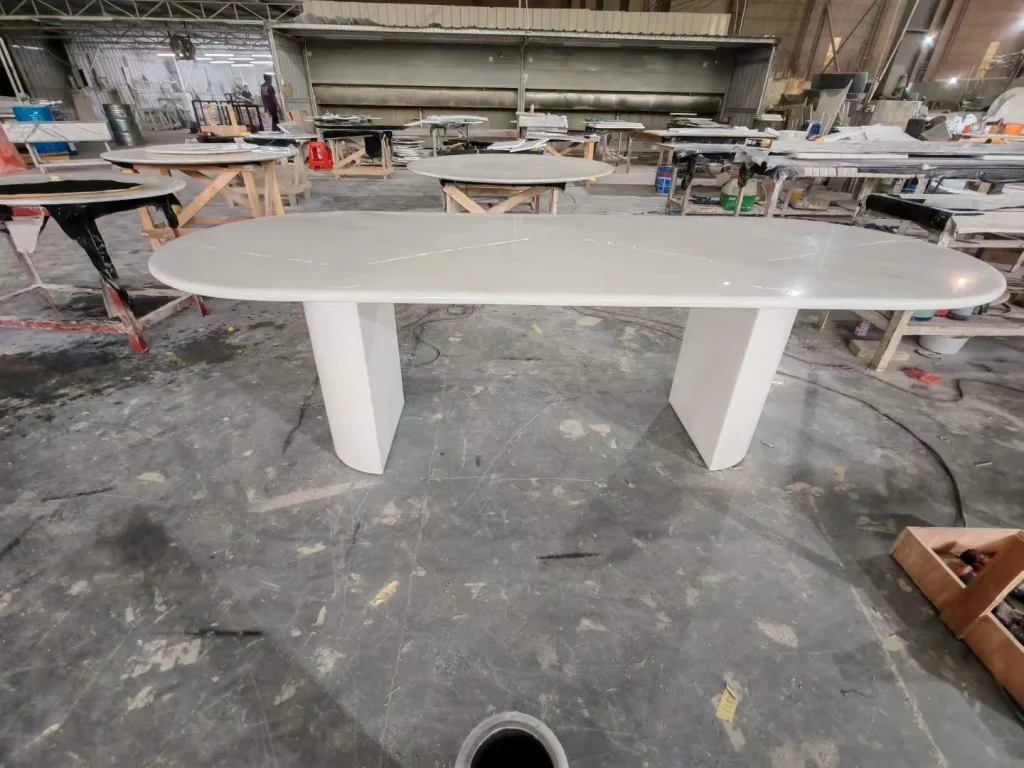
Why do two marble tables with the same size get different prices?
Same-size tables can consume different amounts of usable stone and labor. The specification can look identical on a dimension sheet while the selected slab, edge drawing, base and delivery route remain different.
Why does slab yield matter more than floor area?
Floor area gives the minimum rectangle; slab yield gives the real material requirement. A 1,800 × 900 mm top occupies 1.62 m², yet a fabricator may need a larger slab to preserve a vein sequence, avoid a flaw or place the crop symmetrically.
Book-matching two tables can increase waste because adjacent faces must mirror around a joint. A special edge may also consume face area if the visible band needs to continue around the perimeter. Ask for the cutting diagram with the quote.
How do thickness and overhang affect the base?
Weight rises linearly with thickness. A 1,800 × 900 mm top at 2.7 t/m³ weighs about 87.5 kg (193 lb) at 20 mm, 131.2 kg (289 lb) at 30 mm, and 174.9 kg (386 lb) at 40 mm. Those figures exclude edge build-up, backing and the base.
An overhang changes where the load must travel. A central pedestal can be appropriate for some seating arrangements, but it concentrates support and can obstruct chair space. Two or more supports, a frame or hidden steel may be needed. The fabricator should show the support layout rather than infer it from the tabletop name.
Which finish and edge details change the labor?
Polished marble requires a controlled sequence to bring the face to an even sheen; honed marble needs a consistent low-reflectance surface. A complex edge takes more shaping and polishing than a simple straight edge. The thicker-looking edge created by an apron or built-up border may also require a separate face selection.
Finish should be specified on the quote because “natural marble” does not define a surface. Use the honed versus polished comparison when mark visibility and reflection are the main concerns.
Why can delivery change the answer?
Marble tops are heavy, rigid and vulnerable at corners. A route that needs a lift, narrow stair, long carry or temporary road closure can add labor and protection. “Delivery included” means little until kerbside, room-of-choice and installation are separated.
Measure the final doorway and turning space before ordering. For an upstairs installation, note landings and whether the crate can be opened outside. The moving plan remains part of the total cost even when the stone price does not include it.
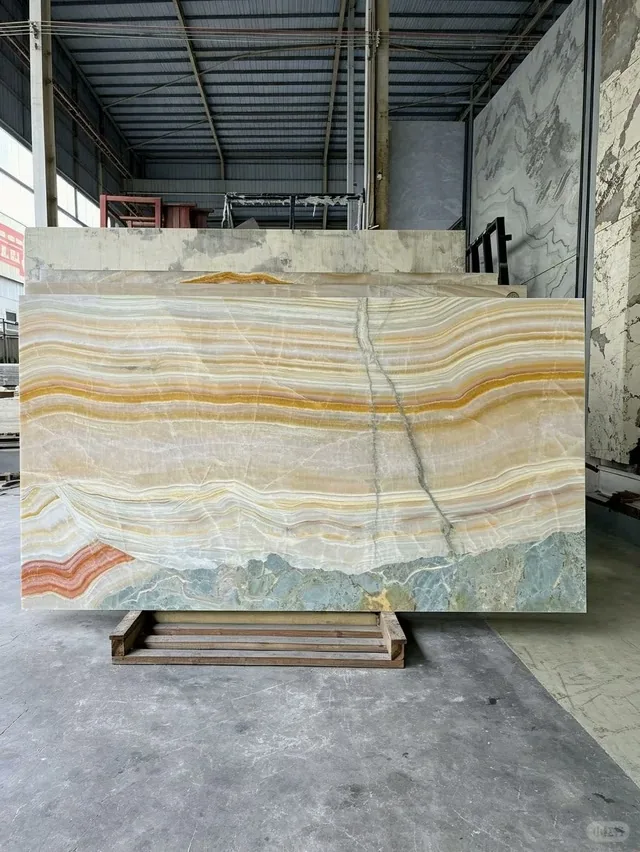
What should you confirm before approving a marble table quote?
Keep one approved specification with one dated quotation so value engineering cannot silently change the product. The details should be complete enough for another fabricator or inspector to understand what is being priced.
| Specification | Minimum detail | Acceptance check |
|---|---|---|
| Stone reference | Commercial name, slab identifier, photograph and measured slab size | The named slab is available for approval |
| Top drawing | Length, width, thickness, edge section, seams and cutouts | Dimensions are shown in mm and in |
| Support drawing | Base footprint, fixing method, bearing points and maximum overhang | Load path is visible |
| Finish | Surface process, sealer product if included, and sample reference | Approval sample and production method match |
| Delivery scope | Origin, destination, access route and who performs placement | Every excluded task is written |
The price depends on the selected table and delivery scope, so request a written quotation through Contact. A photograph of a stone surface is not a substitute for the finish sample or test document.
How can you turn a rough marble table budget into an order?
Use a fixed sequence so the price is revised when the design changes rather than after fabrication starts.
- Set the finished size from seating, circulation and room access. Use the dining table size guide for nominal planner dimensions.
- Select the stone direction and request photographs of the actual slab or slabs. Mark flaws, fissures and the face you expect.
- Draw the top with thickness, edge, seam and support points. Decide whether joints must be book-matched.
- Request an itemized retail or FOB quote with a date, currency and delivery scope. Keep the same scope when comparing offers.
- Approve the slab, finish and production drawing together. Check calculated weight and the route before paying for fabrication.
- Inspect the finished top, packing and lifting plan before dispatch. Confirm who receives and places it at the destination.
Changing the slab after cutting begins can affect both yield and aesthetics. A cheap revision at that stage is unlikely because the material and labor have already been committed.
Which marble table pages help narrow the quote?
Start with the furniture format, then choose the stone direction and finish. This keeps the quote tied to a real table rather than a generic square metre of marble.
Browse marble and stone dining tables for the parent category, round marble dining tables for seating-focused layouts, or oval marble dining tables where corner clearance matters. Material pages for marble for furniture and Calacatta Viola explain why two white marbles can produce different slab yields.
For a smaller first purchase, compare marble coffee table tops. For construction planning, use the marble top thickness guide.
What else changes the real cost of a marble table?
The named stone, finished dimensions and delivery conditions remain the three largest scope variables. Ask for a revised quote whenever one of them changes.
Why is my marble table quote higher than the stone price?
A slab price covers only rough stone. Fabrication adds drawing, cutting, edge shaping, reinforcement, finish work and quality checks. A table also needs a base, internal support, packing and transport. Vein matching can reduce usable slab area, while a long overhang or thin-looking edge can require extra structure. Compare the itemized scope, not the stone label alone.
Does a bigger marble dining table always cost proportionally more?
No. Cost can jump when the top crosses the usable width or length of one slab, because a second slab and a joint may be required. A wider table also gains weight quickly. At 2.7 t/m³, increasing a 20 mm top from 900 mm to 1,000 mm width adds about 13.5 kg per 1,500 mm of length. Quote each size separately.
What is usually excluded from a marble table quote?
Exclusions vary by seller and must be written down. Check whether delivery is kerbside or room-of-choice, whether stairs and lifts are included, and who supplies the base, installation and access protection. Crating, taxes, import clearance and a second visit for final placement may also sit outside the table price. Compare the included scope line by line.
How can I compare two marble table quotations fairly?
Give both suppliers the same drawing, stone reference, finish, edge, base and delivery address. Require separate prices for slab, fabrication, base, packing, transport and installation. Ask each to mark seams, slab yield and overhangs. A lower total is meaningful only when every exclusion and equivalent material condition is identical.
Who wrote this marble table price guide?
- The weight examples use the formula length × width × thickness × density, with a stated marble reference band of 2.5–2.8 t/m³ (156–175 lb/ft³).
- Wikipedia’s marble reference confirms that marble is a carbonate metamorphic rock; this explains the acid-care requirement rather than any specific transaction price.
- Natural Stone Institute care guidance recommends pH-neutral cleaners and prompt removal of acidic spills for natural stone.