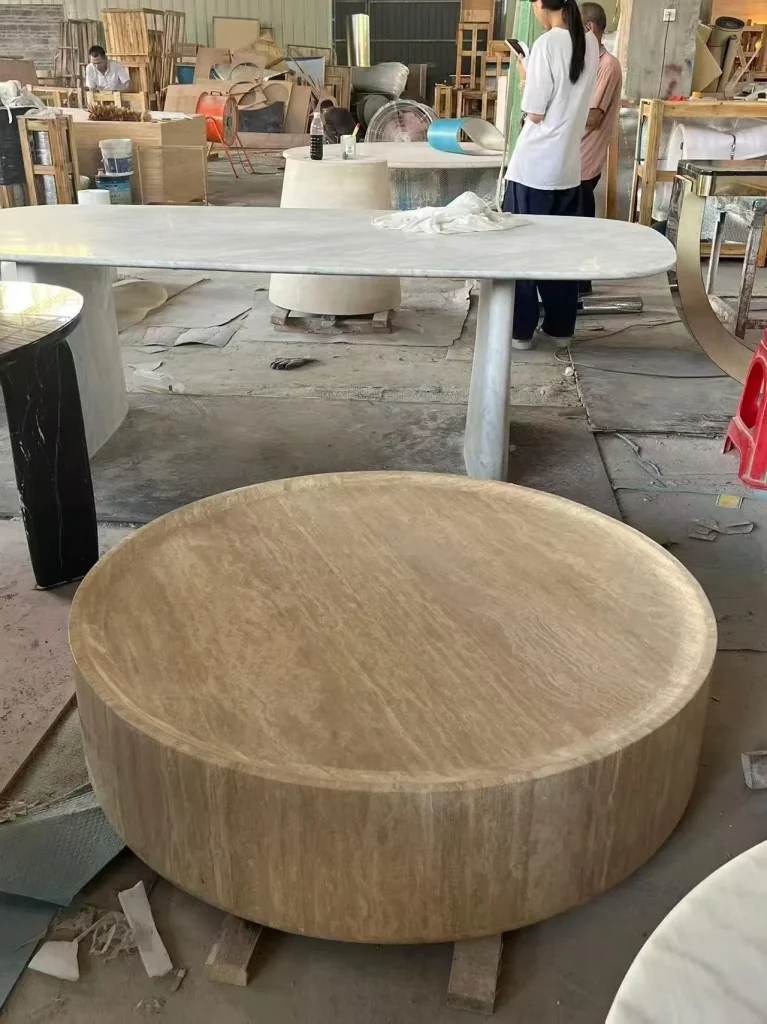
For a 2,000–2,300 mm (79–91 in) sofa, start with a 900–1,200 mm (35–47 in) travertine coffee table and a 400–450 mm (16–18 in) height. Keep the top near two-thirds of the sofa length, then confirm access, top support, and the filled or unfilled finish before production.
The two-thirds rule gives a travertine coffee table its first usable size
Measure the sofa’s actual outside length and leave a comfortable route around the table before fixing a dimension. A 2,000–2,300 mm sofa points to roughly 900–1,200 mm in table length, but a deep room or a narrow walkway can override that proportion.
| Finished top | 20 mm (0.79 in) weight | 30 mm (1.18 in) weight | Planning note |
|---|---|---|---|
| 900 × 600 mm (35 × 24 in) | 23.8–29.2 kg (52.5–64.4 lb) | 35.6–43.7 kg (78.5–96.3 lb) | Compact two-seat setting |
| 1,200 × 600 mm (47 × 24 in) | 31.7–38.9 kg (69.9–85.7 lb) | 47.5–58.3 kg (104.7–128.5 lb) | Common long-sofa proportion |
The weights use solid volume at 2.2–2.7 t/m³ (137.3–168.6 lb/ft³) and exclude the base, build-up, and packing.
Choose a shape that leaves room for knees and circulation
Rectangular tops give the most predictable clearance along a sofa, oval tops soften the corners, and round or organic tops trade corner reach for a larger visual footprint. Compare the travertine coffee tables shown below; the selected room and base still determine the final drawing.
Stock and custom production are available with a minimum order of 1 piece; request this category's product list.
Request product listCheck a round top at its widest diameter and mark organic shapes as a full floor template.
More stone coffee tables in selected finishes
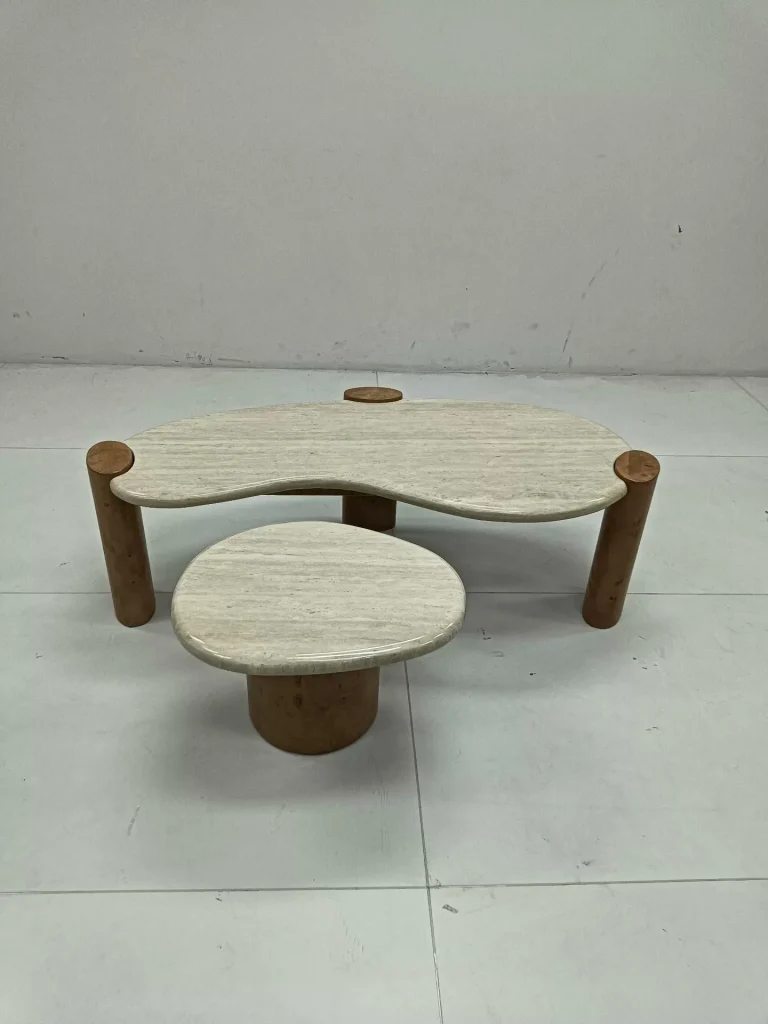
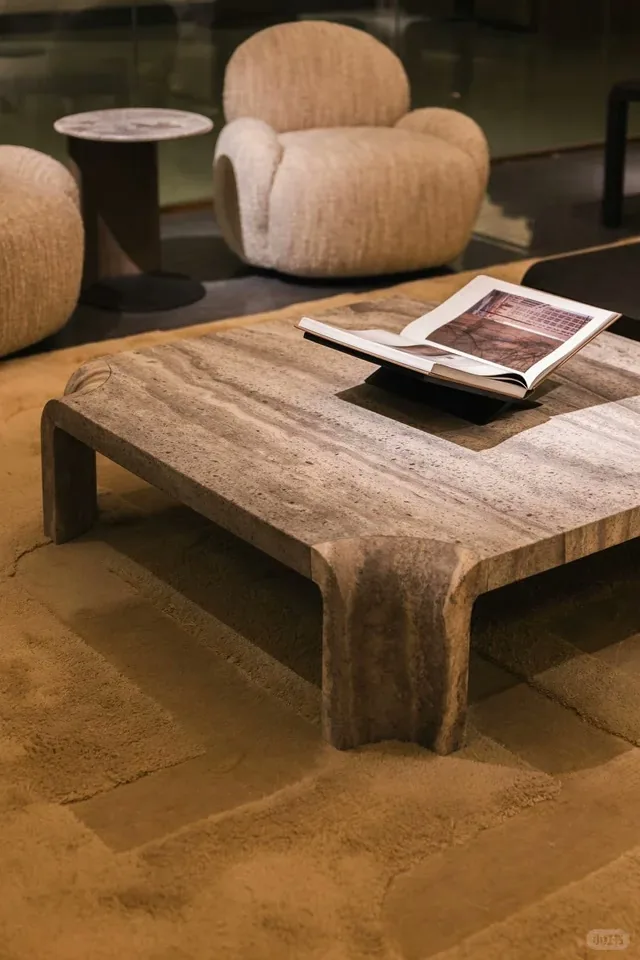
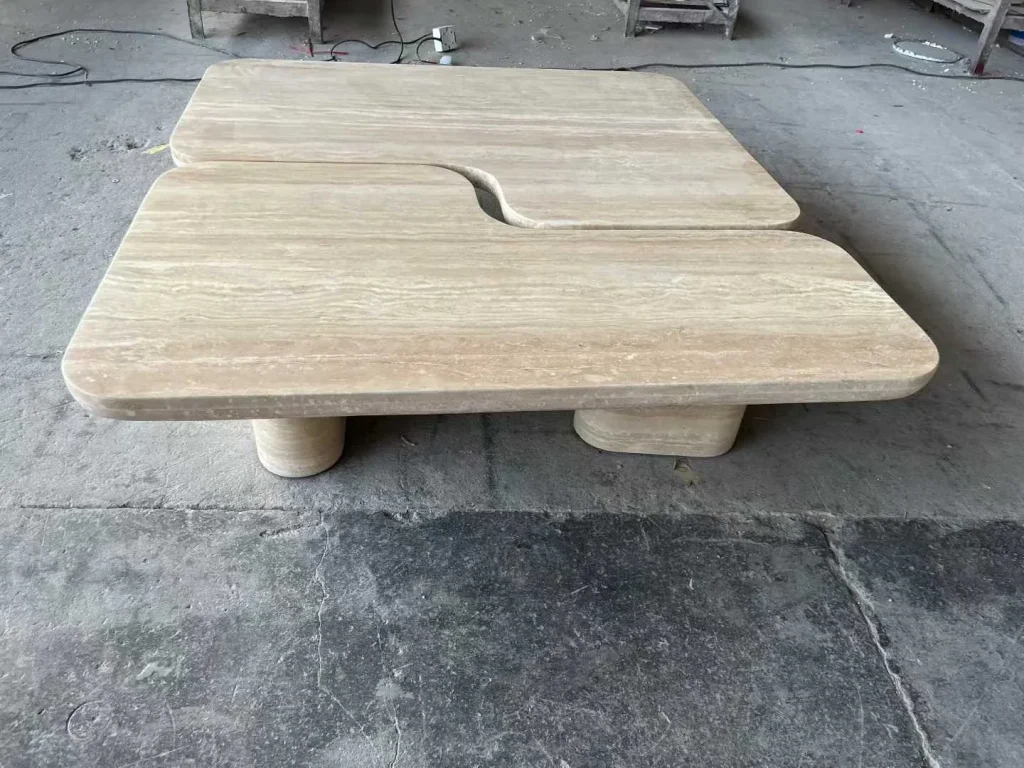
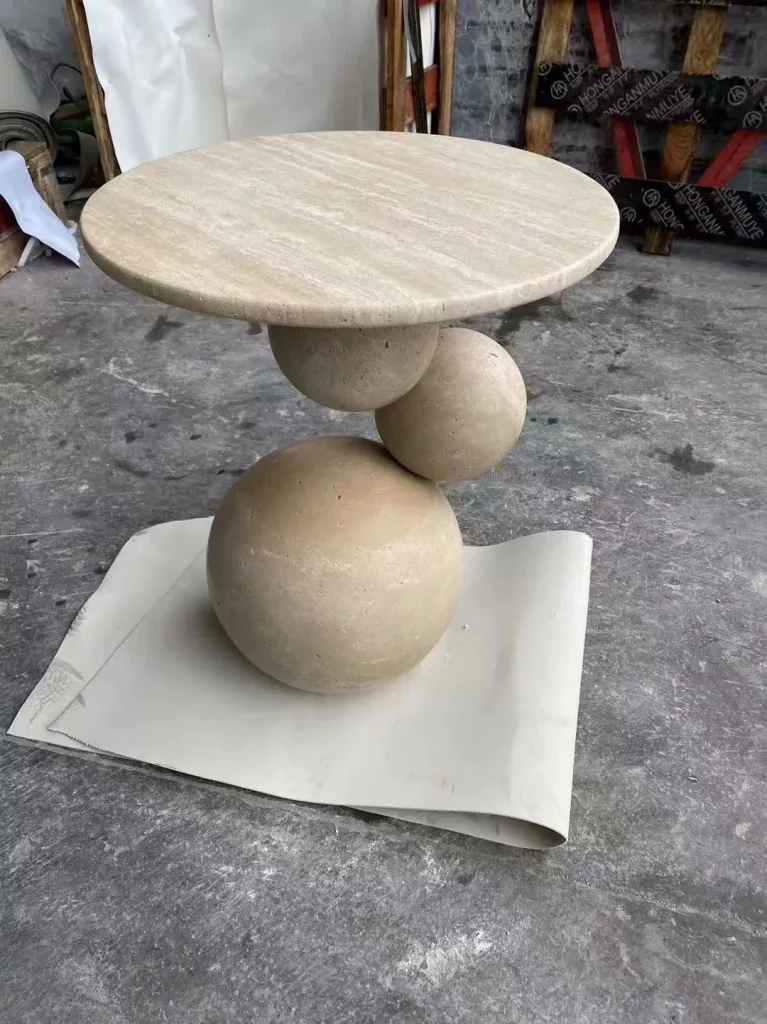
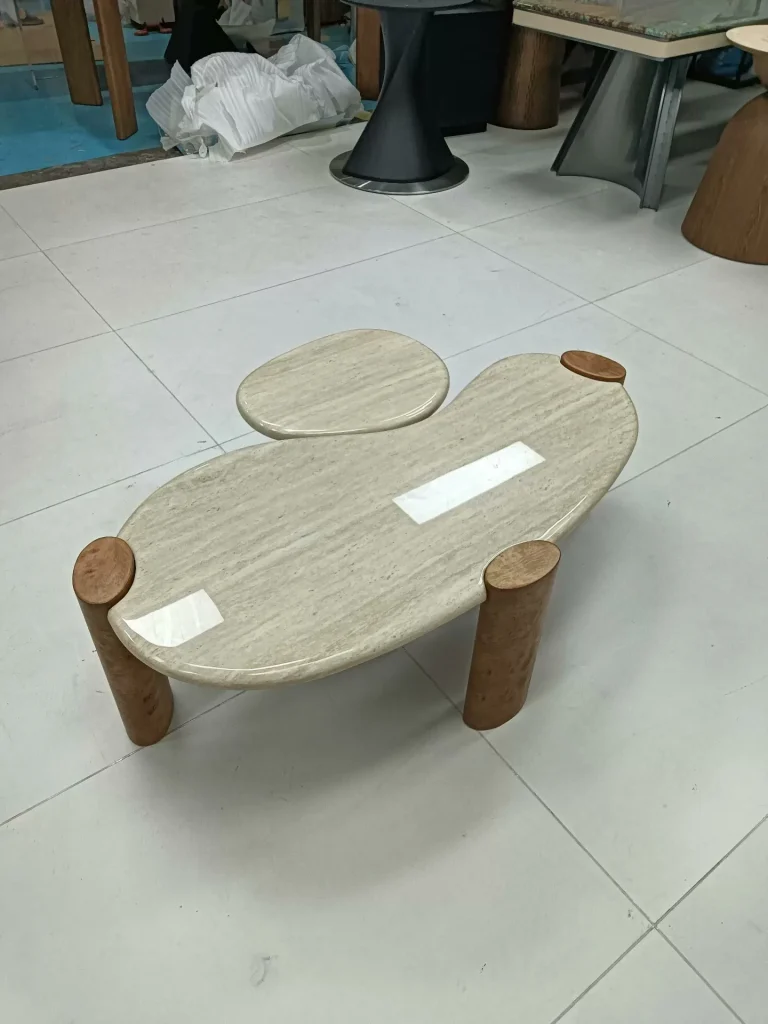
Filled travertine suits a busy coffee table more readily than raw voids
Travertine is a suitable coffee-table stone when the surface treatment matches the use, because its working difference is the visible pit structure rather than a generic “stone” look. Filled stone reduces places for crumbs and rings to settle; unfilled stone keeps deeper texture but demands more cleaning.
| Surface | Visual result | Best condition | Extra care |
|---|---|---|---|
| Filled and honed | Quieter, flatter pits | Daily living room use | Prompt blotting; pH-neutral cleaner |
| Unfilled | Visible voids and linear relief | Low-contact or texture-led interior | Vacuum pits; avoid liquid pooling |
| Polished | Reflective surface, stronger patch contrast | Protected setting with coasters | Water rings and etching show readily |
Travertine’s 2.2–2.7 t/m³ (137.3–168.6 lb/ft³) range does not describe the fill, backing, or base. Put those details in the specification instead of inferring them from a picture.
Use slab direction and base geometry as the second filter
Amazstone’s travertine collection includes names such as White Travertino, Cream White Travertino, Silver Travertino, Romano Classico, Beige Travertino, Golden Travertino, Red Travertino, and Noce Persiano. A name does not confirm a common fill or finish.
Compare the slab’s linear direction with the table shape, and decide whether the movement should run across the sofa or toward it. Also inspect the base: a solid plinth gives visual weight, a central pedestal leaves more foot room, and a dispersed leg frame changes the apparent thickness of a 20 mm top.
Price and production terms need a written quote
Size, fill, base, packing, and delivery scope change the order, so the quotation must resolve each line below.
| Commercial term | What the quote must identify |
|---|---|
| Order quantity | 1 piece |
| Production schedule | About 20 days production + about 30 days shipping; production starts after deposit receipt and drawing confirmation |
| Price basis | Coffee-table quote on request through Contact |
| Stock position | Yes, stock is available. Sizes and quantities are not published. |
Travertine changes the care and weight picture against marble or onyx
The 2.2–2.7 t/m³ (137.3–168.6 lb/ft³) travertine range overlaps marble at 2.5–2.8 t/m³ (156.1–174.8 lb/ft³) and commercial onyx at 2.4–2.7 t/m³ (149.8–168.6 lb/ft³). The exact slab therefore matters more than the family label.
| Comparison | Travertine | Marble | Commercial onyx |
|---|---|---|---|
| Visible character | Bands and pits | Veining and clouding | Strong banding or translucency |
| Reference density | 2.2–2.7 t/m³ (137.3–168.6 lb/ft³) | 2.5–2.8 t/m³ (156.1–174.8 lb/ft³) | 2.4–2.7 t/m³ (149.8–168.6 lb/ft³) |
| Acid sensitivity | Calcite-bearing material can etch | Calcite-bearing material can etch | Verify mineral type; do not infer |
Read the travertine material guide before changing material family.
A coffee table gets cups, grit and spills before it gets polished
Clean with a pH-neutral stone cleaner and blot spills promptly. Sealing reduces absorption but does not make calcite-bearing stone acid-proof.
- Vacuum grit before wiping.
- Avoid acidic cleaners and abrasive pads.
- Test sealer on a hidden area.
What still changes a travertine coffee table specification?
Does the two-thirds rule work for a rounded travertine coffee table?
Use the sofa length as the starting limit, not as a strict shape rule. For a 2,000–2,300 mm (79–91 in) sofa, a 900–1,200 mm (35–47 in) table is a practical range, while a round top needs enough clear walkway that its widest point does not block the route through the room.
Can a travertine coffee table stay unfilled?
Unfilled travertine can stay exposed when the visible pits are part of the design, but they will collect crumb dust and drink rings. A busy living room usually favors filled and honed stone; an unfilled piece needs more frequent vacuuming, prompt blotting, and a sealer compatible with the supplied finish.
What support does a 20 mm travertine coffee top need?
A 20 mm top needs support close enough to the load path that the slab is not asked to bridge an unsupported span. Approve the frame, pedestal, cleats, and fixing points in one drawing; no universal clear span applies because holes, overhangs, and stone quality change the calculation.
These links continue from table size to shape, material and care
Project inquiry
Request a stone furniture quote
Send dimensions, material direction and quantity for a comparable reply.
Useful details include product type, finished dimensions, quantity and destination.
Where do these travertine coffee-table figures come from?
- Travertine is a banded limestone formed by mineral-spring precipitation, which explains its visible voids and linear structure. Travertine reference
- The 900–1,200 mm (35.4–47.2 in) size range applies to a 2,000–2,300 mm (78.7–90.6 in) sofa, subject to room circulation. USGS glossary
- Weight rows use solid volume at 2.2–2.7 t/m³ (137.3–168.6 lb/ft³) and omit the base and packing. ASTM C1527
- Cleaning products must suit the supplied stone finish. Natural Stone Institute care