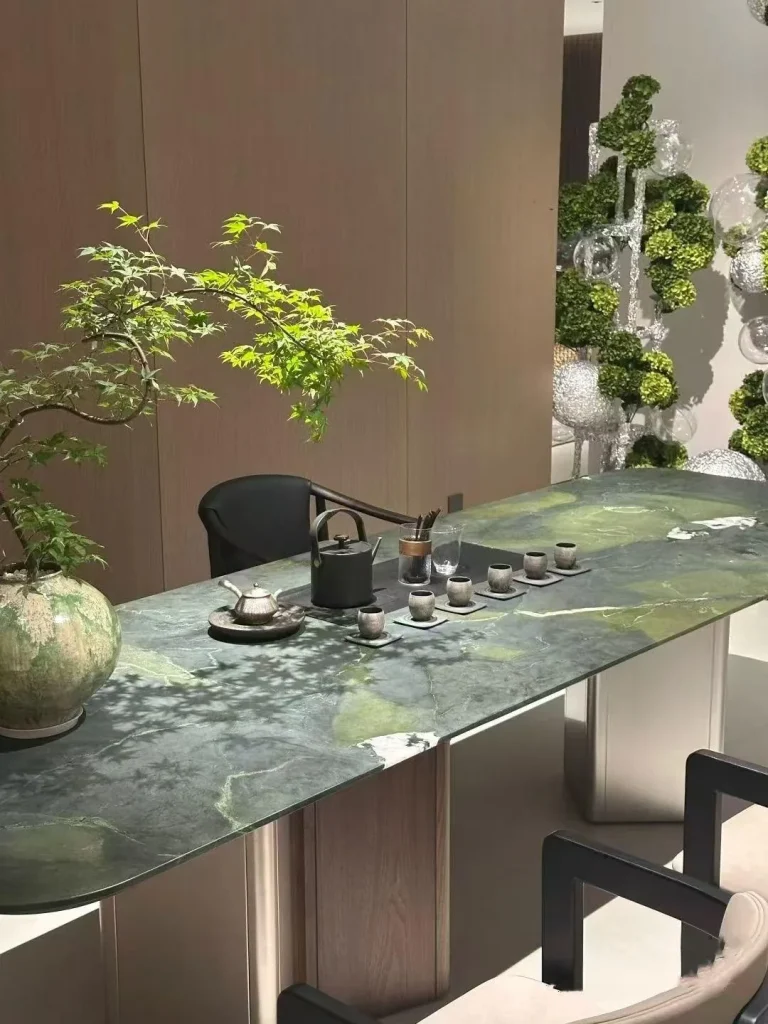
A 2,000 × 1,000 × 20 mm marble dining top (78.7 × 39.4 × 0.79 in) weighs about 108 kg (238 lb) at 2.7 t/m³ (168.6 lb/ft³). That is a solid-slab estimate; support, cut-outs and edge build-up change the finished weight.
Which marble top thickness fits the table design?
Thickness is part of a supported assembly, not a substitute. A 20 mm (0.79 in) top is common; 12 mm (0.47 in) and 30 mm (1.18 in) solve different fabrication and visual-thickness problems.
| Nominal thickness | Use and condition | What to confirm |
|---|---|---|
| 12 mm (0.47 in) | Laminated top or substrate | Continuous support |
| 20 mm (0.79 in) | Common supported blank | Span and cut-outs |
| 30 mm (1.18 in) | Heavier exposed edge | Base and lift |
| 20 + edge strip | Visual thickness | Joint, bond and frame |
Which top shape and size should the finished table expose?
A rectangular top gives a straight dining axis; round or oval tops change circulation and edge flow. Show chairs, base footprint and overhangs.
Stock and custom production are available with a minimum order of 1 piece; request this category's product list.
Request product listMeasure the top separately from the base. A replacement must meet existing fixing points and any cable or motor cut-out.
More stone dining tables in selected finishes
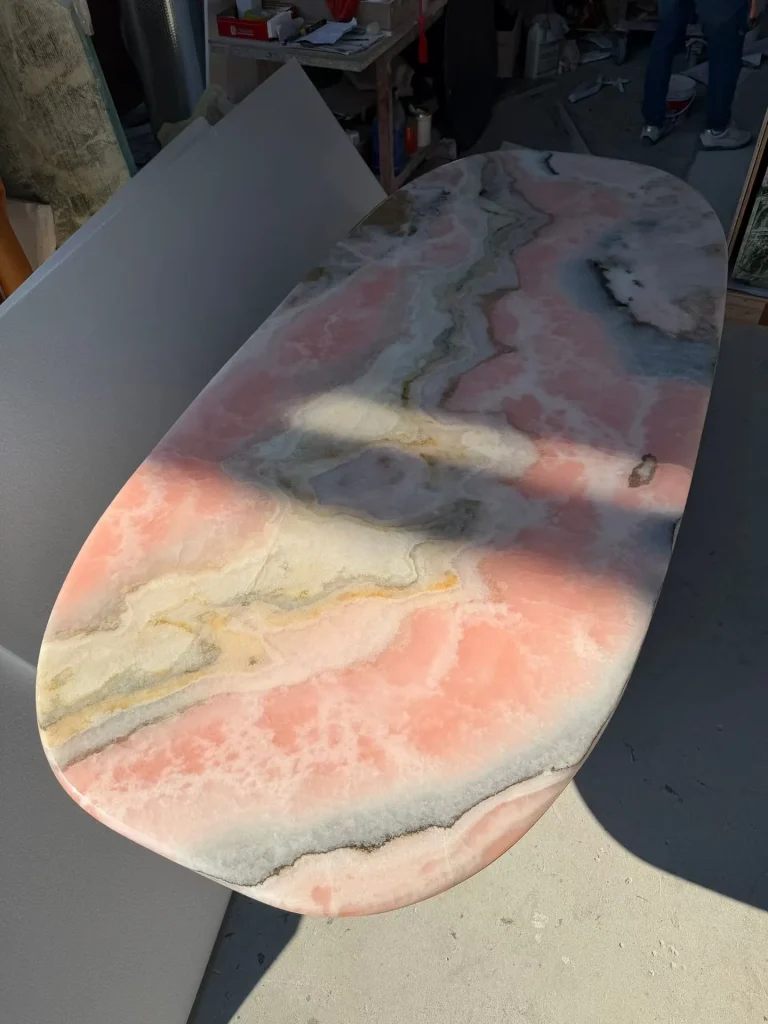
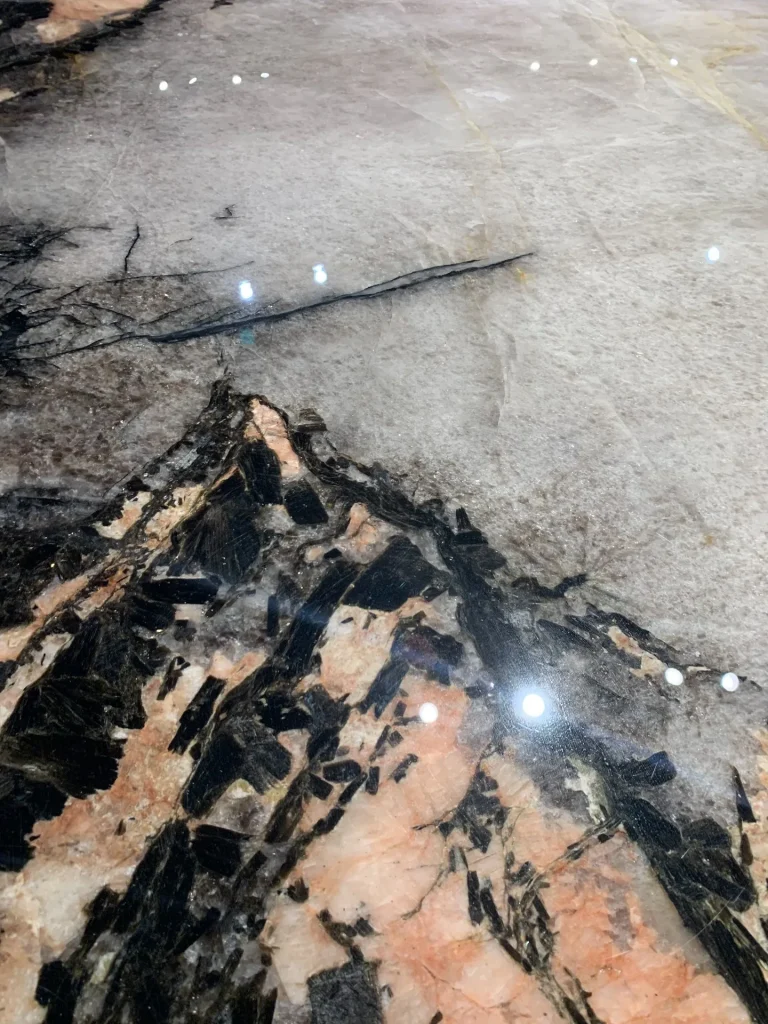
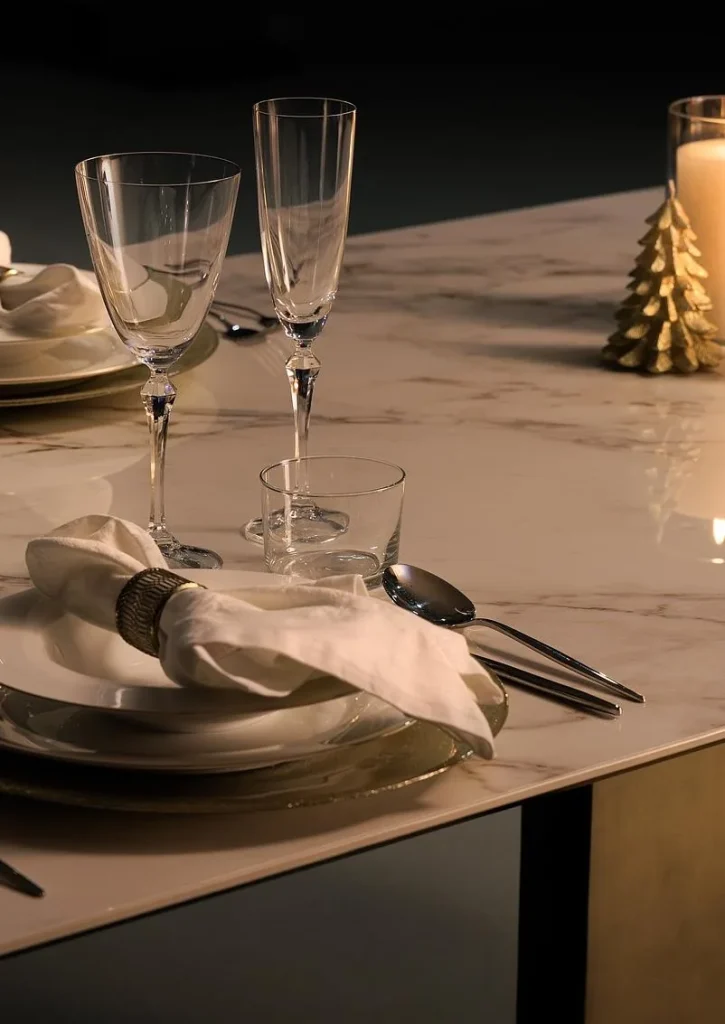
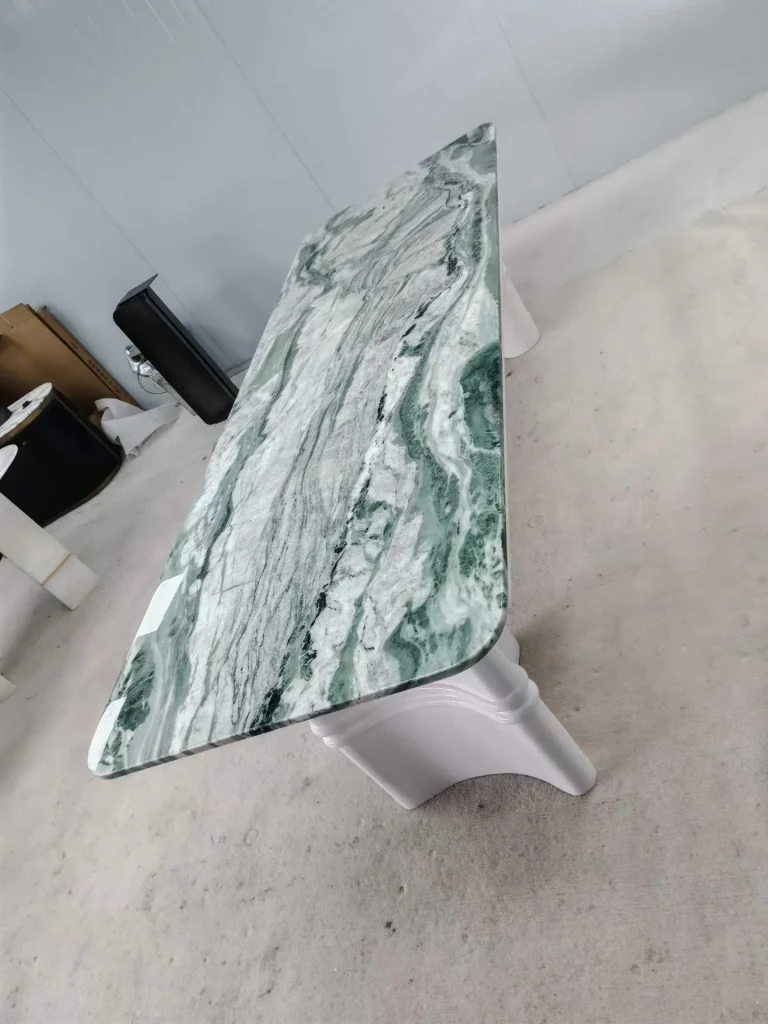
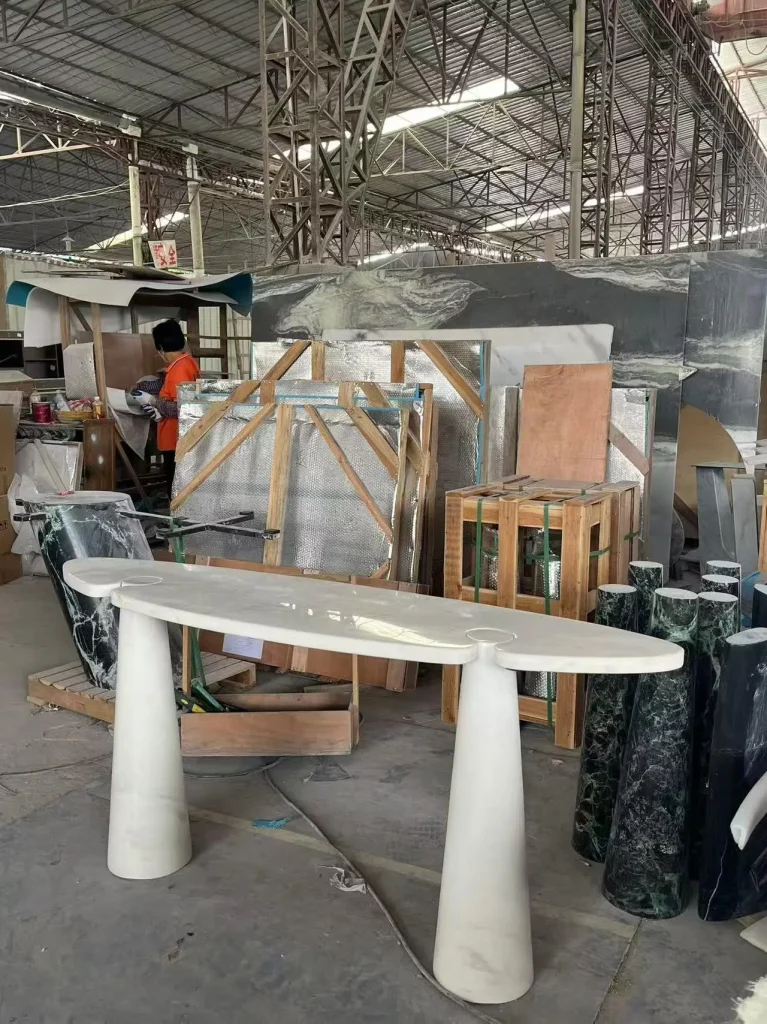
Is marble suitable for a dining table top?
Yes, if the slab is sound, fully supported and sealed. Marble is acid-sensitive and relatively soft, so wine, citrus and ceramic impacts need attention.
| Finished top | Approximate solid blank weight | Support condition |
|---|---|---|
| 1,800 × 900 × 20 mm (70.9 × 35.4 × 0.79 in) | 87 kg (193 lb) | Design the base. |
| 2,000 × 1,000 × 20 mm (78.7 × 39.4 × 0.79 in) | 108 kg (238 lb) | Coordinate rails and fixings. |
| 2,400 × 1,000 × 20 mm (94.5 × 39.4 × 0.79 in) | 130 kg (286 lb) | Check route and capacity. |
| 2,000 × 1,000 × 30 mm (78.7 × 39.4 × 1.18 in) | 162 kg (357 lb) | Plan a team or lift. |
The F1 weight calculator tests other sizes. Weight is not a load rating.
How do 12, 20, 30 mm and doubled edges change the top?
A 12 mm (0.47 in) slab normally needs continuous substrate or a laminated build; it is not a free-spanning shell. A 20 mm (0.79 in) top needs engineered support. A 30 mm (1.18 in) top adds mass; an edge strip can imitate thickness at lower weight.
| Build | Visual result | Hidden requirement |
|---|---|---|
| 12 mm (0.47 in) + substrate | Lightweight-looking | Continuous substrate |
| 20 mm (0.79 in) solid | Straight 20 mm (0.79 in) edge | Support and fixing |
| 30 mm (1.18 in) solid | Heavier rim | Handling and base |
| 20 + 20 mm (0.79 + 0.79 in) strip | 40 mm (1.57 in) visual edge | Bond, color and frame |
An edge strip is not a solid 40 mm (1.57 in) slab. Request a section drawing showing substrate, bond and fixing.
What commercial facts must accompany a marble-top quotation?
Commercial terms must match the measured top and installation.
| Commercial field | Required confirmation |
|---|---|
| Minimum order | 1 piece |
| Production time | About 20 days production + about 30 days shipping; production starts after deposit receipt and drawing confirmation |
| Price band | Dining-table quote on request through Contact |
Ask whether template, base, drilling, polishing, sealing, crating and installation are included.
How does marble compare with travertine and quartzite for a tabletop?
Marble is carbonate; travertine has pits; quartzite is quartz-rich and generally harder. Every option still needs slab inspection and support design.
| Stone | Density reference | Dining-top concern |
|---|---|---|
| Marble | 2.5–2.8 t/m³ (156.1–174.8 lb/ft³) | Seam and acid etching |
| Travertine | 2.2–2.7 t/m³ (137.3–168.6 lb/ft³) | Fill and pits |
| Quartzite | 2.6–2.9 t/m³ (162.3–181.0 lb/ft³) | Weight and identity |
| Onyx | 2.4–2.7 t/m³ (149.8–168.6 lb/ft³) | Backing and repairs |
See the Marble and Travertine guides.
How should a marble dining top be protected and inspected?
Use coasters and trivets, wipe acidic spills promptly and clean with pH-neutral stone product. Inspect edge, seam and fixings.
- Check full support contact.
- Keep acidic cleaners away.
- Recheck seam movement.
- document sealer and adhesive.
A dull ring may be an etch, not dirt. The Marble care guide explains residue versus chemical damage.
Which marble-top questions come before fabrication?
Is marble good for dining table top?
Marble is suitable for a dining top when the slab is sound, supported and sealed, but it remains vulnerable to acid etching and scratches. Use coasters and trivets, wipe wine and citrus promptly and avoid acidic cleaners. Confirm slab, thickness and base.
How much does a marble table top cost?
A reliable price needs dimensions, thickness, slab grade, edge, cut-outs, seam, sealing and delivery. Marble is priced by usable slab and fabrication as well as area, so two 2,000 mm tops can differ substantially. Compare the same trade basis.
Can a 20 mm marble dining top span 2 metres?
It can be possible with engineered substrate, rails or a base that supports the span, but thickness does not establish safety. A 2,000 × 1,000 × 20 mm (78.7 × 39.4 × 0.79 in) top weighs about 108 kg (238 lb) at 2.7 t/m³ (168.6 lb/ft³). Give the engineer the stone, openings, overhang and loads.
How do you seam a two-piece marble dining top?
Place the seam over continuous support and set vein layout before cutting. Both pieces need compatible thickness, edge height and finish, with approved adhesive color. Confirm who measures, supports, transports and installs the top; movement under load can make a seam unsafe.
Where can I connect the top to the table and material?
Project inquiry
Request a stone furniture quote
Send dimensions, material direction and quantity for a comparable reply.
Useful details include product type, finished dimensions, quantity and destination.
Who checked the tabletop thickness and weight calculations?
- Marble is conventionally carbonate rock at 2.5–2.8 t/m³ (156.1–174.8 lb/ft³); examples use 2.7 t/m³ (168.6 lb/ft³). Marble reference
- Weights multiply solid length × width × thickness × density. ASTM C503
- A bonded edge strip creates visual thickness without a solid slab section. Weight calculator
- Sealing does not prevent acid etching. Natural Stone Institute